Beyond the exam. The AP® Precalculus exam does not test this unit. Many classes teach it, and it prepares you for calculus.
A matrix (plural matrices) is a rectangle of numbers arranged in rows and columns. Matrices organize data, like sales by day and item, and later in this unit they turn into functions that move, rotate and stretch the plane. This page covers the language and the arithmetic, above all how to multiply.
Dimensions and entries
A matrix with rows and columns has dimensions (say "m by n"), rows first. The entry in row and column is written .
is , and (row 1, column 3). A matrix with one column, such as , is a column vector.
Adding and scaling
Matrices with the same dimensions add entry by entry, and a number times a matrix multiplies every entry:
Multiplying: row times column
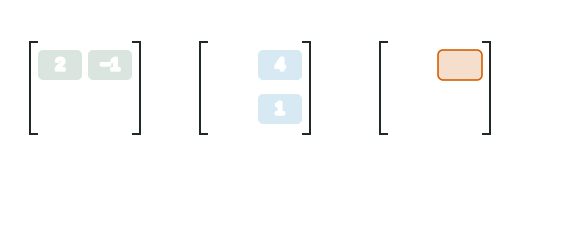
The product is defined when the number of columns of equals the number of rows of . If is and is , then is : the outside numbers give the size, the inside numbers must match.
To find the entry in row , column of , take row of and column of , multiply matching entries and add, just like a dot product.
Figure 1. Row 1 of times column 2 of gives the entry in row 1, column 2 of . LevlPrep original diagram.
Worked example 1. Find for and .
Row 1, column 1: . Row 1, column 2: .
Row 2, column 1: . Row 2, column 2: .
So . In the other order, : a different matrix. Order matters.
Matrices in context
Worked example 2. A food truck sells burgers, fries and drinks at $6, $3 and $2. On Saturday it sells , and ; on Sunday , and . Find each day's revenue.
Put the sales in a matrix (one row per day) and the prices in a column:
Saturday brought in $615 and Sunday $620. The inside dimensions match ( and ) and the result is , one revenue per day.
Rules to keep straight
Operation
When it is defined
Result
same dimensions
same dimensions, entry by entry
any matrix
every entry times
columns of = rows of
rows of by columns of
The identity matrix plays the role of the number : for every matrix . Unlike numbers, though, and are usually different, so always multiply in the order the problem gives.