A parametric function gives a point for each . Draw an arrow from the origin to that point and you have a vector that changes with . Thinking of motion this way lets you use everything you know about vectors: subtracting positions, measuring distances and averaging rates.
Position vectors
A vector-valued function takes an input and returns a vector:
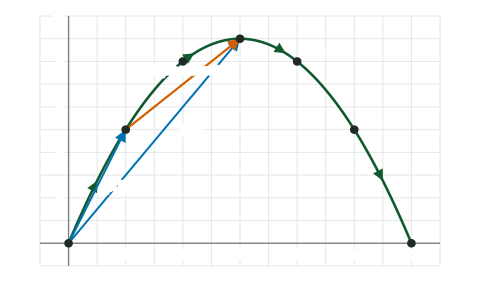
When the arrow is drawn from the origin, is the position vector of the point . As increases, the tip of the arrow traces the same curve, in the same direction, as the parametric function. Nothing new is drawn; the vector form is a new way to compute.
For and , the tip moves from up to at and back down to : an arch. At , , and its magnitude
Displacement
The vector from one position to a later one is the displacement, found by subtracting position vectors:
Worked example 1. For , find the displacement from to and the distance between the two positions.
and .
Displacement: : units right and up.
Distance:
The average rate of change vector
Divide the displacement by the elapsed time and you get the average rate of change of on :
Its components are exactly the average rates of change of and from the lesson on parametric rates, now packed into one vector. It points along the segment from the first position to the second, and its units are distance per unit of time.
Worked example 2. A drone's position, in meters east and north of a depot, is at seconds and at seconds. Find the average rate of change of its position vector on .
Displacement:
Divide by seconds: meters per second, so on average m/s east and m/s north.
What the magnitudes mean
| Vector | Its magnitude is |
|---|---|
| the distance from the origin at time | |
| the straight-line distance between the two positions | |
| that distance divided by the time |
A curved path is longer than the straight segment between its ends, so the distance traveled can be more than the magnitude of the displacement. For on , the displacement is : horizontal, even though the object rose to and came back down in between.