Unit 4 · Topic 4.9

Vector-Valued Functions

A vector-valued function p(t) = ⟨x(t), y(t)⟩ is a parametric function written as position vectors.

Practice 2: Multiple Representations

Beyond the exam. The AP® Precalculus exam does not test this unit. Many classes teach it, and it prepares you for calculus.

Part 1 · Hook

Why this matters

A delivery drone reports its position as an arrow from the depot: so far east, so far north. As the minutes pass the arrow swings and stretches, and its tip draws the flight path. Comparing two arrows tells you how far the drone got and in which direction, on average, it was heading.

Part 2 · Before you start

What this builds on

Part 3 · Prerequisite check

Quick check before you start

1. What is ⟨6,9⟩−⟨2,5⟩\left\langle 6, 9 \right\rangle - \left\langle 2, 5 \right\rangle?

  1. ⟨4,4⟩\left\langle 4, 4 \right\rangle
  2. ⟨8,14⟩\left\langle 8, 14 \right\rangle
  3. ⟨−4,−4⟩\left\langle -4, -4 \right\rangle
  4. ⟨3,4⟩\left\langle 3, 4 \right\rangle
Show the answer

Subtract matching components: 6−2=46 - 2 = 4 and 9−5=49 - 5 = 4.

  • Correct: ⟨4,4⟩\left\langle 4, 4 \right\rangle:
  • ⟨8,14⟩\left\langle 8, 14 \right\rangle:
  • ⟨−4,−4⟩\left\langle -4, -4 \right\rangle:
  • ⟨3,4⟩\left\langle 3, 4 \right\rangle:

2. For x(t)=2tx(t) = 2t and y(t)=6t−t2y(t) = 6t - t^2, where is the point at t=3t = 3?

  1. (6,9)(6, 9)
  2. (6,27)(6, 27)
  3. (9,6)(9, 6)
  4. (3,9)(3, 9)
Show the answer

x(3)=6x(3) = 6 and y(3)=18−9=9y(3) = 18 - 9 = 9.

  • Correct: (6,9)(6, 9):
  • (6,27)(6, 27):
  • (9,6)(9, 6):
  • (3,9)(3, 9):

Part 4 · See it

See it first

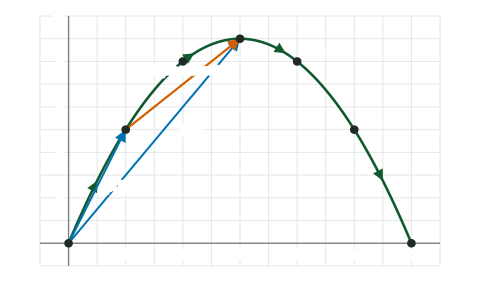
The path of p(t) = <2t, 6t minus t squared> for t from 0 to 6, an arch from (0, 0) up to (6, 9) at t = 3 and down to (12, 0) at t = 6, with points at each whole t. Position vectors p(1) = <2, 5> and p(3) = <6, 9> are drawn from the origin in blue, and the displacement vector p(3) minus p(1) = <4, 4> is drawn from the tip of p(1) to the tip of p(3) in vermillion.
The position vectors p(1)=⟨2,5⟩\mathbf{p}(1) = \left\langle 2, 5 \right\rangle and p(3)=⟨6,9⟩\mathbf{p}(3) = \left\langle 6, 9 \right\rangle of p(t)=⟨2t,6t−t2⟩\mathbf{p}(t) = \left\langle 2t, 6t - t^2 \right\rangle, and the displacement p(3)−p(1)=⟨4,4⟩\mathbf{p}(3) - \mathbf{p}(1) = \left\langle 4, 4 \right\rangle between them. LevlPrep original diagram.

Part 5 · Step by step

How it works, step by step

  1. Write a parametric function as p(t)=⟨x(t),y(t)⟩\mathbf{p}(t) = \left\langle x(t), y(t) \right\rangleeach tt gives a position vector from the origin to the point
  2. Let tt increasethe tip of the position vector traces the same path as the parametric function
  3. Subtract p(t1)\mathbf{p}(t_1) from p(t2)\mathbf{p}(t_2)the displacement vector, from the first position to the second; its magnitude is the distance between them
  4. Divide the displacement by t2−t1t_2 - t_1the average rate of change of p\mathbf{p}: the average rates of xx and yy, as one vector

Part 6 · Key ideas

Key ideas

  • A vector-valued function p(t)\mathbf{p}(t)=⟨x(t),y(t)⟩= \left\langle x(t), y(t) \right\rangle=x(t)i= x(t)\mathbf{i}+y(t)j+ y(t)\mathbf{j} gives a vector for each input tt.
  • Drawn from the origin, p(t)\mathbf{p}(t) is a position vector; its tip traces the curve (x(t),y(t))(x(t), y(t)).
  • Displacement on [t1,t2][t_1, t_2]: p(t2)−p(t1)\mathbf{p}(t_2) - \mathbf{p}(t_1). Distance between the two positions: its magnitude.
  • Average rate of change of p\mathbf{p} on [t1,t2][t_1, t_2]: p(t2)−p(t1)t2−t1\frac{\mathbf{p}(t_2) - \mathbf{p}(t_1)}{t_2 - t_1}, whose components are the average rates of change of xx and yy.

Part 7 · Misconception

A common mistake

The wrong idea: The magnitude of the average rate of change of p\mathbf{p} is the average speed along the path.

What actually happens: It is the straight-line distance between the two positions divided by the time. If the path curves or doubles back, the distance traveled along it is longer, so the average speed along the path is larger.

Part 8 · Check yourself

Check yourself

Exam-style questions. Anything you miss goes into your review queue.

Table

A delivery drone

Position of a drone, in meters east (x) and north (y) of its depot, t seconds after takeoff
tt (seconds)051015
x(t)x(t) (meters)0406060
y(t)y(t) (meters)03070120

1. What is the drone's displacement from t=0t = 0 to t=10t = 10?

  1. ⟨60,70⟩\left\langle 60, 70 \right\rangle
  2. ⟨70,60⟩\left\langle 70, 60 \right\rangle
  3. ⟨6,7⟩\left\langle 6, 7 \right\rangle
  4. ⟨60,120⟩\left\langle 60, 120 \right\rangle
Show the answer

p(10)−p(0)\mathbf{p}(10) - \mathbf{p}(0)=⟨60−0,70−0⟩= \left\langle 60 - 0, 70 - 0 \right\rangle=⟨60,70⟩= \left\langle 60, 70 \right\rangle meters.

  • Correct: ⟨60,70⟩\left\langle 60, 70 \right\rangle: Read both rows at t=10t = 10 and subtract the start.
  • ⟨70,60⟩\left\langle 70, 60 \right\rangle: The components are swapped; east comes first.
  • ⟨6,7⟩\left\langle 6, 7 \right\rangle: This divides by 1010: that is a rate, not a displacement.
  • ⟨60,120⟩\left\langle 60, 120 \right\rangle: 120120 is y(15)y(15), from the wrong column.

2. What is the average rate of change of the drone's position vector on [5,15][5, 15], in meters per second?

  1. ⟨2,9⟩\left\langle 2, 9 \right\rangle
  2. ⟨20,90⟩\left\langle 20, 90 \right\rangle
  3. ⟨6,12⟩\left\langle 6, 12 \right\rangle
  4. ⟨4,3⟩\left\langle 4, 3 \right\rangle
Show the answer

⟨60,120⟩−⟨40,30⟩15−5\frac{\left\langle 60, 120 \right\rangle - \left\langle 40, 30 \right\rangle}{15 - 5}=⟨20,90⟩10= \frac{\left\langle 20, 90 \right\rangle}{10}=⟨2,9⟩= \left\langle 2, 9 \right\rangle.

  • Correct: ⟨2,9⟩\left\langle 2, 9 \right\rangle: Displacement ÷\div 1010 seconds.
  • ⟨20,90⟩\left\langle 20, 90 \right\rangle: This is the displacement; divide by the 1010 seconds.
  • ⟨6,12⟩\left\langle 6, 12 \right\rangle: This divides p(15)\mathbf{p}(15) by 1010; subtract p(5)\mathbf{p}(5) first.
  • ⟨4,3⟩\left\langle 4, 3 \right\rangle: This is p(5)\mathbf{p}(5) divided by 1010.

3. How far is the drone from the depot at t=5t = 5?

No calculator. Type the exact value (a fraction, π, e or a root is fine), in meters.

Show the answer

‖⟨40,30⟩‖\left\| \left\langle 40, 30 \right\rangle \right\|=1600+900= \sqrt{1600 + 900}=50= 50 meters.

  • Answer: 50 meters

4. On [10,15][10, 15] the average rate of change of the position vector is ⟨0,10⟩\left\langle 0, 10 \right\rangle. Which statement does the table support?

  1. At t=15t = 15 the drone is due north of where it was at t=10t = 10
  2. The drone hovered in place from t=10t = 10 to t=15t = 15
  3. The drone moved east and not north from t=10t = 10 to t=15t = 15
  4. The drone flew a straight line due north the whole time
Show the answer

xx is 6060 at both times and yy rose from 7070 to 120120, so the net move is due north. The table cannot show the path between readings.

  • Correct: At t=15t = 15 the drone is due north of where it was at t=10t = 10: Same xx, larger yy: due north.
  • The drone hovered in place from t=10t = 10 to t=15t = 15: yy rose by 5050 meters, so it did not stay put.
  • The drone moved east and not north from t=10t = 10 to t=15t = 15: The east component of the rate is 00.
  • The drone flew a straight line due north the whole time: Two readings give the net move, not the route in between.

5. For a vector-valued function p(t)\mathbf{p}(t) drawn from the origin, what does the tip of p(t)\mathbf{p}(t) trace as tt increases?

  1. The path of (x(t),y(t))(x(t), y(t))
  2. The graph of x(t)x(t) against tt
  3. A circle centered at the origin
  4. A straight line from the origin
Show the answer

The tip is at (x(t),y(t))(x(t), y(t)), so it traces the same curve in the same direction.

  • Correct: The path of (x(t),y(t))(x(t), y(t)): Tip at (x(t),y(t))(x(t), y(t)).
  • The graph of x(t)x(t) against tt: The tip is a point in the xyxy-plane, not on a tt-axis.
  • A circle centered at the origin: Only if ‖p(t)‖\left\| \mathbf{p}(t) \right\| stays constant.
  • A straight line from the origin: Only for special functions, such as ⟨t,2t⟩\left\langle t, 2t \right\rangle.

6. What does ‖p(t)‖=4\left\| \mathbf{p}(t) \right\| = 4 for every tt tell you about p(t)=⟨4cos⁡t,4sin⁡t⟩\mathbf{p}(t) = \left\langle 4\cos t, 4\sin t \right\rangle?

  1. Its tip stays 44 units from the origin: a circle of radius 44
  2. Its tip moves 44 units for each unit of time, along a straight line
  3. Its tip stays at one point, 44 units from the origin
  4. Its tip traces a circle of radius 1616
Show the answer

16cos2⁡t+16sin2⁡t\sqrt{16\cos^2 t + 16\sin^2 t}=4= 4: every position is 44 units from the origin, and the direction changes with tt, so the tip goes around a circle.

  • Correct: Its tip stays 44 units from the origin: a circle of radius 44: Constant distance from the origin, changing direction.
  • Its tip moves 44 units for each unit of time, along a straight line: The length of p(t)\mathbf{p}(t) is a distance from the origin, not a step size.
  • Its tip stays at one point, 44 units from the origin: The direction changes with tt, so the tip moves.
  • Its tip traces a circle of radius 1616: 1616 is the length squared.

Part 9 · Summary

Summary

A vector-valued function p(t)=⟨x(t),y(t)⟩\mathbf{p}(t) = \left\langle x(t), y(t) \right\rangle is a parametric function written as position vectors. The displacement p(t2)−p(t1)\mathbf{p}(t_2) - \mathbf{p}(t_1) says how far and which way the object moved, and dividing by t2−t1t_2 - t_1 gives the average rate of change vector, made of the average rates of xx and yy.

Part 10 · Up next

What comes next

Part 11 · Connections

Connections