Unit 4 Topic 4.8

Vectors

see every function move

3 min readfreeNot practiced

Beyond the exam. The AP® Precalculus exam does not test this unit. Many classes teach it, and it prepares you for calculus.

Many quantities need two pieces of information: not just "how much" but "which way". A wind of 20 km/h from the west is different from a wind of 20 km/h from the north. A vector is a quantity with a magnitude (size) and a direction. You draw it as an arrow; you compute with it through its components.

Components

An arrow from (x1,y1)(x_1, y_1) to (x2,y2)(x_2, y_2) moves x2−x1x_2 - x_1 across and y2−y1y_2 - y_1 up. Those two numbers are its components:

v=⟨x2−x1,y2−y1⟩.\mathbf{v} = \left\langle x_2 - x_1, y_2 - y_1 \right\rangle.

Only the move matters, not where the arrow starts. The arrow from (2,1)(2, 1) to (1,4)(1, 4) and the arrow from (0,0)(0, 0) to (−1,3)(-1, 3) are the same vector, ⟨−1,3⟩\left\langle -1, 3 \right\rangle. Another way to write ⟨a,b⟩\left\langle a, b \right\rangle is ai+bja\mathbf{i} + b\mathbf{j}, where i=⟨1,0⟩\mathbf{i} = \left\langle 1, 0 \right\rangle and j=⟨0,1⟩\mathbf{j} = \left\langle 0, 1 \right\rangle.

Magnitude and direction

The magnitude is the arrow's length, from the Pythagorean theorem: ‖⟨a,b⟩‖=a2+b2\left\| \left\langle a, b \right\rangle \right\| = \sqrt{a^2 + b^2}. Going the other way, a vector with magnitude mm pointing at angle θ\theta from the positive xx-axis has components ⟨mcos⁡θ,msin⁡θ⟩\left\langle m\cos\theta, m\sin\theta \right\rangle, the same idea as a point on a circle of radius mm.

Worked example 1. A boat heads 30∘30^\circ north of east at 1212 km/h, and a current pushes it south at 44 km/h. Find its actual velocity vector and speed.

Heading: ⟨12cos⁡30∘,12sin⁡30∘⟩\left\langle 12\cos 30^\circ, 12\sin 30^\circ \right\rangle=⟨63,6⟩= \left\langle 6\sqrt{3}, 6 \right\rangle, using cos⁡30∘=32\cos 30^\circ = \frac{\sqrt{3}}{2} and sin⁡30∘=12\sin 30^\circ = \frac{1}{2}.

Current: ⟨0,−4⟩\left\langle 0, -4 \right\rangle (south is the negative yy direction).

Sum: ⟨63,2⟩\left\langle 6\sqrt{3}, 2 \right\rangle. Speed: (63)2+22\sqrt{(6\sqrt{3})^2 + 2^2}=108+4= \sqrt{108 + 4}=112= \sqrt{112}=47= 4\sqrt{7} km/h, a little over 10.510.5 km/h.

Adding, subtracting and scaling

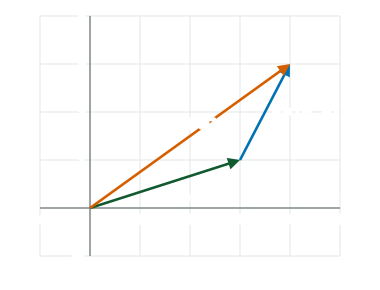
To add u+v\mathbf{u} + \mathbf{v} on a picture, put the tail of v\mathbf{v} at the tip of u\mathbf{u}; the sum runs from the tail of u\mathbf{u} to the tip of v\mathbf{v}. In components you just add matching entries.

Vector u = <3, 1> drawn from the origin to (3, 1) in green, vector v = <1, 2> drawn from the tip of u at (3, 1) to (4, 3) in blue, and their sum u + v = <4, 3> drawn from the origin to (4, 3) in vermillion. The sum has length 5.
Figure 1. ⟨3,1⟩+⟨1,2⟩=⟨4,3⟩\left\langle 3, 1 \right\rangle + \left\langle 1, 2 \right\rangle = \left\langle 4, 3 \right\rangle, tip to tail. LevlPrep original diagram.
OperationComponentsPicture
u+v\mathbf{u} + \mathbf{v}⟨a+c,b+d⟩\left\langle a + c, b + d \right\rangletip to tail
u−v\mathbf{u} - \mathbf{v}⟨a−c,b−d⟩\left\langle a - c, b - d \right\rangleadd the reversed v\mathbf{v}
kuk\mathbf{u}⟨ka,kb⟩\left\langle ka, kb \right\rangle|k||k| times as long; reversed if k<0k < 0
u‖u‖\frac{\mathbf{u}}{\left\| \mathbf{u} \right\|}each component over the lengthsame direction, length 11

The last row is the unit vector in the direction of u\mathbf{u}. For ⟨5,−12⟩\left\langle 5, -12 \right\rangle, the length is 25+144=13\sqrt{25 + 144} = 13, so the unit vector is ⟨513,−1213⟩\left\langle \frac{5}{13}, -\frac{12}{13} \right\rangle.

The dot product and angles

The dot product of u=⟨a,b⟩\mathbf{u} = \left\langle a, b \right\rangle and v=⟨c,d⟩\mathbf{v} = \left\langle c, d \right\rangle is the number u⋅v=ac+bd\mathbf{u} \cdot \mathbf{v} = ac + bd. It is also ‖u‖‖v‖cos⁡θ\left\| \mathbf{u} \right\| \left\| \mathbf{v} \right\| \cos\theta, where θ\theta is the angle between the two arrows when they start at the same point. So

cos⁡θ=u⋅v‖u‖‖v‖.\cos\theta = \frac{\mathbf{u} \cdot \mathbf{v}}{\left\| \mathbf{u} \right\| \left\| \mathbf{v} \right\|}.

Worked example 2. Find the angle between ⟨1,0⟩\left\langle 1, 0 \right\rangle and ⟨1,3⟩\left\langle 1, \sqrt{3} \right\rangle.

Dot product: 1(1)+0(3)=11(1) + 0(\sqrt{3}) = 1. Lengths: 11 and 1+3=2\sqrt{1 + 3} = 2.

cos⁡θ=11⋅2=12\cos\theta = \frac{1}{1 \cdot 2} = \frac{1}{2}, so θ=π3\theta = \frac{\pi}{3}.

A dot product of 00 means cos⁡θ=0\cos\theta = 0: the vectors are perpendicular. ⟨2,3⟩⋅⟨−3,2⟩\left\langle 2, 3 \right\rangle \cdot \left\langle -3, 2 \right\rangle=−6+6= -6 + 6=0= 0. A positive dot product means the angle is less than π2\frac{\pi}{2}; a negative one, more.

Spot a mistake on this page?