A double cone, two ice-cream cones point to point, can be sliced by a plane in different ways. A cut straight across gives a circle; a tilted cut gives an ellipse; a cut parallel to the side gives a parabola; a steep cut through both cones gives the two branches of a hyperbola. These curves are the conic sections. Each is an implicitly defined curve, with an equation in and .
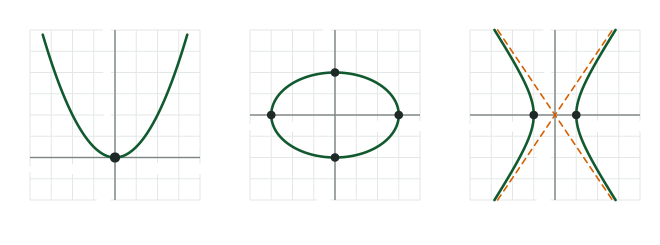
Parabolas
You know , a parabola with vertex that opens up if and down if . Swap the roles of and and you get a parabola that opens sideways:
It has vertex and opens right if , left if . A sideways parabola is not the graph of a function of , since most -values have two -values.
Ellipses
An ellipse with center has the standard form
It reaches units left and right of the center and units up and down. The farthest points along the longer direction are the vertices; the longer axis has length or , whichever is larger. When the ellipse is a circle of radius .
Worked example 1. Describe
Center: and give .
Distances: so across; so up and down. The ellipse is wider than tall.
Vertices: , that is and ; the long axis has length . The top and bottom points are and .
Hyperbolas
Change the plus sign to a minus and the curve breaks into two branches:
This hyperbola opens left and right. Its vertices are , and far from the center each branch gets closer and closer to the asymptotes . If the term comes first,
Worked example 2. Describe .
Center , , ; the term is positive, so it opens left and right. Vertices and . Asymptotes .
It never meets the -axis: gives , so , which has no real solution.
Which conic is it?
| Squared terms | Conic | Example |
|---|---|---|
| only one variable squared | parabola | |
| both squared, same sign | ellipse (circle if the coefficients match) | |
| both squared, opposite signs | hyperbola |
To read the details, rewrite in standard form. Divide so the right side is : becomes . If there are linear terms, complete the square.
Worked example 3. Identify
Group and move the constant:
Complete each square: add and to both sides, .
A circle with center and radius .