Unit 4 Topic 4.4

Parametrically Defined Circles and Lines

see every function move

4 min readfreeNot practiced

Beyond the exam. The AP® Precalculus exam does not test this unit. Many classes teach it, and it prepares you for calculus.

Circles and lines have equations you already know: (x−h)2+(y−k)2=r2(x - h)^2 + (y - k)^2 = r^2 and y=mx+by = mx + b. Parametric equations describe the same shapes as trips: where you start, which way you go, how fast, and where you stop. That extra information is what you need to model a wheel turning or a drone flying.

The unit circle, as a trip

On the unit circle the point at angle tt is (cos⁡t,sin⁡t)(\cos t, \sin t). So the parametric function x(t)=cos⁡tx(t) = \cos t, y(t)=sin⁡ty(t) = \sin t for 0≤t≤2π0 \le t \le 2\pi starts at (1,0)(1, 0) when t=0t = 0, passes (0,1)(0, 1) at t=π2t = \frac{\pi}{2}, (−1,0)(-1, 0) at t=πt = \pi, (0,−1)(0, -1) at t=3π2t = \frac{3\pi}{2}, and returns to (1,0)(1, 0): once around, counterclockwise. The parameter is the angle.

Any circle

Scale by the radius rr, then shift the center to (h,k)(h, k):

x(t)=h+rcos⁡t,y(t)=k+rsin⁡t,0≤t≤2π.x(t) = h + r\cos t, \qquad y(t) = k + r\sin t, \qquad 0 \le t \le 2\pi.

Every point is rr units from (h,k)(h, k). To check, use the Pythagorean identity: (x−h)2(x - h)^2+(y−k)2+ (y - k)^2=r2cos2⁡t= r^2\cos^2 t+r2sin2⁡t+ r^2\sin^2 t=r2= r^2.

Worked example 1. Describe x(t)=−1+5cos⁡tx(t) = -1 + 5\cos t, y(t)=4+5sin⁡ty(t) = 4 + 5\sin t for 0≤t≤2π0 \le t \le 2\pi.

Center (−1,4)(-1, 4), radius 55. At t=0t = 0 the point is (−1+5,4)=(4,4)(-1 + 5, 4) = (4, 4), the rightmost point. As tt increases it goes counterclockwise, reaching the top, (−1,9)(-1, 9), at t=π2t = \frac{\pi}{2}. An equation of the circle is (x+1)2+(y−4)2=25(x + 1)^2 + (y - 4)^2 = 25.

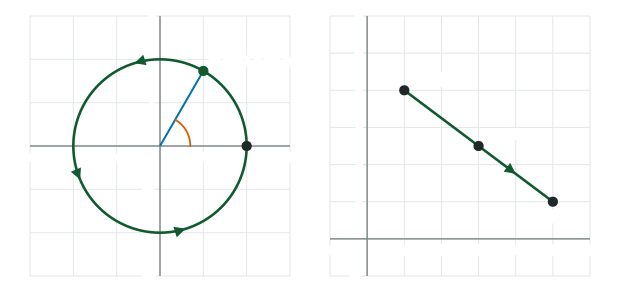
Left: the circle x(t) = 2 cos t, y(t) = 2 sin t. The radius to the point at t = pi/3 makes angle t with the positive x-axis; the trip starts at (2, 0) when t = 0 and arrows show counterclockwise travel. Right: the segment x(t) = 1 + 4t, y(t) = 4 minus 3t from (1, 4) at t = 0 to (5, 1) at t = 1, with the midpoint (3, 2.5) at t = 0.5.
Figure 1. A circle traced from t=0t = 0 (left) and a segment traced from t=0t = 0 to t=1t = 1 (right). LevlPrep original diagram.

Changing the trip, not the circle

Parametric equationsWhat changes
(h+rcos⁡t,k+rsin⁡t)(h + r\cos t, k + r\sin t), 0≤t≤2π0 \le t \le 2\pionce around, counterclockwise from (h+r,k)(h + r, k)
(h+rcos⁡t,k−rsin⁡t)(h + r\cos t, k - r\sin t), 0≤t≤2π0 \le t \le 2\pisame start, clockwise
(h+rsin⁡t,k+rcos⁡t)(h + r\sin t, k + r\cos t), 0≤t≤2π0 \le t \le 2\pistarts at the top, (h,k+r)(h, k + r), clockwise
(h+rcos⁡2t,k+rsin⁡2t)(h + r\cos 2t, k + r\sin 2t), 0≤t≤π0 \le t \le \pionce around in half the parameter time
(h+rcos⁡t,k+rsin⁡t)(h + r\cos t, k + r\sin t), 0≤t≤π0 \le t \le \pithe upper half only

For the third row, check two points: t=0t = 0 gives (h,k+r)(h, k + r), the top, and t=π2t = \frac{\pi}{2} gives (h+r,k)(h + r, k), the right side. Top to right is clockwise.

Segments and lines

To go from (x1,y1)(x_1, y_1) to (x2,y2)(x_2, y_2) in a straight line, start at the first point and add a fraction tt of the change in each coordinate:

x(t)=x1+(x2−x1)t,y(t)=y1+(y2−y1)t,0≤t≤1.x(t) = x_1 + (x_2 - x_1)t, \qquad y(t) = y_1 + (y_2 - y_1)t, \qquad 0 \le t \le 1.

At t=0t = 0 you are at the start, at t=1t = 1 at the end, and at t=12t = \frac{1}{2} at the midpoint. Letting tt run over all real numbers gives the whole line. If the trip takes TT units of time instead of 11, divide the change by TT: x(t)x(t)=x1+x2−x1Tt= x_1 + \frac{x_2 - x_1}{T}t.

Worked example 2. A drone flies straight from (−2,5)(-2, 5) to (6,1)(6, 1) in 44 seconds. Write its position.

The change in xx is 6−(−2)=86 - (-2) = 8, so xx grows by 84=2\frac{8}{4} = 2 each second: x(t)=−2+2tx(t) = -2 + 2t. The change in yy is 1−5=−41 - 5 = -4, so yy changes by −1-1 each second: y(t)=5−ty(t) = 5 - t. Check: at t=4t = 4, (−2+8,5−4)=(6,1)(-2 + 8, 5 - 4) = (6, 1).

The path's slope is rate of yrate of x\frac{\text{rate of } y}{\text{rate of } x}=−12= \frac{-1}{2}, the same as 1−56−(−2)\frac{1 - 5}{6 - (-2)}.

In general, x(t)=x0+atx(t) = x_0 + at, y(t)=y0+bty(t) = y_0 + bt is a line through (x0,y0)(x_0, y_0) with slope ba\frac{b}{a} when a≠0a \ne 0, and a vertical line when a=0a = 0 and b≠0b \ne 0.

Spot a mistake on this page?