So far most functions have come as formulas: , or and . Many curves are more natural as a single equation tying and together. A circle is the clearest case: says "the distance from the origin is 5" without ever saying .
Explicit and implicit
| Form | Example | How you get points |
|---|---|---|
| Explicit | put in , read off | |
| Parametric | put in , read off and | |
| Implicit | put in , solve for every |
The graph of an implicitly defined function is the set of all points that make its equation true. To check whether a point is on the curve, substitute both coordinates: is on because , and is not because .
Finding points
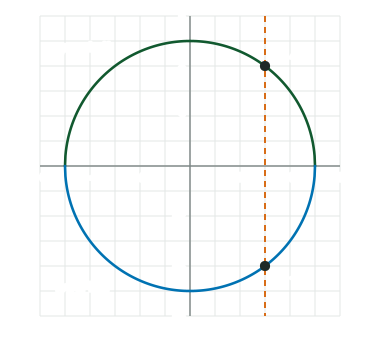
Worked example 1. Find every point of with .
Substitute: , so .
Factor: , so or .
The points are and . One , two -values: this curve is not the graph of a function of .
Splitting a curve into functions
A curve that fails the vertical line test can often be cut into pieces that pass it. For the circle , solving for gives : the upper half and the lower half are each functions of .
Worked example 2. Solve for .
Treat it as a quadratic in : , with , , .
The quadratic formula:
The "+" sign gives the upper piece and the "−" sign the lower piece. Check with : gives and , as before.
The square root also tells you how wide the curve is. Real values of exist only when , that is . At the two ends the square root is and the two pieces meet.
Symmetry from the equation
You can read symmetry without graphing. Swapping and in gives the same equation, so if is on the curve, so is : the curve is symmetric about the line . Replacing with and with also gives the same equation, so is on it too.
Implicit equations that are functions
Some implicit equations do give one for each . In , the left side increases whenever increases, so two different -values can never give the same . This defines as a function of , even though solving for by hand is hard. A table is easy, though: choose , compute . From the points and , the average rate of change of with respect to is , the slope of the segment joining them.