Beyond the exam. The AP® Precalculus exam does not test this unit. Many classes teach it, and it prepares you for calculus.
You can now describe curves two ways: as an equation in and (an implicitly defined curve) and as a parametric function . This page turns the first kind into the second, and back. Turning an equation into parametric equations is called finding a parametrization.
Graphs of functions
The easiest case: if the curve is , let itself be the parameter.
For , use ; it traces the parabola from left to right as increases. If the curve is , a function of , use as the parameter instead: becomes , traced from bottom to top.
Ellipses: the Pythagorean identity
For , the two fractions are squares that add to , just like . So set
Worked example 1. Parametrize .
, , , : , , .
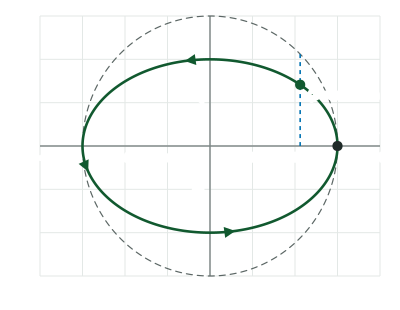
Check: . The trip starts at when and goes once around counterclockwise.
Figure 1. : the circle of radius squeezed vertically by the factor . LevlPrep original diagram.
As with circles, reverses the direction, and and go around twice as fast. The parameter is not the angle of the point from the center unless .
Worked example 2. Parametrize and say which branch gives.
, . Check: .
For , , so and : the right branch. As increases, increases, so the point moves up the branch, from far below to far above. The values are left out, where and are undefined; gives the left branch.
Going back: removing the parameter
To find the equation a parametric curve satisfies, solve each coordinate for the trig function and use the matching identity. For , : and , so . For polynomials, solve one coordinate for and substitute: gives and .
Many parametrizations, one curve
Curve
A parametrization
Identity used
none
none
ellipse
hyperbola
None of these is the only choice. also traces all of , because takes every real value. But traces only the right half, since . Always check that the parameter interval covers the whole curve you want, and nothing more.