Unit 4 · Topic 4.7

Parametrization of Implicitly Defined Functions

To parametrize a curve given by an equation, choose x(t) and y(t) that make the equation true for every t : (t, f(t)) for a graph, (h + acos t, k + bsin t) for an ellipse, (h + asec t, k + btan t) for a hyperbola.

Practice 1: Procedural and Symbolic FluencyPractice 2: Multiple Representations

Beyond the exam. The AP® Precalculus exam does not test this unit. Many classes teach it, and it prepares you for calculus.

Part 1 · Hook

Why this matters

A drawing program, a robot arm and an animation all need curves as trips: a point that moves along the curve as time runs. If a curve is given as an equation, such as the outline of an elliptical track, you need parametric equations that trace it. Trig identities turn out to be exactly the tool.

Part 2 · Before you start

What this builds on

Part 3 · Prerequisite check

Quick check before you start

1. Which identity is true for every tt?

  1. cos2⁡t+sin2⁡t=1\cos^2 t + \sin^2 t = 1
  2. cos⁡t+sin⁡t=1\cos t + \sin t = 1
  3. cos2⁡t−sin2⁡t=1\cos^2 t - \sin^2 t = 1
  4. tan2⁡t+1=cos2⁡t\tan^2 t + 1 = \cos^2 t
Show the answer

The Pythagorean identity: on the unit circle, (cos⁡t)2+(sin⁡t)2=1(\cos t)^2 + (\sin t)^2 = 1.

  • Correct: cos2⁡t+sin2⁡t=1\cos^2 t + \sin^2 t = 1:
  • cos⁡t+sin⁡t=1\cos t + \sin t = 1:
  • cos2⁡t−sin2⁡t=1\cos^2 t - \sin^2 t = 1:
  • tan2⁡t+1=cos2⁡t\tan^2 t + 1 = \cos^2 t:

2. What is the center of the ellipse (x−1)29+(y−2)24\frac{(x - 1)^2}{9} + \frac{(y - 2)^2}{4}=1= 1?

  1. (1,2)(1, 2)
  2. (−1,−2)(-1, -2)
  3. (9,4)(9, 4)
  4. (3,2)(3, 2)
Show the answer

Standard form (x−h)2a2+(y−k)2b2\frac{(x - h)^2}{a^2} + \frac{(y - k)^2}{b^2}=1= 1 has center (h,k)=(1,2)(h, k) = (1, 2).

  • Correct: (1,2)(1, 2):
  • (−1,−2)(-1, -2):
  • (9,4)(9, 4):
  • (3,2)(3, 2):

Part 4 · See it

See it first

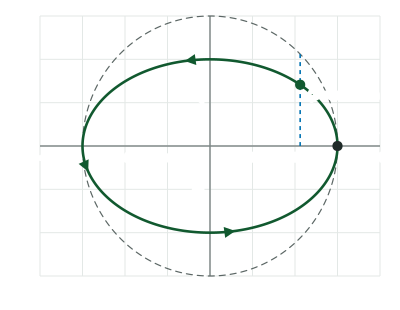
The ellipse x squared over 9 plus y squared over 4 = 1 traced by x(t) = 3 cos t, y(t) = 2 sin t. The trip starts at (3, 0) when t = 0 and arrows show counterclockwise travel. The point for t = pi/4 is marked at (3 cos(pi/4), 2 sin(pi/4)), about (2.12, 1.41); a dashed circle of radius 3 and the ellipse share the x-coordinate 3 cos t.
(3cos⁡t,2sin⁡t)(3\cos t, 2\sin t) traces the ellipse x29+y24=1\frac{x^2}{9} + \frac{y^2}{4} = 1 counterclockwise from (3,0)(3, 0). The point shares its xx-coordinate with the point at angle tt on the dashed circle of radius 33. LevlPrep original diagram.

Part 5 · Step by step

How it works, step by step

  1. A curve is the graph of y=f(x)y = f(x)x(t)=tx(t) = t, y(t)=f(t)y(t) = f(t) traces it left to right
  2. Set x−ha=cos⁡t\frac{x - h}{a} = \cos t and y−kb=sin⁡t\frac{y - k}{b} = \sin tcos2⁡t+sin2⁡t=1\cos^2 t + \sin^2 t = 1 makes every point satisfy the ellipse equation
  3. Set x−ha=sec⁡t\frac{x - h}{a} = \sec t and y−kb=tan⁡t\frac{y - k}{b} = \tan tsec2⁡t−tan2⁡t=1\sec^2 t - \tan^2 t = 1 makes every point satisfy the hyperbola equation
  4. Undo it: solve each equation for the trig function and use the identityyou get back the equation in xx and yy, with the parameter removed

Part 6 · Key ideas

Key ideas

  • A parametrization of a curve is a parametric function that traces it. A graph y=f(x)y = f(x): (t,f(t))(t, f(t)). A curve x=g(y)x = g(y): (g(t),t)(g(t), t).
  • Ellipse (x−h)2a2+(y−k)2b2\frac{(x - h)^2}{a^2} + \frac{(y - k)^2}{b^2}=1= 1: (h+acos⁡t,k+bsin⁡t)(h + a\cos t, k + b\sin t), 0≤t≤2π0 \le t \le 2\pi.
  • Hyperbola (x−h)2a2−(y−k)2b2\frac{(x - h)^2}{a^2} - \frac{(y - k)^2}{b^2}=1= 1: (h+asec⁡t,k+btan⁡t)(h + a\sec t, k + b\tan t); −π2<t<π2-\frac{\pi}{2} < t < \frac{\pi}{2} gives the right branch.
  • A curve has many parametrizations; they can differ in start, direction and speed.

Part 7 · Misconception

A common mistake

The wrong idea: (3cos⁡t,2sin⁡t)(3\cos t, 2\sin t) traces a circle, because it uses cos⁡t\cos t and sin⁡t\sin t like the unit circle.

What actually happens: The different multipliers stretch the circle: (x3)2\left(\frac{x}{3}\right)^2+(y2)2+ \left(\frac{y}{2}\right)^2=cos2⁡t= \cos^2 t+sin2⁡t+ \sin^2 t=1= 1, an ellipse reaching 33 units left and right and 22 units up and down from the center.

Part 8 · Check yourself

Check yourself

Exam-style questions. Anything you miss goes into your review queue.

Graph

An ellipse traced from a starting point

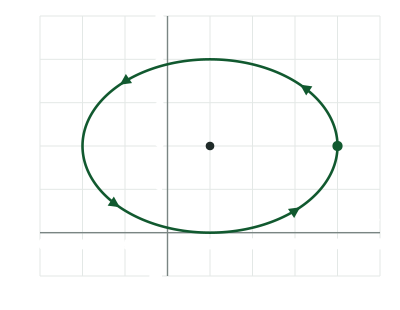
A point travels once around the ellipse for 0≤t≤2π0 \le t \le 2\pi, starting at the marked point and moving counterclockwise. The ellipse has center (1,2)(1, 2) and reaches 33 units left and right and 22 units up and down.

An ellipse with center (1, 2), reaching 3 units left and right of the center and 2 units above and below it. The trip starts at (4, 2), marked t = 0, and arrows show counterclockwise travel.
LevlPrep original diagram.

1. Which parametric function traces the ellipse as shown?

  1. (1+3cos⁡t,2+2sin⁡t)(1 + 3\cos t, 2 + 2\sin t)
  2. (1+2cos⁡t,2+3sin⁡t)(1 + 2\cos t, 2 + 3\sin t)
  3. (1+3sin⁡t,2+2cos⁡t)(1 + 3\sin t, 2 + 2\cos t)
  4. (1+9cos⁡t,2+4sin⁡t)(1 + 9\cos t, 2 + 4\sin t)
Show the answer

Center (1,2)(1, 2), 33 across, 22 up and down: (1+3cos⁡t,2+2sin⁡t)(1 + 3\cos t, 2 + 2\sin t). At t=0t = 0 it is at (4,2)(4, 2), and it moves up next: counterclockwise.

  • Correct: (1+3cos⁡t,2+2sin⁡t)(1 + 3\cos t, 2 + 2\sin t): a=3a = 3 goes with cosine for xx, b=2b = 2 with sine for yy.
  • (1+2cos⁡t,2+3sin⁡t)(1 + 2\cos t, 2 + 3\sin t): This ellipse is 22 across and 33 up and down, taller than wide.
  • (1+3sin⁡t,2+2cos⁡t)(1 + 3\sin t, 2 + 2\cos t): This starts at (1,4)(1, 4), the top, and goes clockwise.
  • (1+9cos⁡t,2+4sin⁡t)(1 + 9\cos t, 2 + 4\sin t): Multiply by a=3a = 3 and b=2b = 2, not by their squares.

2. Where is the point when t=π2t = \frac{\pi}{2}?

  1. (1,4)(1, 4)
  2. (4,2)(4, 2)
  3. (−2,2)(-2, 2)
  4. (1,0)(1, 0)
Show the answer

x=1+3cos⁡π2=1x = 1 + 3\cos\frac{\pi}{2} = 1 and y=2+2sin⁡π2=4y = 2 + 2\sin\frac{\pi}{2} = 4: the top of the ellipse.

  • Correct: (1,4)(1, 4): cos⁡π2=0\cos\frac{\pi}{2} = 0, sin⁡π2=1\sin\frac{\pi}{2} = 1.
  • (4,2)(4, 2): (4,2)(4, 2) is the start, t=0t = 0.
  • (−2,2)(-2, 2): (−2,2)(-2, 2) is at t=πt = \pi.
  • (1,0)(1, 0): (1,0)(1, 0) is the bottom, at t=3π2t = \frac{3\pi}{2}.

3. What is the xx-coordinate of the point when t=π3t = \frac{\pi}{3}?

No calculator. Type the exact value (a fraction, π, e or a root is fine).

Show the answer

xx=1+3cos⁡π3= 1 + 3\cos\frac{\pi}{3}=1+32= 1 + \frac{3}{2}=52= \frac{5}{2}.

  • Answer: 52\frac{5}{2} ≈ 2.500

4. Remove the parameter. Which equation does every point of the ellipse satisfy?

  1. (x−1)29+(y−2)24\frac{(x - 1)^2}{9} + \frac{(y - 2)^2}{4}=1= 1
  2. (x−1)23+(y−2)22\frac{(x - 1)^2}{3} + \frac{(y - 2)^2}{2}=1= 1
  3. (x+1)29+(y+2)24\frac{(x + 1)^2}{9} + \frac{(y + 2)^2}{4}=1= 1
  4. (x−1)29−(y−2)24\frac{(x - 1)^2}{9} - \frac{(y - 2)^2}{4}=1= 1
Show the answer

cos⁡t=x−13\cos t = \frac{x - 1}{3} and sin⁡t=y−22\sin t = \frac{y - 2}{2}; squaring and adding gives (x−1)29+(y−2)24\frac{(x - 1)^2}{9} + \frac{(y - 2)^2}{4}=1= 1.

  • Correct: (x−1)29+(y−2)24\frac{(x - 1)^2}{9} + \frac{(y - 2)^2}{4}=1= 1: Square both quotients and add.
  • (x−1)23+(y−2)22\frac{(x - 1)^2}{3} + \frac{(y - 2)^2}{2}=1= 1: (x−13)2\left(\frac{x - 1}{3}\right)^2 has 99 underneath.
  • (x+1)29+(y+2)24\frac{(x + 1)^2}{9} + \frac{(y + 2)^2}{4}=1= 1: The center is (1,2)(1, 2), so subtract.
  • (x−1)29−(y−2)24\frac{(x - 1)^2}{9} - \frac{(y - 2)^2}{4}=1= 1: cos2⁡t+sin2⁡t=1\cos^2 t + \sin^2 t = 1 is a sum: an ellipse, not a hyperbola.

5. Which parametric function traces y=x2−3xy = x^2 - 3x from left to right?

  1. (t,t2−3t)(t, t^2 - 3t)
  2. (t2−3t,t)(t^2 - 3t, t)
  3. (t,t2)(t, t^2)
  4. (t2,t4−3t2)(t^2, t^4 - 3t^2)
Show the answer

Let x=tx = t; then y=t2−3ty = t^2 - 3t. As tt increases, xx increases.

  • Correct: (t,t2−3t)(t, t^2 - 3t): x=tx = t, y=f(t)y = f(t).
  • (t2−3t,t)(t^2 - 3t, t): This swaps the coordinates: it traces x=y2−3yx = y^2 - 3y.
  • (t,t2)(t, t^2): This traces y=x2y = x^2, without the −3x-3x.
  • (t2,t4−3t2)(t^2, t^4 - 3t^2): x=t2≥0x = t^2 \ge 0, so this traces only the right part and doubles back.

6. Which parametric function traces the curve x=y2+1x = y^2 + 1?

  1. (t2+1,t)(t^2 + 1, t)
  2. (t,t2+1)(t, t^2 + 1)
  3. (t2+1,t2)(t^2 + 1, t^2)
  4. (t+1,t2)(t + 1, t^2)
Show the answer

The curve is xx as a function of yy, so let y=ty = t and x=t2+1x = t^2 + 1.

  • Correct: (t2+1,t)(t^2 + 1, t): y=ty = t, x=g(t)x = g(t).
  • (t,t2+1)(t, t^2 + 1): This traces y=x2+1y = x^2 + 1, a parabola opening up.
  • (t2+1,t2)(t^2 + 1, t^2): y=t2≥0y = t^2 \ge 0, so only the upper half.
  • (t+1,t2)(t + 1, t^2): This traces y=(x−1)2y = (x - 1)^2, a parabola opening up.

Part 9 · Summary

Summary

To parametrize a curve given by an equation, choose x(t)x(t) and y(t)y(t) that make the equation true for every tt: (t,f(t))(t, f(t)) for a graph, (h+acos⁡t,k+bsin⁡t)(h + a\cos t, k + b\sin t) for an ellipse, (h+asec⁡t,k+btan⁡t)(h + a\sec t, k + b\tan t) for a hyperbola. To go back, solve for the trig functions and use a Pythagorean identity.
Part 10 · Up next

What comes next

Part 11 · Connections

Connections