Unit 4 · Topic 4.8

Vectors

A vector ⟨a, b⟩ is a size and a direction: a across, b up, length √(a² + b²) .

Practice 1: Procedural and Symbolic FluencyPractice 2: Multiple Representations

Beyond the exam. The AP® Precalculus exam does not test this unit. Many classes teach it, and it prepares you for calculus.

Part 1 · Hook

Why this matters

A pilot sets a heading and a speed, and the wind pushes the plane sideways. Where does the plane actually go? Speeds with directions, pushes and pulls, and moves on a map all have a size and a direction. Vectors are the quantities that keep both, and they add in a way plain numbers do not.

Part 2 · Prerequisite check

Quick check before you start

1. What is the distance from (0,0)(0, 0) to (3,4)(3, 4)?

  1. 55
  2. 77
  3. 2525
  4. 11
Show the answer

32+42=25=5\sqrt{3^2 + 4^2} = \sqrt{25} = 5.

  • Correct: 55:
  • 77:
  • 2525:
  • 11:

2. What are cos⁡π6\cos\frac{\pi}{6} and sin⁡π6\sin\frac{\pi}{6}?

  1. 32\frac{\sqrt{3}}{2} and 12\frac{1}{2}
  2. 12\frac{1}{2} and 32\frac{\sqrt{3}}{2}
  3. 22\frac{\sqrt{2}}{2} and 22\frac{\sqrt{2}}{2}
  4. 3\sqrt{3} and 11
Show the answer

The angle π6\frac{\pi}{6} (30∘30^\circ) has cosine 32\frac{\sqrt{3}}{2} and sine 12\frac{1}{2}.

  • Correct: 32\frac{\sqrt{3}}{2} and 12\frac{1}{2}:
  • 12\frac{1}{2} and 32\frac{\sqrt{3}}{2}:
  • 22\frac{\sqrt{2}}{2} and 22\frac{\sqrt{2}}{2}:
  • 3\sqrt{3} and 11:

Part 3 · See it

See it first

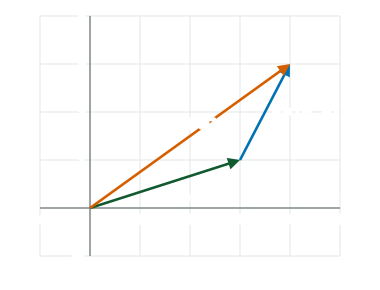
Vector u = <3, 1> drawn from the origin to (3, 1) in green, vector v = <1, 2> drawn from the tip of u at (3, 1) to (4, 3) in blue, and their sum u + v = <4, 3> drawn from the origin to (4, 3) in vermillion. The sum has length 5.
Adding vectors tip to tail: u=⟨3,1⟩\mathbf{u} = \left\langle 3, 1 \right\rangle then v=⟨1,2⟩\mathbf{v} = \left\langle 1, 2 \right\rangle lands at the tip of u+v=⟨4,3⟩\mathbf{u} + \mathbf{v} = \left\langle 4, 3 \right\rangle. LevlPrep original diagram.

Part 4 · Step by step

How it works, step by step

  1. A vector goes from (x1,y1)(x_1, y_1) to (x2,y2)(x_2, y_2)its components are ⟨x2−x1,y2−y1⟩\left\langle x_2 - x_1, y_2 - y_1 \right\rangle, wherever it is drawn
  2. Square the components, add, take the square rootthe magnitude ‖v‖\left\| \mathbf{v} \right\|, the vector's length
  3. Place the second vector at the tip of the firstthe sum runs from the first tail to the second tip; in components, add matching entries
  4. Multiply matching components and addthe dot product; it is 00 exactly when the vectors are perpendicular

Part 5 · Key ideas

Key ideas

  • A vector has a magnitude and a direction. v=⟨a,b⟩=ai+bj\mathbf{v} = \left\langle a, b \right\rangle = a\mathbf{i} + b\mathbf{j} moves aa across and bb up; its magnitude is ‖v‖=a2+b2\left\| \mathbf{v} \right\| = \sqrt{a^2 + b^2}.
  • A vector of magnitude mm at angle θ\theta from the positive xx-axis is ⟨mcos⁡θ,msin⁡θ⟩\left\langle m\cos\theta, m\sin\theta \right\rangle.
  • Add and subtract component by component. A scalar multiple kvk\mathbf{v} stretches by |k||k| and reverses if k<0k < 0. A unit vector v‖v‖\frac{\mathbf{v}}{\left\| \mathbf{v} \right\|} has length 11.
  • Dot product: ⟨a,b⟩⋅⟨c,d⟩\left\langle a, b \right\rangle \cdot \left\langle c, d \right\rangle=ac= ac+bd+ bd=‖u‖‖v‖cos⁡θ= \left\| \mathbf{u} \right\| \left\| \mathbf{v} \right\| \cos\theta, θ\theta the angle between them.

Part 6 · Misconception

A common mistake

The wrong idea: The magnitude of u+v\mathbf{u} + \mathbf{v} is the magnitude of u\mathbf{u} plus the magnitude of v\mathbf{v}.

What actually happens: Lengths add only when the vectors point the same way. ⟨3,0⟩+⟨0,4⟩=⟨3,4⟩\left\langle 3, 0 \right\rangle + \left\langle 0, 4 \right\rangle = \left\langle 3, 4 \right\rangle has length 55, not 3+4=73 + 4 = 7. Add the components first, then find the length.

Part 7 · Check yourself

Check yourself

Exam-style questions. Anything you miss goes into your review queue.

Graph

Two vectors on a grid

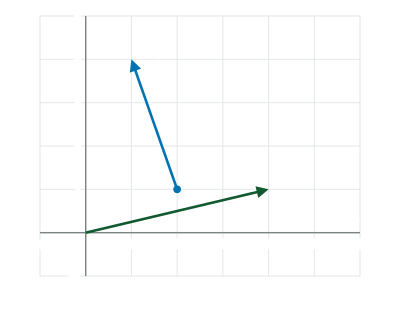
Vector u\mathbf{u} is drawn from (0,0)(0, 0) to (4,1)(4, 1); vector v\mathbf{v} is drawn from (2,1)(2, 1) to (1,4)(1, 4).

Vector u drawn from (0, 0) to (4, 1) in green. Vector v drawn from (2, 1) to (1, 4) in blue. Both start and end at grid points.
LevlPrep original diagram.

1. What are the components of v\mathbf{v}?

  1. ⟨−1,3⟩\left\langle -1, 3 \right\rangle
  2. ⟨1,−3⟩\left\langle 1, -3 \right\rangle
  3. ⟨1,4⟩\left\langle 1, 4 \right\rangle
  4. ⟨3,−1⟩\left\langle 3, -1 \right\rangle
Show the answer

Terminal minus initial: ⟨1−2,4−1⟩=⟨−1,3⟩\left\langle 1 - 2, 4 - 1 \right\rangle = \left\langle -1, 3 \right\rangle, one unit left and three up.

  • Correct: ⟨−1,3⟩\left\langle -1, 3 \right\rangle: 1−2=−11 - 2 = -1 across, 4−1=34 - 1 = 3 up.
  • ⟨1,−3⟩\left\langle 1, -3 \right\rangle: This subtracts the other way, from tip to tail; it points the opposite direction.
  • ⟨1,4⟩\left\langle 1, 4 \right\rangle: (1,4)(1, 4) is where the arrow ends; subtract where it starts.
  • ⟨3,−1⟩\left\langle 3, -1 \right\rangle: The components are swapped.

2. What is u+v\mathbf{u} + \mathbf{v}?

  1. ⟨3,4⟩\left\langle 3, 4 \right\rangle
  2. ⟨5,−2⟩\left\langle 5, -2 \right\rangle
  3. ⟨−4,3⟩\left\langle -4, 3 \right\rangle
  4. ⟨4,4⟩\left\langle 4, 4 \right\rangle
Show the answer

⟨4+(−1),1+3⟩\left\langle 4 + (-1), 1 + 3 \right\rangle=⟨3,4⟩= \left\langle 3, 4 \right\rangle, adding matching components.

  • Correct: ⟨3,4⟩\left\langle 3, 4 \right\rangle: 4−1=34 - 1 = 3 and 1+3=41 + 3 = 4.
  • ⟨5,−2⟩\left\langle 5, -2 \right\rangle: This is u−v\mathbf{u} - \mathbf{v}.
  • ⟨−4,3⟩\left\langle -4, 3 \right\rangle: This multiplies matching components; add them.
  • ⟨4,4⟩\left\langle 4, 4 \right\rangle: 4+(−1)=34 + (-1) = 3, not 44.

3. What is ‖u+v‖\left\| \mathbf{u} + \mathbf{v} \right\|?

No calculator. Type the exact value (a fraction, π, e or a root is fine).

Show the answer

‖⟨3,4⟩‖=9+16=5\left\| \left\langle 3, 4 \right\rangle \right\| = \sqrt{9 + 16} = 5.

  • Answer: 5

4. What is u⋅v\mathbf{u} \cdot \mathbf{v}?

No calculator. Type the exact value (a fraction, π, e or a root is fine).

Show the answer

4(−1)+1(3)4(-1) + 1(3)=−4+3= -4 + 3=−1= -1. It is negative, so the angle between u\mathbf{u} and v\mathbf{v} is more than π2\frac{\pi}{2}.

  • Answer: -1

5. What is the unit vector in the direction of ⟨5,−12⟩\left\langle 5, -12 \right\rangle?

  1. ⟨513,−1213⟩\left\langle \frac{5}{13}, -\frac{12}{13} \right\rangle
  2. ⟨517,−1217⟩\left\langle \frac{5}{17}, -\frac{12}{17} \right\rangle
  3. ⟨1,−1⟩\left\langle 1, -1 \right\rangle
  4. ⟨57,−127⟩\left\langle \frac{5}{7}, -\frac{12}{7} \right\rangle
Show the answer

The length is 25+144=13\sqrt{25 + 144} = 13. Divide each component by 1313.

  • Correct: ⟨513,−1213⟩\left\langle \frac{5}{13}, -\frac{12}{13} \right\rangle: Each component over the length 1313.
  • ⟨517,−1217⟩\left\langle \frac{5}{17}, -\frac{12}{17} \right\rangle: 17=5+1217 = 5 + 12 is not the length; use 52+122\sqrt{5^2 + 12^2}.
  • ⟨1,−1⟩\left\langle 1, -1 \right\rangle: This changes the direction; the ratio of components must stay 5:−125 : -12.
  • ⟨57,−127⟩\left\langle \frac{5}{7}, -\frac{12}{7} \right\rangle: 7=12−57 = 12 - 5 is not the length.

6. Which vector is perpendicular to ⟨2,3⟩\left\langle 2, 3 \right\rangle?

  1. ⟨−3,2⟩\left\langle -3, 2 \right\rangle
  2. ⟨3,2⟩\left\langle 3, 2 \right\rangle
  3. ⟨−2,−3⟩\left\langle -2, -3 \right\rangle
  4. ⟨2,−3⟩\left\langle 2, -3 \right\rangle
Show the answer

⟨2,3⟩⋅⟨−3,2⟩\left\langle 2, 3 \right\rangle \cdot \left\langle -3, 2 \right\rangle=−6+6= -6 + 6=0= 0, so the vectors are perpendicular.

  • Correct: ⟨−3,2⟩\left\langle -3, 2 \right\rangle: Dot product 00.
  • ⟨3,2⟩\left\langle 3, 2 \right\rangle: 6+6=126 + 6 = 12, not 00.
  • ⟨−2,−3⟩\left\langle -2, -3 \right\rangle: This points the opposite way: dot product −13-13.
  • ⟨2,−3⟩\left\langle 2, -3 \right\rangle: 4−9=−54 - 9 = -5, not 00.

Part 8 · Summary

Summary

A vector ⟨a,b⟩\left\langle a, b \right\rangle is a size and a direction: aa across, bb up, length a2+b2\sqrt{a^2 + b^2}. Vectors add tip to tail (component by component), scale by numbers, and give a unit vector when divided by their length. The dot product ac+bdac + bd measures the angle between two vectors and is 00 for perpendicular ones.

Part 9 · Up next

What comes next

Part 10 · Connections

Connections