Beyond the exam. The AP® Precalculus exam does not test this unit. Many classes teach it, and it prepares you for calculus.
For numbers, every nonzero has a reciprocal with . For matrices the role of is played by the identity , and the role of "nonzero" is played by one number computed from the entries: the determinant.
The determinant
For a matrix,
the product down the main diagonal minus the product up the other diagonal. For , .
What the determinant measures
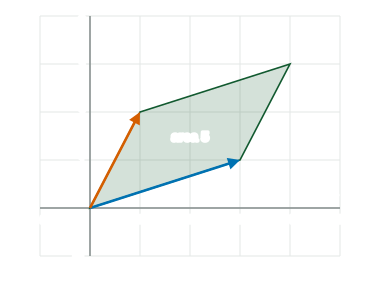
Draw the two columns of the matrix as vectors from the origin. They make a parallelogram, and its area is the absolute value of the determinant.
Figure 1. Columns and : area . LevlPrep original diagram.
The sign records order: swapping the two columns gives the same parallelogram but changes the sign of the determinant. Doubling one column doubles the area and the determinant; multiplying the whole matrix by triples both columns, so the determinant is multiplied by . When the determinant is , the columns lie along one line and the "parallelogram" is flat.
The inverse
The inverse of a square matrix is the matrix with . For a matrix with :
In words: swap the diagonal entries, change the signs of the other two, divide every entry by the determinant.
Worked example 1. Find the inverse of and check it.
. Swap and negate: . Divide by : .
Check one entry of : row 1 of times column 2 of is , as it should be. The full product is .
When there is no inverse
If , the formula would divide by zero, and in fact no inverse exists. Take , with . Then , and also . Two different columns give the same result, so no matrix could send back to the right one.
Solving a system with the inverse
The system , is the matrix equation with and .
Worked example 2. Solve it with .
Multiply both sides on the left by : .
Row 1: . Row 2: . So , . Check: and .
The order matters: , not , because multiplies from the left.