Unit 4 · Topic 4.11

The Inverse and Determinant of a Matrix

For a 2×2 matrix the determinant ad − bc is the signed area of the parallelogram made by its columns.

Practice 1: Procedural and Symbolic Fluency

Beyond the exam. The AP® Precalculus exam does not test this unit. Many classes teach it, and it prepares you for calculus.

Part 1 · Hook

Why this matters

A secret message is scrambled by multiplying blocks of numbers by a matrix. To read it, you need the matrix that undoes the scrambling. One number, the determinant, tells you whether such an undo matrix exists, and it also measures how much the matrix stretches areas.

Part 2 · Before you start

What this builds on

Part 3 · Prerequisite check

Quick check before you start

1. What is [2113][1−1]\left[ \begin{matrix} 2 & 1 \\ 1 & 3 \end{matrix} \right]\left[ \begin{matrix} 1 \\ -1 \end{matrix} \right]?

  1. [1−2]\left[ \begin{matrix} 1 \\ -2 \end{matrix} \right]
  2. [2−3]\left[ \begin{matrix} 2 \\ -3 \end{matrix} \right]
  3. [34]\left[ \begin{matrix} 3 \\ 4 \end{matrix} \right]
  4. [1−2]\left[ \begin{matrix} 1 & -2 \end{matrix} \right]
Show the answer

Row 1: 2(1)+1(−1)=12(1) + 1(-1) = 1. Row 2: 1(1)+3(−1)=−21(1) + 3(-1) = -2.

  • Correct: [1−2]\left[ \begin{matrix} 1 \\ -2 \end{matrix} \right]:
  • [2−3]\left[ \begin{matrix} 2 \\ -3 \end{matrix} \right]:
  • [34]\left[ \begin{matrix} 3 \\ 4 \end{matrix} \right]:
  • [1−2]\left[ \begin{matrix} 1 & -2 \end{matrix} \right]:

2. What is the area of a parallelogram with base 55 and height 33?

  1. 1515
  2. 7.57.5
  3. 88
  4. 1616
Show the answer

Base times height: 5⋅3=155 \cdot 3 = 15.

  • Correct: 1515:
  • 7.57.5:
  • 88:
  • 1616:

Part 4 · See it

See it first

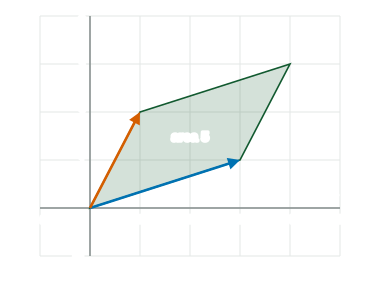
The column vectors <3, 1> and <1, 2> drawn from the origin, and the shaded parallelogram they make, with corners (0, 0), (3, 1), (4, 3) and (1, 2). Its area is 5, the determinant 3 times 2 minus 1 times 1.
The columns of [3112]\left[ \begin{matrix} 3 & 1 \\ 1 & 2 \end{matrix} \right], drawn as ⟨3,1⟩\left\langle 3, 1 \right\rangle and ⟨1,2⟩\left\langle 1, 2 \right\rangle, make a parallelogram of area 3(2)−1(1)=53(2) - 1(1) = 5, the determinant. LevlPrep original diagram.

Part 5 · Step by step

How it works, step by step

  1. For A=[abcd]A = \left[ \begin{matrix} a & b \\ c & d \end{matrix} \right], compute ad−bcad - bcthe determinant det⁡A\det A
  2. Draw the two columns of AA as vectors from the originthey make a parallelogram whose area is |det⁡A|\left| \det A \right|
  3. det⁡A≠0\det A \ne 0AA has an inverse: swap aa and dd, negate bb and cc, divide by det⁡A\det A
  4. det⁡A=0\det A = 0the columns lie on one line, the parallelogram is flat, and AA has no inverse

Part 6 · Key ideas

Key ideas

  • The determinant of [abcd]\left[ \begin{matrix} a & b \\ c & d \end{matrix} \right] is ad−bcad - bc. Its absolute value is the area of the parallelogram made by the two columns.
  • The inverse matrix A−1A^{-1} satisfies AA−1=A−1A=IAA^{-1} = A^{-1}A = I. For det⁡A≠0\det A \ne 0: A−1A^{-1}=1ad−bc[d−b−ca]= \frac{1}{ad - bc}\left[ \begin{matrix} d & -b \\ -c & a \end{matrix} \right].
  • det⁡A=0\det A = 0 means no inverse: two different inputs give the same product, so nothing can undo AA.
  • If AX=BAX = B and AA has an inverse, then X=A−1BX = A^{-1}B.

Part 7 · Misconception

A common mistake

The wrong idea: The inverse of [abcd]\left[ \begin{matrix} a & b \\ c & d \end{matrix} \right] is [1a1b1c1d]\left[ \begin{matrix} \frac{1}{a} & \frac{1}{b} \\ \frac{1}{c} & \frac{1}{d} \end{matrix} \right].

What actually happens: Reciprocals of the entries do not undo matrix multiplication. Swap aa and dd, change the signs of bb and cc, and divide by ad−bcad - bc; then check that AA−1=IAA^{-1} = I.

Part 8 · Check yourself

Check yourself

Exam-style questions. Anything you miss goes into your review queue.

Table

Two matrices

A=[4322],B=[6342]A = \left[ \begin{matrix} 4 & 3 \\ 2 & 2 \end{matrix} \right], \qquad B = \left[ \begin{matrix} 6 & 3 \\ 4 & 2 \end{matrix} \right]

1. What is det⁡A\det A?

No calculator. Type the exact value (a fraction, π, e or a root is fine).

Show the answer

det⁡A\det A=4(2)−3(2)= 4(2) - 3(2)=8−6= 8 - 6=2= 2.

  • Answer: 2

2. Which matrix has no inverse?

  1. BB, since det⁡B=0\det B = 0
  2. AA, since det⁡A=2\det A = 2
  3. Both, since neither is the identity
  4. Neither, since no entry is zero
Show the answer

det⁡B\det B=6(2)−3(4)= 6(2) - 3(4)=12−12= 12 - 12=0= 0, so BB has no inverse. det⁡A=2≠0\det A = 2 \ne 0, so AA does.

  • Correct: BB, since det⁡B=0\det B = 0: Determinant 00: no inverse.
  • AA, since det⁡A=2\det A = 2: A nonzero determinant means AA is invertible.
  • Both, since neither is the identity: A matrix need not be II to have an inverse; it needs a nonzero determinant.
  • Neither, since no entry is zero: Nonzero entries do not guarantee an inverse; det⁡B=0\det B = 0.

3. What is A−1A^{-1}?

  1. [1−32−12]\left[ \begin{matrix} 1 & -\frac{3}{2} \\ -1 & 2 \end{matrix} \right]
  2. [2−3−24]\left[ \begin{matrix} 2 & -3 \\ -2 & 4 \end{matrix} \right]
  3. [14131212]\left[ \begin{matrix} \frac{1}{4} & \frac{1}{3} \\ \frac{1}{2} & \frac{1}{2} \end{matrix} \right]
  4. [13212]\left[ \begin{matrix} 1 & \frac{3}{2} \\ 1 & 2 \end{matrix} \right]
Show the answer

Swap the diagonal, negate the others, divide by det⁡A=2\det A = 2: 12[2−3−24]\frac{1}{2}\left[ \begin{matrix} 2 & -3 \\ -2 & 4 \end{matrix} \right]=[1−32−12]= \left[ \begin{matrix} 1 & -\frac{3}{2} \\ -1 & 2 \end{matrix} \right].

  • Correct: [1−32−12]\left[ \begin{matrix} 1 & -\frac{3}{2} \\ -1 & 2 \end{matrix} \right]: 12\frac{1}{2} times the swapped-and-negated matrix.
  • [2−3−24]\left[ \begin{matrix} 2 & -3 \\ -2 & 4 \end{matrix} \right]: Divide by the determinant, 22.
  • [14131212]\left[ \begin{matrix} \frac{1}{4} & \frac{1}{3} \\ \frac{1}{2} & \frac{1}{2} \end{matrix} \right]: Reciprocals of the entries do not undo matrix multiplication.
  • [13212]\left[ \begin{matrix} 1 & \frac{3}{2} \\ 1 & 2 \end{matrix} \right]: Change the signs of the off-diagonal entries.

4. Solve A[xy]=[74]A\left[ \begin{matrix} x \\ y \end{matrix} \right] = \left[ \begin{matrix} 7 \\ 4 \end{matrix} \right].

  1. [11]\left[ \begin{matrix} 1 \\ 1 \end{matrix} \right]
  2. [74]\left[ \begin{matrix} 7 \\ 4 \end{matrix} \right]
  3. [2−13]\left[ \begin{matrix} 2 \\ -\frac{1}{3} \end{matrix} \right]
  4. [−11]\left[ \begin{matrix} -1 \\ 1 \end{matrix} \right]
Show the answer

A−1[74]A^{-1}\left[ \begin{matrix} 7 \\ 4 \end{matrix} \right]=[1(7)−32(4)−1(7)+2(4)]= \left[ \begin{matrix} 1(7) - \frac{3}{2}(4) \\ -1(7) + 2(4) \end{matrix} \right]=[11]= \left[ \begin{matrix} 1 \\ 1 \end{matrix} \right]. Check: 4+3=74 + 3 = 7, 2+2=42 + 2 = 4.

  • Correct: [11]\left[ \begin{matrix} 1 \\ 1 \end{matrix} \right]: x=1x = 1, y=1y = 1.
  • [74]\left[ \begin{matrix} 7 \\ 4 \end{matrix} \right]: This is the right side; multiply it by A−1A^{-1}.
  • [2−13]\left[ \begin{matrix} 2 \\ -\frac{1}{3} \end{matrix} \right]: Use A−1A^{-1}; dividing 77 by entries of AA does not solve the system.
  • [−11]\left[ \begin{matrix} -1 \\ 1 \end{matrix} \right]: 4(−1)+3(1)=−14(-1) + 3(1) = -1, not 77.

5. Write det⁡[k32k]\det \left[ \begin{matrix} k & 3 \\ 2 & k \end{matrix} \right] as an expression in kk.

Type an expression.

Show the answer

ad−bcad - bc=k⋅k−3⋅2= k \cdot k - 3 \cdot 2=k2−6= k^2 - 6.

  • Answer: k2−6k^{2} - 6

6. What is the inverse of [2153]\left[ \begin{matrix} 2 & 1 \\ 5 & 3 \end{matrix} \right]?

  1. [3−1−52]\left[ \begin{matrix} 3 & -1 \\ -5 & 2 \end{matrix} \right]
  2. [2−1−53]\left[ \begin{matrix} 2 & -1 \\ -5 & 3 \end{matrix} \right]
  3. [−315−2]\left[ \begin{matrix} -3 & 1 \\ 5 & -2 \end{matrix} \right]
  4. [3152]\left[ \begin{matrix} 3 & 1 \\ 5 & 2 \end{matrix} \right]
Show the answer

det⁡=6−5=1\det = 6 - 5 = 1. Swap 22 and 33, negate 11 and 55, divide by 11.

  • Correct: [3−1−52]\left[ \begin{matrix} 3 & -1 \\ -5 & 2 \end{matrix} \right]: Swap the diagonal, negate the rest, divide by 11.
  • [2−1−53]\left[ \begin{matrix} 2 & -1 \\ -5 & 3 \end{matrix} \right]: Swap the diagonal entries 22 and 33.
  • [−315−2]\left[ \begin{matrix} -3 & 1 \\ 5 & -2 \end{matrix} \right]: Every sign is flipped: this is −1-1 times the inverse. Swap 22 and 33 but keep their signs.
  • [3152]\left[ \begin{matrix} 3 & 1 \\ 5 & 2 \end{matrix} \right]: Change the signs of 11 and 55.

Part 9 · Summary

Summary

For a 2×22 \times 2 matrix the determinant ad−bcad - bc is the signed area of the parallelogram made by its columns. If it is not 00, the inverse is 1ad−bc[d−b−ca]\frac{1}{ad - bc}\left[ \begin{matrix} d & -b \\ -c & a \end{matrix} \right], which undoes the matrix and solves AX=BAX = B as X=A−1BX = A^{-1}B. If it is 00, there is no inverse.

Part 10 · Up next

What comes next

Part 11 · Connections

Connections