A linear transformation sends ⟨x, y⟩ to ⟨ax + by, cx + dy⟩ , which is the matrix [a, b; c, d] times the input.
Practice 2: Multiple Representations
Beyond the exam. The AP® Precalculus exam does not test this unit. Many classes teach it, and it prepares you for calculus.
Part 1 · Hook
Why this matters
Photo apps rotate, flip, stretch and slant pictures. Each of those moves sends every point of the image to a new point by the same rule, keeps the center fixed and keeps straight lines straight. Every such move is a matrix, and the matrix can be read straight off a picture of where the square goes.
Part 2 · Before you start
What this builds on
Part 3 · Prerequisite check
Quick check before you start
1. What is ?
Show the answer
Row 1: . Row 2: .
Correct: :
:
:
:
2. What is ?
Show the answer
.
Correct: :
:
:
:
Part 4 · See it
See it first
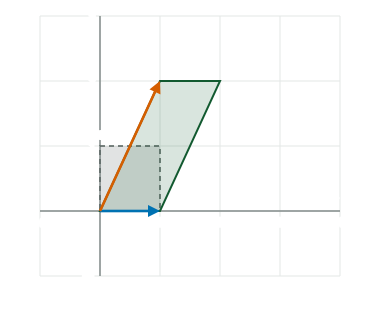
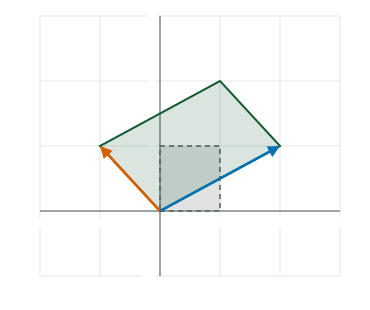
The matrix sends to its first column, , and to its second column, . The unit square becomes a parallelogram of area , the determinant. LevlPrep original diagram.
Part 5 · Step by step
How it works, step by step
→ is multiplication by the matrix , with the input written as a column
Apply to and to →you get the first and second columns of the matrix
Every point moves by the same matrix→the origin stays put, lines stay lines and the grid becomes a grid of parallelograms
Take the determinant of the matrix→its absolute value is the factor by which every area is multiplied; a negative sign means the picture is flipped
Part 6 · Key ideas
Key ideas
A linear transformation of the plane has the form : multiplication by .
The columns of the matrix are and , so a picture of where the unit square goes gives the matrix.
Rotation by counterclockwise: . Reflection across the -axis: . Dilation by : .
Areas are multiplied by ; a negative determinant reverses orientation.
Part 7 · Misconception
A common mistake
The wrong idea: If and , the matrix is .
What actually happens: The images go in as columns, not rows: the matrix is . Check: it sends to its first column, .
Part 8 · Check yourself
Check yourself
Exam-style questions. Anything you miss goes into your review queue.
Graph
A square and its image
A linear transformation sends the unit square (dashed) to the shaded parallelogram. The arrows show and .
LevlPrep original diagram.
1. What is the matrix of ?
Show the answer
The columns are the images: and .
Correct: : Images as columns.
: The images were written as rows; they go in as columns.
: The columns are in the wrong order: the image of the first unit vector comes first.
: , so the bottom right entry is .
2. What is ?
Show the answer
: copies of plus copies of .
Correct: : and .
: This uses the images as rows instead of columns.
: , not .
: This multiplies matching entries; use row times column.
3. What is the area of the shaded parallelogram?
No calculator. Type the exact value (a fraction, π, e or a root is fine).
Show the answer
The unit square (area ) is scaled by .
Answer: 3
4. A triangle of area is transformed by . What is the area of its image?
No calculator. Type the exact value (a fraction, π, e or a root is fine).
Show the answer
Every area is multiplied by : .
Answer: 15
5. Which matrix rotates the plane by counterclockwise?
Show the answer
A quarter turn counterclockwise sends to and to : those are the columns.
Correct: : Columns: images of the two unit vectors.
: This sends to : a clockwise quarter turn.
: This is the reflection across the -axis.
: This is a half turn, by .
6. Which matrix reflects the plane across the line ?
Show the answer
The reflection swaps the coordinates: and .
Correct: : Swap and .
: This reflects across the -axis.
: This reflects across the -axis.
: This reflects across the line .
Part 9 · Summary
Summary
A linear transformation sends to , which is the matrix times the input. Its columns are the images of and . Rotations, reflections, dilations and shears are all linear, and every area is multiplied by the absolute value of the determinant.