Unit 4 · Topic 4.13

Matrices as Functions

A matrix is a function on vectors.

Practice 2: Multiple RepresentationsPractice 3: Communication and Reasoning

Beyond the exam. The AP® Precalculus exam does not test this unit. Many classes teach it, and it prepares you for calculus.

Part 1 · Hook

Why this matters

A game character turns a quarter turn and then mirrors itself. Each move is a matrix, so the pair of moves should be one matrix too. It is, as long as you multiply in the right order. Thinking of matrices as functions, with inputs and outputs, tells you which order, and how to undo a move.

Part 2 · Before you start

What this builds on

Part 3 · Prerequisite check

Quick check before you start

1. If f(x)=2xf(x) = 2x and g(x)=x+1g(x) = x + 1, what is f(g(3))f(g(3))?

  1. 88
  2. 77
  3. 66
  4. 99
Show the answer

Inside first: g(3)=4g(3) = 4, then f(4)=8f(4) = 8.

  • Correct: 88:
  • 77:
  • 66:
  • 99:

2. Which matrix rotates the plane by π2\frac{\pi}{2} counterclockwise?

  1. [0−110]\left[ \begin{matrix} 0 & -1 \\ 1 & 0 \end{matrix} \right]
  2. [01−10]\left[ \begin{matrix} 0 & 1 \\ -1 & 0 \end{matrix} \right]
  3. [100−1]\left[ \begin{matrix} 1 & 0 \\ 0 & -1 \end{matrix} \right]
  4. [0110]\left[ \begin{matrix} 0 & 1 \\ 1 & 0 \end{matrix} \right]
Show the answer

Its columns are the images of ⟨1,0⟩\left\langle 1, 0 \right\rangle and ⟨0,1⟩\left\langle 0, 1 \right\rangle: ⟨0,1⟩\left\langle 0, 1 \right\rangle and ⟨−1,0⟩\left\langle -1, 0 \right\rangle.

  • Correct: [0−110]\left[ \begin{matrix} 0 & -1 \\ 1 & 0 \end{matrix} \right]:
  • [01−10]\left[ \begin{matrix} 0 & 1 \\ -1 & 0 \end{matrix} \right]:
  • [100−1]\left[ \begin{matrix} 1 & 0 \\ 0 & -1 \end{matrix} \right]:
  • [0110]\left[ \begin{matrix} 0 & 1 \\ 1 & 0 \end{matrix} \right]:

Part 4 · See it

See it first

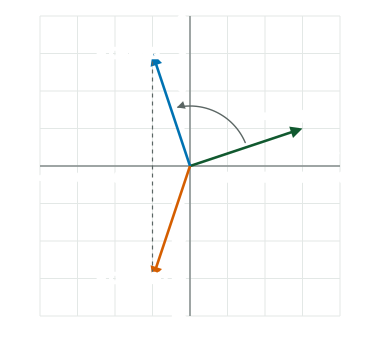
The vector v = <3, 1> in green is rotated a quarter turn counterclockwise to Rv = <-1, 3> in blue, then reflected across the x-axis to FRv = <-1, -3> in vermillion. A curved arrow marks the rotation and a dashed line the reflection.
v=⟨3,1⟩\mathbf{v} = \left\langle 3, 1 \right\rangle is rotated by RR to ⟨−1,3⟩\left\langle -1, 3 \right\rangle, then reflected by FF to ⟨−1,−3⟩\left\langle -1, -3 \right\rangle. The single matrix for "RR, then FF" is FRFR. LevlPrep original diagram.

Part 5 · Step by step

How it works, step by step

  1. A matrix AA takes an input vector v\mathbf{v}it returns the output AvA\mathbf{v}, so AA acts as a function on vectors
  2. Apply BB first, then AAthe output is A(Bv)=(AB)vA(B\mathbf{v}) = (AB)\mathbf{v}: the matrix of the composition is ABAB, written right to left
  3. det⁡A≠0\det A \ne 0A−1A^{-1} is the matrix of the inverse function: it sends each output back to its input
  4. det⁡A=0\det A = 0two inputs share an output, so the transformation has no inverse

Part 6 · Key ideas

Key ideas

  • A 2×22 \times 2 matrix AA is a function from vectors to vectors: input v\mathbf{v}, output AvA\mathbf{v}.
  • Composition of linear transformations: "first BB, then AA" has matrix ABAB. The first move is on the right, next to v\mathbf{v}.
  • The inverse transformation has matrix A−1A^{-1}, and exists exactly when det⁡A≠0\det A \ne 0. To find the input with output w\mathbf{w}, compute A−1wA^{-1}\mathbf{w}.
  • Repeating AA nn times has matrix AnA^n, and det⁡(AB)=det⁡A⋅det⁡B\det(AB) = \det A \cdot \det B.

Part 7 · Misconception

A common mistake

The wrong idea: "Rotate with RR, then reflect with FF" has the matrix RFRF, because RR comes first.

What actually happens: The first move acts on v\mathbf{v} first, so it sits next to v\mathbf{v}: F(Rv)=(FR)vF(R\mathbf{v}) = (FR)\mathbf{v}. Read a product right to left, like f(g(x))f(g(x)).

Part 8 · Check yourself

Check yourself

Exam-style questions. Anything you miss goes into your review queue.

Table

A rotation and a reflection

RR rotates the plane by π2\frac{\pi}{2} counterclockwise and FF reflects it across the xx-axis.

R=[0−110],F=[100−1]R = \left[ \begin{matrix} 0 & -1 \\ 1 & 0 \end{matrix} \right], \qquad F = \left[ \begin{matrix} 1 & 0 \\ 0 & -1 \end{matrix} \right]

1. Which matrix does "rotate with RR, then reflect with FF" in one step?

  1. [0−1−10]\left[ \begin{matrix} 0 & -1 \\ -1 & 0 \end{matrix} \right]
  2. [0110]\left[ \begin{matrix} 0 & 1 \\ 1 & 0 \end{matrix} \right]
  3. [1−11−1]\left[ \begin{matrix} 1 & -1 \\ 1 & -1 \end{matrix} \right]
  4. [01−10]\left[ \begin{matrix} 0 & 1 \\ -1 & 0 \end{matrix} \right]
Show the answer

Rotate first, so RR is on the right: FRFR=[100−1][0−110]= \left[ \begin{matrix} 1 & 0 \\ 0 & -1 \end{matrix} \right]\left[ \begin{matrix} 0 & -1 \\ 1 & 0 \end{matrix} \right]=[0−1−10]= \left[ \begin{matrix} 0 & -1 \\ -1 & 0 \end{matrix} \right].

  • Correct: [0−1−10]\left[ \begin{matrix} 0 & -1 \\ -1 & 0 \end{matrix} \right]: FRFR: the first move on the right.
  • [0110]\left[ \begin{matrix} 0 & 1 \\ 1 & 0 \end{matrix} \right]: This is RFRF: reflect first, then rotate.
  • [1−11−1]\left[ \begin{matrix} 1 & -1 \\ 1 & -1 \end{matrix} \right]: This adds RR and FF; composing multiplies.
  • [01−10]\left[ \begin{matrix} 0 & 1 \\ -1 & 0 \end{matrix} \right]: This is R−1R^{-1}, a clockwise quarter turn.

2. Which matrix does "reflect with FF, then rotate with RR" in one step?

  1. [0110]\left[ \begin{matrix} 0 & 1 \\ 1 & 0 \end{matrix} \right]
  2. [0−1−10]\left[ \begin{matrix} 0 & -1 \\ -1 & 0 \end{matrix} \right]
  3. [0−110]\left[ \begin{matrix} 0 & -1 \\ 1 & 0 \end{matrix} \right]
  4. [1001]\left[ \begin{matrix} 1 & 0 \\ 0 & 1 \end{matrix} \right]
Show the answer

Reflect first, so FF is on the right: RFRF=[0−110][100−1]= \left[ \begin{matrix} 0 & -1 \\ 1 & 0 \end{matrix} \right]\left[ \begin{matrix} 1 & 0 \\ 0 & -1 \end{matrix} \right]=[0110]= \left[ \begin{matrix} 0 & 1 \\ 1 & 0 \end{matrix} \right].

  • Correct: [0110]\left[ \begin{matrix} 0 & 1 \\ 1 & 0 \end{matrix} \right]: Reflect first, so FF sits on the right.
  • [0−1−10]\left[ \begin{matrix} 0 & -1 \\ -1 & 0 \end{matrix} \right]: This is FRFR, the other order.
  • [0−110]\left[ \begin{matrix} 0 & -1 \\ 1 & 0 \end{matrix} \right]: This is RR alone; the reflection is missing.
  • [1001]\left[ \begin{matrix} 1 & 0 \\ 0 & 1 \end{matrix} \right]: The two moves do not cancel; RF≠IRF \ne I.

3. What is the image of ⟨2,1⟩\left\langle 2, 1 \right\rangle when it is rotated with RR and then reflected with FF?

  1. ⟨−1,−2⟩\left\langle -1, -2 \right\rangle
  2. ⟨−1,2⟩\left\langle -1, 2 \right\rangle
  3. ⟨1,2⟩\left\langle 1, 2 \right\rangle
  4. ⟨2,−1⟩\left\langle 2, -1 \right\rangle
Show the answer

R[21]=[−12]R\left[ \begin{matrix} 2 \\ 1 \end{matrix} \right] = \left[ \begin{matrix} -1 \\ 2 \end{matrix} \right], then FF flips the second entry: ⟨−1,−2⟩\left\langle -1, -2 \right\rangle. Or FR[21]FR\left[ \begin{matrix} 2 \\ 1 \end{matrix} \right] directly.

  • Correct: ⟨−1,−2⟩\left\langle -1, -2 \right\rangle: Rotate, then reflect.
  • ⟨−1,2⟩\left\langle -1, 2 \right\rangle: This is after the rotation only.
  • ⟨1,2⟩\left\langle 1, 2 \right\rangle: This is the other order, RFRF.
  • ⟨2,−1⟩\left\langle 2, -1 \right\rangle: This is after the reflection only.

4. The matrix FR=[0−1−10]FR = \left[ \begin{matrix} 0 & -1 \\ -1 & 0 \end{matrix} \right] is a single reflection. Across which line?

  1. y=−xy = -x
  2. y=xy = x
  3. the yy-axis
  4. the xx-axis
Show the answer

FR[xy]=[−y−x]FR\left[ \begin{matrix} x \\ y \end{matrix} \right] = \left[ \begin{matrix} -y \\ -x \end{matrix} \right]: it swaps the coordinates and negates both. Points on y=−xy = -x, such as ⟨1,−1⟩\left\langle 1, -1 \right\rangle, stay put.

  • Correct: y=−xy = -x: ⟨1,−1⟩→⟨1,−1⟩\left\langle 1, -1 \right\rangle \to \left\langle 1, -1 \right\rangle: fixed on y=−xy = -x.
  • y=xy = x: Reflection across y=xy = x is RFRF; it fixes ⟨1,1⟩\left\langle 1, 1 \right\rangle, which FRFR sends to ⟨−1,−1⟩\left\langle -1, -1 \right\rangle.
  • the yy-axis: The yy-axis reflection sends ⟨1,0⟩\left\langle 1, 0 \right\rangle to ⟨−1,0⟩\left\langle -1, 0 \right\rangle; FRFR sends it to ⟨0,−1⟩\left\langle 0, -1 \right\rangle.
  • the xx-axis: That is FF alone; the rotation changes it.

5. In the product ABvAB\mathbf{v}, which transformation acts on v\mathbf{v} first?

  1. BB, the one next to v\mathbf{v}
  2. AA, the one written first
  3. Both at once, so the order makes no difference
  4. Whichever has the larger determinant
Show the answer

ABv=A(Bv)AB\mathbf{v} = A(B\mathbf{v}): BB acts first, like gg in f(g(x))f(g(x)).

  • Correct: BB, the one next to v\mathbf{v}: Right to left.
  • AA, the one written first: Written first, applied last.
  • Both at once, so the order makes no difference: ABAB and BABA usually differ, so the order matters.
  • Whichever has the larger determinant: Determinants do not set the order.

6. A rotation by π6\frac{\pi}{6} counterclockwise is applied three times. Which single matrix does the same?

  1. [0−110]\left[ \begin{matrix} 0 & -1 \\ 1 & 0 \end{matrix} \right]
  2. [01−10]\left[ \begin{matrix} 0 & 1 \\ -1 & 0 \end{matrix} \right]
  3. [−100−1]\left[ \begin{matrix} -1 & 0 \\ 0 & -1 \end{matrix} \right]
  4. [32−121232]\left[ \begin{matrix} \frac{\sqrt{3}}{2} & -\frac{1}{2} \\ \frac{1}{2} & \frac{\sqrt{3}}{2} \end{matrix} \right]
Show the answer

Three turns of π6\frac{\pi}{6} make π2\frac{\pi}{2}, and the rotation by π2\frac{\pi}{2} counterclockwise has columns (0,1)(0, 1) and (−1,0)(-1, 0).

  • Correct: [0−110]\left[ \begin{matrix} 0 & -1 \\ 1 & 0 \end{matrix} \right]: 3⋅π6=π23 \cdot \frac{\pi}{6} = \frac{\pi}{2}.
  • [01−10]\left[ \begin{matrix} 0 & 1 \\ -1 & 0 \end{matrix} \right]: This turns clockwise.
  • [−100−1]\left[ \begin{matrix} -1 & 0 \\ 0 & -1 \end{matrix} \right]: This is a half turn, π\pi.
  • [32−121232]\left[ \begin{matrix} \frac{\sqrt{3}}{2} & -\frac{1}{2} \\ \frac{1}{2} & \frac{\sqrt{3}}{2} \end{matrix} \right]: This is one turn of π6\frac{\pi}{6}, not three.

Part 9 · Summary

Summary

A matrix is a function on vectors. Doing BB and then AA is the single matrix ABAB, read right to left, and repeating AA gives AnA^n. When det⁡A≠0\det A \ne 0, A−1A^{-1} undoes AA and recovers an input from its output; when det⁡A=0\det A = 0, two inputs share an output and nothing can undo it.

Part 10 · Up next

What comes next

Part 11 · Connections

Connections