Implicitly Defined Functions
An implicitly defined function is an equation linking x and y ; its graph is every solution point.
Beyond the exam. The AP® Precalculus exam does not test this unit. Many classes teach it, and it prepares you for calculus.
Part 1 · Hook
Why this matters
Part 2 · Before you start
What this builds on
Part 3 · Prerequisite check
Quick check before you start
1. Solve .
- or
- or
- or
Show the answer
- Correct: or :
- or :
- or :
- :
2. Does the graph of pass the vertical line test?
- No: gives and
- Yes: each gives one
- Yes: it is a parabola
- No: it has no -intercept
Show the answer
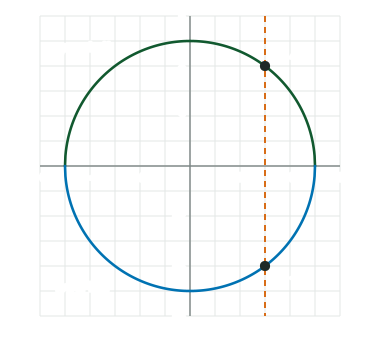
The vertical line meets the graph at and , two points, so is not a function of .
- Correct: No: gives and :
- Yes: each gives one :
- Yes: it is a parabola:
- No: it has no -intercept:
Part 4 · See it
See it first
Part 5 · Step by step
How it works, step by step
- An equation links and without solving for its graph is every point that makes the equation true
- Substitute a value of you get an equation in alone; each solution gives a point of the curve
- Some gives two or more values of the curve is not the graph of a function of , but it can be split into pieces that are
- For some the equation in has no real solutionthe curve has no points above or below that , which bounds how far left or right it reaches
Part 6 · Key ideas
Key ideas
- An implicitly defined function is given by an equation in and , such as , instead of . Its graph is the set of solutions.
- To test a point, substitute both coordinates. To find points, substitute one coordinate and solve for the other.
- If one gives two -values, the curve is not a function of . Solving for (sometimes with the quadratic formula) splits it into functions.
- An implicit equation can define a function you cannot easily solve for, such as .
Part 7 · Misconception
A common mistake
The wrong idea: An equation that is not written as cannot define a function.
What actually happens: What matters is whether each gives one . gives exactly one for each , so it defines as a function of even though the formula is hard to write.
Part 8 · Check yourself
Check yourself
Exam-style questions. Anything you miss goes into your review queue.
Table
Points on the curve
| −2 | −1 | 0 | 1 | 2 | |
|---|---|---|---|---|---|
| −10 | −2 | 0 | 2 | 10 |
1. Find for the point of the curve with .
No calculator. Type the exact value (a fraction, π, e or a root is fine).
Show the answer
- Answer: 30
2. Which value of goes with ?
- and
Show the answer
The table shows gives . No other works, since increases as increases.
- Correct: : .
- : This puts in for ; is the -value.
- : .
- and : gives , not .
3. Does define as a function of ?
- Yes: increases with , so each has one
- No: it is not written in the form , so it is no function
- No: is cubed, so has three values of
- Yes: the table lists five different values of
Show the answer
and both increase with , so their sum does too. Two different -values give two different -values, so each has one .
- Correct: Yes: increases with , so each has one : An increasing left side means no repeats.
- No: it is not written in the form , so it is no function: The form does not decide it; one per does.
- No: is cubed, so has three values of : has one real solution, .
- Yes: the table lists five different values of : Five rows cannot show what happens for every ; the reason is that increases.
4. The average rate of change of with respect to is between and and between and . What does this suggest?
- The curve gets less steep as increases past
- The curve gets steeper as increases past
- decreases as increases past
- The curve is a straight line through the origin
Show the answer
Both rates are positive, so increases, but the second is smaller: each unit of adds less to . The curve flattens.
- Correct: The curve gets less steep as increases past : A smaller positive slope means less steep.
- The curve gets steeper as increases past : Steeper would need a larger slope; .
- decreases as increases past : Positive rates mean increases with .
- The curve is a straight line through the origin: A line has one slope; these differ.
5. What is an implicitly defined function?
- An equation linking and , not solved for
- A function whose formula has no in it
- A function given by a table of values and nothing else
- A pair of formulas and for a curve
Show the answer
"Implicit" means the relationship is stated as an equation linking and ; the graph is every solution point.
- Correct: An equation linking and , not solved for : An equation links and ; points are its solutions.
- A function whose formula has no in it: A formula with no is a constant function, written explicitly.
- A function given by a table of values and nothing else: A table gives values, not an equation.
- A pair of formulas and for a curve: That describes a parametric function.
6. Which points of have ?
- and
- , the point above the axis
- and
- and
Show the answer
, so and or .
- Correct: and : Both square roots of .
- , the point above the axis: also has the root .
- and : is ; take the square root.
- and : subtracts , not .
Part 9 · Summary
Summary
Part 10 · Up next
What comes next
Part 11 · Connections