Unit 4 · Topic 4.6

Conic Sections

Conic sections are the parabola, the ellipse and the hyperbola, all implicitly defined curves.

Practice 1: Procedural and Symbolic FluencyPractice 2: Multiple Representations

Beyond the exam. The AP® Precalculus exam does not test this unit. Many classes teach it, and it prepares you for calculus.

Part 1 · Hook

Why this matters

Slice a cone with a flat cut and the edge of the cut is a curve. Tilt the cut and the curve changes: a circle, a stretched oval, a U-shape, or a pair of open branches. These conic sections show up as satellite dishes, planet orbits and the shadow a lampshade throws on a wall.

Part 2 · Before you start

What this builds on

Part 3 · Prerequisite check

Quick check before you start

1. What is the vertex of y=2(x−3)2+1y = 2(x - 3)^2 + 1?

  1. (3,1)(3, 1)
  2. (−3,1)(-3, 1)
  3. (1,3)(1, 3)
  4. (3,2)(3, 2)
Show the answer

y=a(x−h)2+ky = a(x - h)^2 + k has vertex (h,k)=(3,1)(h, k) = (3, 1).

  • Correct: (3,1)(3, 1):
  • (−3,1)(-3, 1):
  • (1,3)(1, 3):
  • (3,2)(3, 2):

2. Which points of x2+y2=9x^2 + y^2 = 9 have y=0y = 0?

  1. (3,0)(3, 0) and (−3,0)(-3, 0)
  2. (9,0)(9, 0) and (−9,0)(-9, 0)
  3. (0,3)(0, 3) and (0,−3)(0, -3)
  4. (3,0)(3, 0), the one point on the right
Show the answer

x2=9x^2 = 9, so x=3x = 3 or x=−3x = -3.

  • Correct: (3,0)(3, 0) and (−3,0)(-3, 0):
  • (9,0)(9, 0) and (−9,0)(-9, 0):
  • (0,3)(0, 3) and (0,−3)(0, -3):
  • (3,0)(3, 0), the one point on the right:

Part 4 · See it

See it first
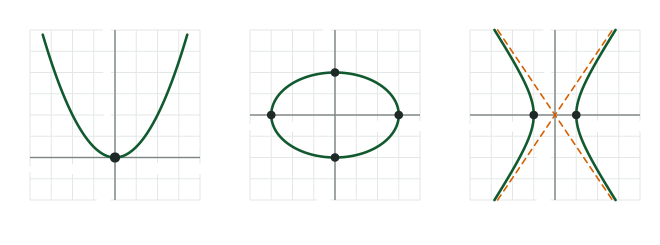
Three graphs. Left: the parabola y = 0.5 x squared with its vertex at the origin. Middle: the ellipse x squared over 9 plus y squared over 4 = 1, centered at the origin, with vertices (3, 0) and (-3, 0) and the ends of the short axis at (0, 2) and (0, -2). Right: the hyperbola x squared minus y squared over 2.25 = 1, with vertices (1, 0) and (-1, 0), two branches opening left and right, and dashed asymptotes y = 1.5x and y = -1.5x.
A parabola, an ellipse and a hyperbola. The ellipse reaches 33 across and 22 up from its center; the hyperbola has two branches that approach the dashed asymptotes. LevlPrep original diagram.

Part 5 · Step by step

How it works, step by step

  1. Only one variable is squared, as in y=a(x−h)2+ky = a(x - h)^2 + kthe curve is a parabola with vertex (h,k)(h, k)
  2. Both squares are added and set equal to 11: (x−h)2a2+(y−k)2b2\frac{(x - h)^2}{a^2} + \frac{(y - k)^2}{b^2}=1= 1an ellipse with center (h,k)(h, k), reaching aa units across and bb units up and down
  3. The squares are subtracted: (x−h)2a2−(y−k)2b2\frac{(x - h)^2}{a^2} - \frac{(y - k)^2}{b^2}=1= 1a hyperbola with center (h,k)(h, k), opening left and right, with asymptotes of slope ±ba\pm\frac{b}{a}
  4. The equation is not in standard formcomplete the square in each variable, then read the conic off the signs

Part 6 · Key ideas

Key ideas

  • Parabola: y−k=a(x−h)2y - k = a(x - h)^2 opens up or down; x−h=a(y−k)2x - h = a(y - k)^2 opens right (a>0a > 0) or left.
  • Ellipse: (x−h)2a2+(y−k)2b2\frac{(x - h)^2}{a^2} + \frac{(y - k)^2}{b^2}=1= 1, center (h,k)(h, k); vertices aa units across and bb units up and down. a=ba = b gives a circle.
  • Hyperbola: (x−h)2a2−(y−k)2b2\frac{(x - h)^2}{a^2} - \frac{(y - k)^2}{b^2}=1= 1 opens left and right, vertices (h±a,k)(h \pm a, k), asymptotes y−k=±ba(x−h)y - k = \pm\frac{b}{a}(x - h). With yy first it opens up and down.
  • Both squares with the same sign: ellipse. Opposite signs: hyperbola. One square: parabola.

Part 7 · Misconception

A common mistake

The wrong idea: In (x−1)216+(y+2)24\frac{(x - 1)^2}{16} + \frac{(y + 2)^2}{4}=1= 1 the ellipse reaches 16 units left and right of its center.

What actually happens: The denominators are squares. a2=16a^2 = 16, so it reaches a=4a = 4 units left and right, and b2=4b^2 = 4 gives 22 units up and down.

Part 8 · Check yourself

Check yourself

Exam-style questions. Anything you miss goes into your review queue.

Graph

An ellipse

−4−3−2−1123456−5−4−3−2−11xy

1. What is the center of the ellipse?

  1. (1,−2)(1, -2)
  2. (−1,2)(-1, 2)
  3. (1,2)(1, 2)
  4. (−2,1)(-2, 1)
Show the answer

The ellipse runs from x=−3x = -3 to x=5x = 5 and from y=−4y = -4 to y=0y = 0. The middle of each range is x=1x = 1 and y=−2y = -2.

  • Correct: (1,−2)(1, -2): Midpoints of [−3,5][-3, 5] and [−4,0][-4, 0].
  • (−1,2)(-1, 2): Both signs are flipped; the ellipse is below the xx-axis.
  • (1,2)(1, 2): The center is below the axis, at y=−2y = -2.
  • (−2,1)(-2, 1): The coordinates are swapped.

2. Which equation does the ellipse have?

  1. (x−1)216+(y+2)24\frac{(x - 1)^2}{16} + \frac{(y + 2)^2}{4}=1= 1
  2. (x−1)24+(y+2)216\frac{(x - 1)^2}{4} + \frac{(y + 2)^2}{16}=1= 1
  3. (x+1)216+(y−2)24\frac{(x + 1)^2}{16} + \frac{(y - 2)^2}{4}=1= 1
  4. (x−1)24+(y+2)22\frac{(x - 1)^2}{4} + \frac{(y + 2)^2}{2}=1= 1
Show the answer

Center (1,−2)(1, -2); it reaches 44 units across, so a2=16a^2 = 16, and 22 units up and down, so b2=4b^2 = 4.

  • Correct: (x−1)216+(y+2)24\frac{(x - 1)^2}{16} + \frac{(y + 2)^2}{4}=1= 1: Center (1,−2)(1, -2), a=4a = 4, b=2b = 2.
  • (x−1)24+(y+2)216\frac{(x - 1)^2}{4} + \frac{(y + 2)^2}{16}=1= 1: This one is taller than wide; the graph is wider.
  • (x+1)216+(y−2)24\frac{(x + 1)^2}{16} + \frac{(y - 2)^2}{4}=1= 1: (x+1)(x + 1) and (y−2)(y - 2) put the center at (−1,2)(-1, 2).
  • (x−1)24+(y+2)22\frac{(x - 1)^2}{4} + \frac{(y + 2)^2}{2}=1= 1: The denominators are a2a^2 and b2b^2, not aa and bb.

3. Which points are the vertices at the ends of the long axis?

  1. (5,−2)(5, -2) and (−3,−2)(-3, -2)
  2. (1,0)(1, 0) and (1,−4)(1, -4)
  3. (17,−2)(17, -2) and (−15,−2)(-15, -2)
  4. (5,2)(5, 2) and (−3,2)(-3, 2)
Show the answer

The long axis is horizontal: (1±4,−2)(1 \pm 4, -2), which is (5,−2)(5, -2) and (−3,−2)(-3, -2).

  • Correct: (5,−2)(5, -2) and (−3,−2)(-3, -2): 44 units left and right of (1,−2)(1, -2).
  • (1,0)(1, 0) and (1,−4)(1, -4): These are the ends of the short axis, 22 units up and down.
  • (17,−2)(17, -2) and (−15,−2)(-15, -2): Move a=4a = 4 units, not a2=16a^2 = 16.
  • (5,2)(5, 2) and (−3,2)(-3, 2): The vertices share the center's yy-coordinate, −2-2.

4. What is the length of the long axis of the ellipse?

No calculator. Type the exact value (a fraction, π, e or a root is fine).

Show the answer

From (−3,−2)(-3, -2) to (5,−2)(5, -2) is 5−(−3)=85 - (-3) = 8, which is 2a=2(4)2a = 2(4).

  • Answer: 8

5. Describe the graph of y2−4x2=16y^2 - 4x^2 = 16.

  1. A hyperbola opening up and down
  2. A hyperbola opening left and right
  3. An ellipse centered at the origin
  4. A parabola opening to the right
Show the answer

Opposite signs: a hyperbola. Divide by 1616: y216−x24=1\frac{y^2}{16} - \frac{x^2}{4} = 1. The yy term is positive, so it opens up and down, with vertices (0,±4)(0, \pm 4).

  • Correct: A hyperbola opening up and down: yy term positive: up and down.
  • A hyperbola opening left and right: Left and right needs the xx term positive.
  • An ellipse centered at the origin: An ellipse needs the same sign on both squares.
  • A parabola opening to the right: Both variables are squared, so it is not a parabola.

6. Rewrite x2+y2−6x+4y−3x^2 + y^2 - 6x + 4y - 3=0= 0 by completing the square. What is the graph?

  1. A circle with center (3,−2)(3, -2) and radius 44
  2. A circle with center (−3,2)(-3, 2) and radius 44
  3. A circle with center (3,−2)(3, -2) and radius 1616
  4. A circle with center (3,−2)(3, -2) and radius 3\sqrt{3}
Show the answer

(x2−6x+9)(x^2 - 6x + 9)+(y2+4y+4)+ (y^2 + 4y + 4)=3= 3+9+ 9+4+ 4, so (x−3)2+(y+2)2=16(x - 3)^2 + (y + 2)^2 = 16: center (3,−2)(3, -2), radius 44.

  • Correct: A circle with center (3,−2)(3, -2) and radius 44: (x−3)2+(y+2)2=16(x - 3)^2 + (y + 2)^2 = 16.
  • A circle with center (−3,2)(-3, 2) and radius 44: (x−3)2(x - 3)^2 means the center has x=3x = 3.
  • A circle with center (3,−2)(3, -2) and radius 1616: 1616 is the radius squared.
  • A circle with center (3,−2)(3, -2) and radius 3\sqrt{3}: Add the 99 and 44 to the right side too: 3+9+4=163 + 9 + 4 = 16.

Part 9 · Summary

Summary

Conic sections are the parabola, the ellipse and the hyperbola, all implicitly defined curves. In standard form you read off the center or vertex, the distances aa and bb from the denominators' square roots, and for a hyperbola the asymptotes y−k=±ba(x−h)y - k = \pm\frac{b}{a}(x - h). The signs of the squared terms tell which conic you have.

Part 10 · Up next

What comes next

Part 11 · Connections

Connections