Unit 4 · Topic 4.4

Parametrically Defined Circles and Lines

(h + rcos t, k + rsin t) for 0 ≤ t ≤ 2π traces the circle with center (h, k) and radius r once counterclockwise, starting at (h + r, k) .

Practice 1: Procedural and Symbolic FluencyPractice 2: Multiple Representations

Beyond the exam. The AP® Precalculus exam does not test this unit. Many classes teach it, and it prepares you for calculus.

Part 1 · Hook

Why this matters

A seat on a Ferris wheel, the tip of a clock hand and a satellite in a round orbit all trace circles, and a drone flying from one landing pad to another traces a straight segment. Parametric equations describe both, and they also say where the trip starts, which way it goes and how long it takes.

Part 2 · Before you start

What this builds on

Part 3 · Prerequisite check

Quick check before you start

1. What are the coordinates of the point on the unit circle at angle π2\frac{\pi}{2}?

  1. (0,1)(0, 1)
  2. (1,0)(1, 0)
  3. (−1,0)(-1, 0)
  4. (0,−1)(0, -1)
Show the answer

(cos⁡π2,sin⁡π2)(\cos\frac{\pi}{2}, \sin\frac{\pi}{2})=(0,1)= (0, 1), a quarter turn counterclockwise from (1,0)(1, 0).

  • Correct: (0,1)(0, 1):
  • (1,0)(1, 0):
  • (−1,0)(-1, 0):
  • (0,−1)(0, -1):

2. What is the slope of the line through (1,4)(1, 4) and (5,1)(5, 1)?

  1. −34-\frac{3}{4}
  2. −43-\frac{4}{3}
  3. 34\frac{3}{4}
  4. −3-3
Show the answer

1−45−1=−34\frac{1 - 4}{5 - 1} = \frac{-3}{4}.

  • Correct: −34-\frac{3}{4}:
  • −43-\frac{4}{3}:
  • 34\frac{3}{4}:
  • −3-3:

3. What is the center of the circle (x−2)2+(y+1)2=9(x - 2)^2 + (y + 1)^2 = 9?

  1. (2,−1)(2, -1)
  2. (−2,1)(-2, 1)
  3. (2,1)(2, 1)
  4. (3,3)(3, 3)
Show the answer

(x−h)2+(y−k)2=r2(x - h)^2 + (y - k)^2 = r^2 has center (h,k)(h, k); y+1=y−(−1)y + 1 = y - (-1), so k=−1k = -1.

  • Correct: (2,−1)(2, -1):
  • (−2,1)(-2, 1):
  • (2,1)(2, 1):
  • (3,3)(3, 3):

Part 4 · See it

See it first

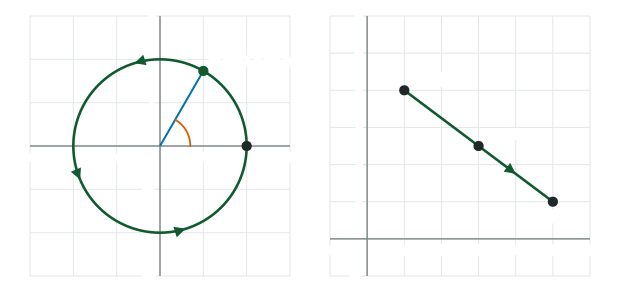
Left: the circle x(t) = 2 cos t, y(t) = 2 sin t. The radius to the point at t = pi/3 makes angle t with the positive x-axis; the trip starts at (2, 0) when t = 0 and arrows show counterclockwise travel. Right: the segment x(t) = 1 + 4t, y(t) = 4 minus 3t from (1, 4) at t = 0 to (5, 1) at t = 1, with the midpoint (3, 2.5) at t = 0.5.
Left: (2cos⁡t,2sin⁡t)(2\cos t, 2\sin t) starts at (2,0)(2, 0) and goes counterclockwise; tt is the angle. Right: (1+4t,4−3t)(1 + 4t, 4 - 3t) for 0≤t≤10 \le t \le 1 goes from (1,4)(1, 4) to (5,1)(5, 1). LevlPrep original diagram.

Part 5 · Step by step

How it works, step by step

  1. x(t)=h+rcos⁡tx(t) = h + r\cos t and y(t)=k+rsin⁡ty(t) = k + r\sin tevery point is rr units from (h,k)(h, k), so the curve is a circle with center (h,k)(h, k) and radius rr
  2. tt runs from 00 to 2π2\pithe point starts at (h+r,k)(h + r, k) and goes once around counterclockwise
  3. Replace sin⁡t\sin t with −sin⁡t-\sin tthe same circle from the same start, but clockwise
  4. xx and yy are both linear functions of ttthe points lie on a line whose slope is the rate of yy over the rate of xx

Part 6 · Key ideas

Key ideas

  • A parametric circle: x(t)=h+rcos⁡tx(t) = h + r\cos t, y(t)=k+rsin⁡ty(t) = k + r\sin t, 0≤t≤2π0 \le t \le 2\pi, traces the circle with center (h,k)(h, k) and radius rr once, counterclockwise from (h+r,k)(h + r, k).
  • Change the direction with k−rsin⁡tk - r\sin t; change the speed with cos⁡(bt)\cos(bt) and sin⁡(bt)\sin(bt); trace an arc with a shorter interval of tt.
  • A segment from (x1,y1)(x_1, y_1) to (x2,y2)(x_2, y_2): x(t)x(t)=x1+(x2−x1)t= x_1 + (x_2 - x_1)t, y(t)y(t)=y1+(y2−y1)t= y_1 + (y_2 - y_1)t, 0≤t≤10 \le t \le 1.
  • If x(t)=x0+atx(t) = x_0 + at and y(t)=y0+bty(t) = y_0 + bt with a≠0a \ne 0, the line has slope ba\frac{b}{a}.

Part 7 · Misconception

A common mistake

The wrong idea: (3+2cos⁡t,1+2sin⁡t)(3 + 2\cos t, 1 + 2\sin t) is a circle of radius 33 centered at (2,1)(2, 1).

What actually happens: The number added is the center's coordinate and the number multiplying cos⁡t\cos t and sin⁡t\sin t is the radius: center (3,1)(3, 1), radius 22.

Part 8 · Check yourself

Check yourself

Exam-style questions. Anything you miss goes into your review queue.

Graph

A circle with a starting point

A point travels once around the circle shown for 0≤t≤2π0 \le t \le 2\pi, starting at the marked point and moving counterclockwise.
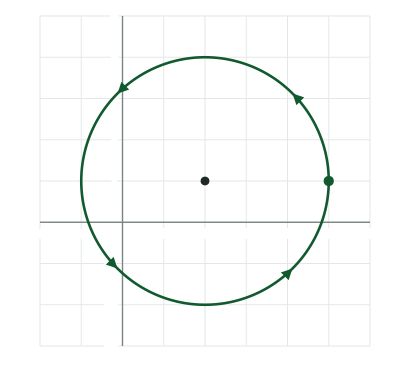
A circle with center (2, 1) and radius 3. The trip starts at (5, 1), marked t = 0, and arrows show counterclockwise travel. The center is marked.
LevlPrep original diagram.

1. Which parametric function traces the circle as shown?

  1. (2+3cos⁡t,1+3sin⁡t)(2 + 3\cos t, 1 + 3\sin t)
  2. (2+3cos⁡t,1−3sin⁡t)(2 + 3\cos t, 1 - 3\sin t)
  3. (2+3sin⁡t,1+3cos⁡t)(2 + 3\sin t, 1 + 3\cos t)
  4. (2+9cos⁡t,1+9sin⁡t)(2 + 9\cos t, 1 + 9\sin t)
Show the answer

The center is (2,1)(2, 1) and the radius is 33. (2+3cos⁡t,1+3sin⁡t)(2 + 3\cos t, 1 + 3\sin t) starts at (5,1)(5, 1) when t=0t = 0 and moves counterclockwise.

  • Correct: (2+3cos⁡t,1+3sin⁡t)(2 + 3\cos t, 1 + 3\sin t): Center (2,1)(2, 1), radius 33, start (5,1)(5, 1), counterclockwise.
  • (2+3cos⁡t,1−3sin⁡t)(2 + 3\cos t, 1 - 3\sin t): With 1−3sin⁡t1 - 3\sin t the point moves down first from (5,1)(5, 1): clockwise.
  • (2+3sin⁡t,1+3cos⁡t)(2 + 3\sin t, 1 + 3\cos t): This starts at (2,4)(2, 4), the top, and moves clockwise.
  • (2+9cos⁡t,1+9sin⁡t)(2 + 9\cos t, 1 + 9\sin t): The radius multiplies cos⁡t\cos t and sin⁡t\sin t; 99 is the radius squared.

2. Where is the point when t=π2t = \frac{\pi}{2}?

  1. (2,4)(2, 4)
  2. (−1,1)(-1, 1)
  3. (2,−2)(2, -2)
  4. (5,4)(5, 4)
Show the answer

xx=2+3cos⁡π2= 2 + 3\cos\frac{\pi}{2}=2+0= 2 + 0=2= 2 and yy=1+3sin⁡π2= 1 + 3\sin\frac{\pi}{2}=1+3= 1 + 3=4= 4: the top of the circle, a quarter turn counterclockwise from the start.

  • Correct: (2,4)(2, 4): A quarter turn counterclockwise from (5,1)(5, 1) is the top, (2,4)(2, 4).
  • (−1,1)(-1, 1): (−1,1)(-1, 1) is at t=πt = \pi, half a turn.
  • (2,−2)(2, -2): (2,−2)(2, -2) is at t=3π2t = \frac{3\pi}{2}, the bottom.
  • (5,4)(5, 4): x=2+3cos⁡π2=2x = 2 + 3\cos\frac{\pi}{2} = 2, not 55.

3. For which values of tt is the point on the upper half of the circle, y≥1y \ge 1?

  1. 0≤t≤π0 \le t \le \pi
  2. π2≤t≤3π2\frac{\pi}{2} \le t \le \frac{3\pi}{2}
  3. π≤t≤2π\pi \le t \le 2\pi
  4. 0≤t≤π20 \le t \le \frac{\pi}{2}
Show the answer

y=1+3sin⁡t≥1y = 1 + 3\sin t \ge 1 exactly when sin⁡t≥0\sin t \ge 0, which on [0,2π][0, 2\pi] is 0≤t≤π0 \le t \le \pi.

  • Correct: 0≤t≤π0 \le t \le \pi: sin⁡t≥0\sin t \ge 0 on [0,π][0, \pi].
  • π2≤t≤3π2\frac{\pi}{2} \le t \le \frac{3\pi}{2}: On this interval cos⁡t≤0\cos t \le 0: the left half.
  • π≤t≤2π\pi \le t \le 2\pi: Here sin⁡t≤0\sin t \le 0: the lower half.
  • 0≤t≤π20 \le t \le \frac{\pi}{2}: This is only the upper right quarter.

4. Which change makes the point travel clockwise around the same circle, starting at the same point?

  1. Replace 1+3sin⁡t1 + 3\sin t with 1−3sin⁡t1 - 3\sin t
  2. Replace 2+3cos⁡t2 + 3\cos t with 2−3cos⁡t2 - 3\cos t
  3. Let tt run from 00 to 4π4\pi instead
  4. Replace the 33 with −3-3 in both coordinates
Show the answer

With y=1−3sin⁡ty = 1 - 3\sin t the start is still (5,1)(5, 1), but just after t=0t = 0 the point moves down: clockwise.

  • Correct: Replace 1+3sin⁡t1 + 3\sin t with 1−3sin⁡t1 - 3\sin t: xx is unchanged, so the start stays (5,1)(5, 1), and the point moves down first.
  • Replace 2+3cos⁡t2 + 3\cos t with 2−3cos⁡t2 - 3\cos t: This starts at (−1,1)(-1, 1), a different point.
  • Let tt run from 00 to 4π4\pi instead: This goes around twice, still counterclockwise.
  • Replace the 33 with −3-3 in both coordinates: This starts at (−1,1)(-1, 1) and still goes counterclockwise.

5. How does (cos⁡t,sin⁡t)(\cos t, \sin t) for 0≤t≤2π0 \le t \le 2\pi trace the unit circle?

  1. It starts at (1,0)(1, 0) and goes once around counterclockwise
  2. It starts at (0,1)(0, 1) and goes once around clockwise
  3. It starts at (1,0)(1, 0) and goes once around clockwise
  4. It starts at (0,1)(0, 1) and goes once around counterclockwise
Show the answer

At t=0t = 0 the point is (cos⁡0,sin⁡0)=(1,0)(\cos 0, \sin 0) = (1, 0); at t=π2t = \frac{\pi}{2} it is (0,1)(0, 1). Right to top is counterclockwise.

  • Correct: It starts at (1,0)(1, 0) and goes once around counterclockwise: (1,0)(1, 0) then (0,1)(0, 1): counterclockwise.
  • It starts at (0,1)(0, 1) and goes once around clockwise: (0,1)(0, 1) is the start of (sin⁡t,cos⁡t)(\sin t, \cos t).
  • It starts at (1,0)(1, 0) and goes once around clockwise: From (1,0)(1, 0) the point rises toward (0,1)(0, 1), which is counterclockwise.
  • It starts at (0,1)(0, 1) and goes once around counterclockwise: At t=0t = 0 the point is (1,0)(1, 0), not (0,1)(0, 1).

6. Describe the trip traced by (4sin⁡t,4cos⁡t)(4\sin t, 4\cos t) for 0≤t≤2π0 \le t \le 2\pi.

  1. It starts at (0,4)(0, 4) and goes once around clockwise
  2. It starts at (4,0)(4, 0) and goes once around counterclockwise
  3. It starts at (0,4)(0, 4) and goes once around counterclockwise
  4. It starts at (4,0)(4, 0) and goes once around clockwise
Show the answer

At t=0t = 0: (0,4)(0, 4), the top. At t=π2t = \frac{\pi}{2}: (4,0)(4, 0), the right side. Top to right is clockwise.

  • Correct: It starts at (0,4)(0, 4) and goes once around clockwise: Top, then right: clockwise.
  • It starts at (4,0)(4, 0) and goes once around counterclockwise: That describes (4cos⁡t,4sin⁡t)(4\cos t, 4\sin t); here sine comes first.
  • It starts at (0,4)(0, 4) and goes once around counterclockwise: From the top the point moves to the right side, which is clockwise.
  • It starts at (4,0)(4, 0) and goes once around clockwise: At t=0t = 0, x=4sin⁡0=0x = 4\sin 0 = 0, so the start is (0,4)(0, 4).

Part 9 · Summary

Summary

(h+rcos⁡t,k+rsin⁡t)(h + r\cos t, k + r\sin t) for 0≤t≤2π0 \le t \le 2\pi traces the circle with center (h,k)(h, k) and radius rr once counterclockwise, starting at (h+r,k)(h + r, k). A segment from PP to QQ is P+(Q−P)tP + (Q - P)t for 0≤t≤10 \le t \le 1, coordinate by coordinate. Both describe not only a set of points but a trip along it.

Part 10 · Up next

What comes next

Part 11 · Connections

Connections