Unit 4 · Topic 4.10
Matrices
A matrix is a rectangle of numbers with dimensions rows by columns.
Practice 1: Procedural and Symbolic Fluency
Beyond the exam. The AP® Precalculus exam does not test this unit. Many classes teach it, and it prepares you for calculus.
Part 1 · Hook
Why this matters
A food truck sells three items on two days. A table of how many it sold, times a list of prices, gives each day's revenue in one step. That rectangular table is a matrix, and the "row times column" rule for multiplying matrices is exactly the arithmetic the food truck owner would do by hand.
Part 2 · Prerequisite check
Quick check before you start
1. What is ?
Show the answer
Multiply matching components and add: .
- Correct: :
- :
- :
- :
2. Solve the system , .
- ,
- ,
- ,
- ,
Show the answer
Adding the equations gives , so and .
- Correct: , :
- , :
- , :
- , :
Part 4 · Step by step
How it works, step by step
- A matrix has rows and columns→its dimensions are , rows first
- The number of columns of equals the number of rows of → is defined; an times an gives an
- Take row of and column of →multiply matching entries and add: that is the entry in row , column of
- Swap the order of the factors→ usually differs from , or is undefined at all
Part 5 · Key ideas
Key ideas
- A matrix is a rectangular array of numbers. An matrix has rows and columns; is the entry in row , column .
- Add matrices of the same dimensions entry by entry; a number times a matrix multiplies every entry.
- Matrix multiplication: entry of is row of times column of , multiplied entry by entry and added. It needs columns of = rows of .
- Order matters: usually . The identity gives .
Part 6 · Misconception
A common mistake
The wrong idea: To multiply two matrices, multiply the entries in the same positions.
What actually happens: Each entry of the product combines a whole row with a whole column. Multiplying matching positions is a different operation, and it does not give the revenue, the combined transformation or anything else the product is used for.
Part 7 · Check yourself
Check yourself
Exam-style questions. Anything you miss goes into your review queue.
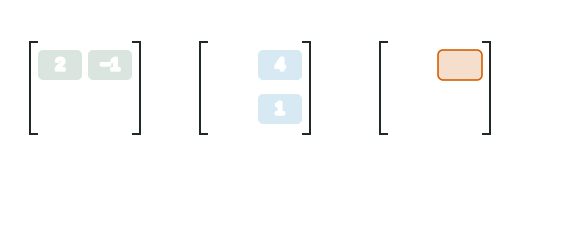
Table
Three matrices
1. What is ?
Show the answer
Row 1 of with each column of : and . Row 2: and .
- Correct: : Row times column for each of the four entries.
- : This is ; the order is reversed.
- : This multiplies entries in matching positions; use rows times columns.
- : Row 2, column 2: .
2. What is the entry in row 1, column 2 of ?
No calculator. Type the exact value (a fraction, π, e or a root is fine).
Show the answer
Row 1 of is and column 2 of is : .
3. Which products are defined? Select all that apply.
Show the answer
and are ; is . A product needs the inside numbers to match.
- Correct: : : inside .
- Correct: : : inside .
- : : inside .
- : : inside .
4. What are the dimensions of ?
Show the answer
: the outside numbers give .
- Correct: : Rows of by columns of .
- : Rows come first: has rows, has columns.
- : has columns, so the product does too.
- : has rows, so the product does too.
5. What are the dimensions of ?
Show the answer
Two rows and three columns: , rows first.
- Correct: : Rows by columns.
- : Rows come first: there are rows.
- : Count rows and columns, not entries.
- : There are columns.
6. What is ?
Show the answer
Row 1: . Row 2: . A times a is .
- Correct: : Each row times the column.
- : This multiplies matching positions ( and ); use whole rows.
- : This uses columns of the first matrix instead of rows.
- : The product is , a column, not a row.
Part 8 · Summary
Summary
A matrix is a rectangle of numbers with dimensions rows by columns. Matrices of the same size add entry by entry. A product
is defined when
has as many columns as
has rows; each entry is a row of
times a column of
. The order of the factors matters.
Part 9 · Up next
What comes next
Part 10 · Connections
Connections