Parametric Functions and Rates of Change
For a parametric function on [t_1, t_2] , the average rates of change of x(t) and y(t) say how fast each coordinate changed per unit of t .
Beyond the exam. The AP® Precalculus exam does not test this unit. Many classes teach it, and it prepares you for calculus.
Part 1 · Hook
Why this matters
Part 2 · Before you start
What this builds on
Part 3 · Prerequisite check
Quick check before you start
1. What is the average rate of change of on ?
Show the answer
- Correct: :
- :
- :
- :
2. For and , where is the point at ?
Show the answer
and .
- Correct: :
- :
- :
- :
Part 4 · See it
See it first
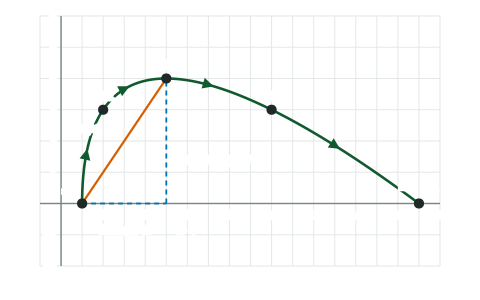
Part 5 · Step by step
How it works, step by step
- Pick an interval of the parameter, find the two points and
- Divide the change in by the average rate of change of on ; do the same for
- Divide the change in by the change in the slope of the segment joining the two points, how steep the path is there on average
- The change in is but changesthe segment is vertical and its slope is undefined
Part 6 · Key ideas
Key ideas
- The average rate of change of on is ; the same for . Units: units of per unit of .
- The slope of the segment joining the two points is : the average rate of change of with respect to .
- That slope equals (rate of ) divided by (rate of ), as long as the change in is not .
- Over equal intervals of , average rates that increase mean the rate of change is increasing.
Part 7 · Misconception
A common mistake
The wrong idea: The slope of a parametric path between two points is .
What actually happens: That is the average rate of change of with respect to . The slope of the path compares with : divide the change in by the change in .
Part 8 · Check yourself
Check yourself
Exam-style questions. Anything you miss goes into your review queue.
Graph
The curve
The curve , for , with the points for marked.
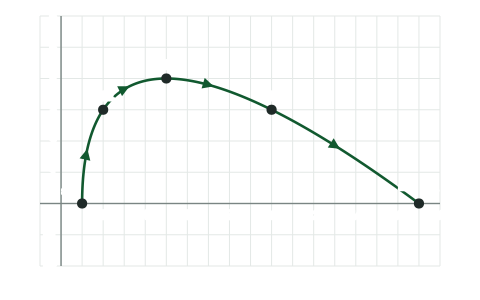
1. What is the slope of the segment joining the points for and ?
Show the answer
The points are and . Slope
- Correct: : Change in is , change in is : slope .
- : is the average rate of change of with respect to , .
- : is the change in alone; divide by the change in .
- : This divides the change in by the change in .
2. The points for and are and . Which statement is true?
- The segment has slope , though the point moved right
- The point did not move between and
- The slope is undefined, since the -values are equal
- The average rate of change of on is
Show the answer
The change in is and the change in is , so the slope is . The segment is horizontal, but the point moved right and went up and down in between.
- Correct: The segment has slope , though the point moved right: Equal -values, different -values: a horizontal segment.
- The point did not move between and : went from to , so the point moved.
- The slope is undefined, since the -values are equal: Undefined slope comes from a change in of ; here the change in is .
- The average rate of change of on is : The rate of is .
3. Find the slope of the segment joining the points for and .
No calculator. Type the exact value (a fraction, π, e or a root is fine).
Show the answer
The points are and . Slope
- Answer: ≈ -0.333
4. On which intervals is the average rate of change of equal to ? Select all that apply.
Show the answer
gives at to . On : . On : .
- Correct: : .
- Correct: : .
- : .
- : .
5. A curve is given by and . Find the slope of the segment joining the points for and .
No calculator. Type the exact value (a fraction, π, e or a root is fine).
Show the answer
At : . At : . Slope
- Answer: ≈ -0.667
6. Between and , a point ends up farther left and higher than it started. What is the sign of the slope of the segment joining its two positions?
- Negative
- Positive
- Zero
- Undefined
Show the answer
Farther left: change in is negative. Higher: change in is positive. Positive over negative is negative.
- Correct: Negative: is negative.
- Positive: Positive needs both changes with the same sign, such as right and up.
- Zero: Zero needs no change in .
- Undefined: Undefined needs no change in .
Part 9 · Summary
Summary
Part 10 · Up next
What comes next
Part 11 · Connections