Unit 3 · Topic 3.3

Sine and Cosine Function Values

Exact sines and cosines at multiples of π/6 and π/4 come from the 30-60-90 and 45-45-90 triangles.

Practice 1: Procedural and Symbolic FluencyPractice 2: Multiple Representations

Part 1 · Hook

Why this matters

On the exam's no-calculator part, and in every question about periodic models, you need values like cos⁡2π3\cos\frac{2\pi}{3} instantly and exactly. You do not have to memorize sixteen points. Two triangles and one rule about signs produce every one of them.

Part 2 · Before you start

What this builds on

Part 3 · Prerequisite check

Quick check before you start

1. A 30-60-90 triangle has hypotenuse 11. How long is the leg across from the 30∘30^\circ angle?

  1. 12\frac{1}{2}
  2. 32\frac{\sqrt{3}}{2}
  3. 22
  4. 22\frac{\sqrt{2}}{2}
Show the answer

The sides are 1:3:21 : \sqrt{3} : 2; scaled to hypotenuse 1 they are 12:32:1\frac{1}{2} : \frac{\sqrt{3}}{2} : 1. The short leg is across from 30∘30^\circ.

  • Correct: 12\frac{1}{2}:
  • 32\frac{\sqrt{3}}{2}:
  • 22:
  • 22\frac{\sqrt{2}}{2}:

2. The terminal ray of θ\theta meets the unit circle at (0.6,−0.8)(0.6, -0.8). What is cos⁡θ\cos\theta?

  1. 0.60.6
  2. −0.8-0.8
  3. −43-\frac{4}{3}
  4. 0.80.8
Show the answer

cos⁡θ\cos\theta is the xx-coordinate of the point.

  • Correct: 0.60.6:
  • −0.8-0.8:
  • −43-\frac{4}{3}:
  • 0.80.8:

Part 4 · See it

See it first

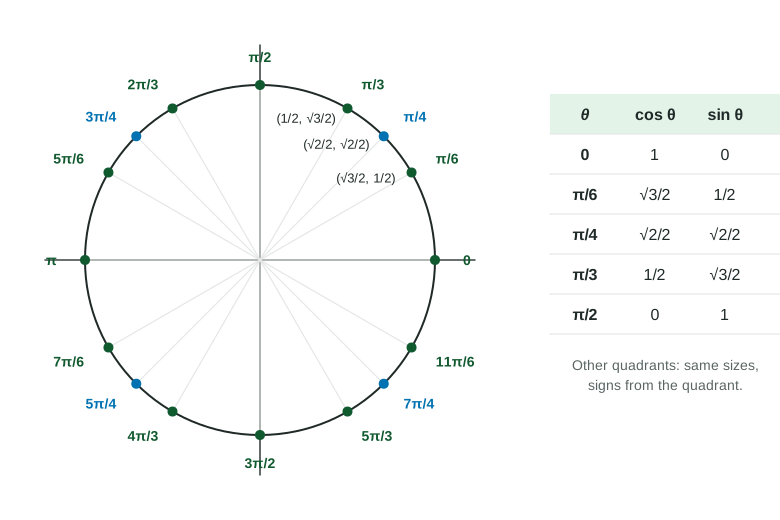
A circle of radius 1 centered at the origin with a dot at every multiple of pi/6 and pi/4 from 0 to 2 pi, each labeled with its angle in radians. The first-quadrant points are labeled with their coordinates: at pi/6, (square root of 3 over 2, 1/2); at pi/4, (square root of 2 over 2, square root of 2 over 2); at pi/3, (1/2, square root of 3 over 2). A table to the right lists cosine and sine at 0, pi/6, pi/4, pi/3 and pi/2: cosine 1, root 3 over 2, root 2 over 2, 1/2, 0 and sine 0, 1/2, root 2 over 2, root 3 over 2, 1. The other quadrants repeat these values with signs set by the quadrant.
Every multiple of π6\frac{\pi}{6} and π4\frac{\pi}{4}. The first-quadrant values repeat in every quadrant; only the signs change. LevlPrep original diagram.

Part 5 · Step by step

How it works, step by step

  1. An angle of π6\frac{\pi}{6}, π4\frac{\pi}{4} or π3\frac{\pi}{3} on the unit circle makes a right triangle with hypotenuse 1it is a special right triangle, so the coordinates are exact: (32,12)\left(\frac{\sqrt{3}}{2}, \frac{1}{2}\right), (22,22)\left(\frac{\sqrt{2}}{2}, \frac{\sqrt{2}}{2}\right), (12,32)\left(\frac{1}{2}, \frac{\sqrt{3}}{2}\right)
  2. An angle in another quadrant, such as 5π6\frac{5\pi}{6}its reference angle, the acute angle between the terminal ray and the xx-axis, is π6\frac{\pi}{6}, so its coordinates have the same sizes
  3. The quadrant decides the signs5π6\frac{5\pi}{6} is in Quadrant II, so cos⁡5π6=−32\cos\frac{5\pi}{6} = -\frac{\sqrt{3}}{2} and sin⁡5π6=12\sin\frac{5\pi}{6} = \frac{1}{2}
  4. A circle of radius rr instead of 1scale the coordinates by rr: the point at angle θ\theta is (rcos⁡θ,rsin⁡θ)(r\cos\theta, r\sin\theta)

Part 6 · Key ideas

Key ideas

  • The special angles are the multiples of π6\frac{\pi}{6} and π4\frac{\pi}{4}. Their sines and cosines are 00, ±12\pm\frac{1}{2}, ±22\pm\frac{\sqrt{2}}{2}, ±32\pm\frac{\sqrt{3}}{2} or ±1\pm 1.
  • Method: find the reference angle, take the first-quadrant value, then give it the sign of the quadrant.
  • For a reference angle of π6\frac{\pi}{6} or π3\frac{\pi}{3}, the coordinate that is larger in size is 32\frac{\sqrt{3}}{2}: it belongs to the axis the ray is closer to.
  • On a circle of radius rr centered at the origin, the point at angle θ\theta is (rcos⁡θ,rsin⁡θ)(r\cos\theta, r\sin\theta).

Part 7 · Misconception

A common mistake

The wrong idea: sin⁡2π3=−32\sin\frac{2\pi}{3} = -\frac{\sqrt{3}}{2}, because the angle is past π2\frac{\pi}{2}, so everything turns negative.

What actually happens: Only the coordinate on the negative side changes sign. 2π3\frac{2\pi}{3} is in Quadrant II, left of the yy-axis but above the xx-axis: cos⁡2π3=−12\cos\frac{2\pi}{3} = -\frac{1}{2} and sin⁡2π3=32\sin\frac{2\pi}{3} = \frac{\sqrt{3}}{2}.

Part 8 · Check yourself

Check yourself

Exam-style questions. Anything you miss goes into your review queue.

Graph

A point on a circle of radius 4

The circle x2+y2=16x^2 + y^2 = 16 is centered at the origin OO. The point QQ is on the circle, on the terminal ray of the angle 2π3\frac{2\pi}{3} in standard position.
−5−4−3−2−112345−5−4−3−2−112345xyQ

1. What is the xx-coordinate of QQ?

No calculator. Type the exact value (a fraction, π, e or a root is fine).

Show the answer

x=4cos⁡2π3x = 4\cos\frac{2\pi}{3}. The reference angle is π3\frac{\pi}{3} and Quadrant II makes cosine negative: 4(−12)=−24\left(-\frac{1}{2}\right) = -2.

  • Answer: -2

2. What is the yy-coordinate of QQ?

No calculator. Type the exact value (a fraction, π, e or a root is fine).

Show the answer

yy=4sin⁡2π3= 4\sin\frac{2\pi}{3}=4⋅32= 4 \cdot \frac{\sqrt{3}}{2}=23= 2\sqrt{3}.

  • Answer: 232\,\sqrt{3} ≈ 3.464

3. What is the slope of the segment OQOQ?

  1. −3-\sqrt{3}
  2. −33-\frac{\sqrt{3}}{3}
  3. 3\sqrt{3}
  4. −12-\frac{1}{2}
Show the answer

The slope is tan⁡2π3\tan\frac{2\pi}{3}=3/2−1/2= \frac{\sqrt{3}/2}{-1/2}=−3= -\sqrt{3}; with the coordinates, 23−2=−3\frac{2\sqrt{3}}{-2} = -\sqrt{3}. The radius does not change the slope.

  • Correct: −3-\sqrt{3}: Rise 232\sqrt{3} over run −2-2.
  • −33-\frac{\sqrt{3}}{3}: This is tan⁡5π6\tan\frac{5\pi}{6}: it divides xx by yy instead of yy by xx.
  • 3\sqrt{3}: The segment rises to the left, so the slope is negative.
  • −12-\frac{1}{2}: This is cos⁡2π3\cos\frac{2\pi}{3}, a coordinate, not the slope of the ray.

4. The point RR is on the same circle, on the terminal ray of 2π3+π\frac{2\pi}{3} + \pi. What are the coordinates of RR?

  1. (2,−23)(2, -2\sqrt{3})
  2. (−2,−23)(-2, -2\sqrt{3})
  3. (23,−2)(2\sqrt{3}, -2)
  4. (−2,23)(-2, 2\sqrt{3})
Show the answer

Half a turn more points the ray the opposite way, so RR is diametrically opposite QQ: both coordinates change sign, (2,−23)(2, -2\sqrt{3}). Check: 5π3\frac{5\pi}{3} is in Quadrant IV with reference angle π3\frac{\pi}{3}.

  • Correct: (2,−23)(2, -2\sqrt{3}): Opposite QQ through the center: (2,−23)(2, -2\sqrt{3}).
  • (−2,−23)(-2, -2\sqrt{3}): This flips only the yy-coordinate, the reflection across the xx-axis, which is the angle 4π3\frac{4\pi}{3}.
  • (23,−2)(2\sqrt{3}, -2): This swaps the sizes; with reference angle π3\frac{\pi}{3} the larger size belongs to yy.
  • (−2,23)(-2, 2\sqrt{3}): This is QQ itself, the point for a full turn 2π2\pi, not half a turn.

5. What is the exact value of sin⁡5π4\sin\frac{5\pi}{4}?

No calculator. Type the exact value (a fraction, π, e or a root is fine).

Show the answer

Quadrant III, reference angle 5π4−π=π4\frac{5\pi}{4} - \pi = \frac{\pi}{4}: sin⁡5π4=−22\sin\frac{5\pi}{4} = -\frac{\sqrt{2}}{2}.

  • Answer: −22\frac{-\sqrt{2}}{2} ≈ -0.707

6. What is the exact value of cos⁡2π3\cos\frac{2\pi}{3}?

No calculator. Type the exact value (a fraction, π, e or a root is fine).

Show the answer

Quadrant II, reference angle π−2π3=π3\pi - \frac{2\pi}{3} = \frac{\pi}{3}: cos⁡2π3=−12\cos\frac{2\pi}{3} = -\frac{1}{2}.

  • Answer: −12\frac{-1}{2} ≈ -0.500

7. A point is on a circle of radius 10 centered at the origin, on the terminal ray of π6\frac{\pi}{6}. What are its coordinates?

  1. (53,5)(5\sqrt{3}, 5)
  2. (5,53)(5, 5\sqrt{3})
  3. (32,12)\left(\frac{\sqrt{3}}{2}, \frac{1}{2}\right)
  4. (103,10)(10\sqrt{3}, 10)
Show the answer

(rcos⁡θ,rsin⁡θ)(r\cos\theta, r\sin\theta)=(10⋅32,10⋅12)= \left(10 \cdot \frac{\sqrt{3}}{2}, 10 \cdot \frac{1}{2}\right)=(53,5)= (5\sqrt{3}, 5).

  • Correct: (53,5)(5\sqrt{3}, 5): Scale (32,12)\left(\frac{\sqrt{3}}{2}, \frac{1}{2}\right) by 10.
  • (5,53)(5, 5\sqrt{3}): This is the point at π3\frac{\pi}{3}: the coordinates are swapped.
  • (32,12)\left(\frac{\sqrt{3}}{2}, \frac{1}{2}\right): This is the point on the unit circle; multiply by the radius 10.
  • (103,10)(10\sqrt{3}, 10): This doubles the right answer: 10⋅32=5310 \cdot \frac{\sqrt{3}}{2} = 5\sqrt{3}, not 10310\sqrt{3}.

Part 9 · Summary

Summary

Exact sines and cosines at multiples of π6\frac{\pi}{6} and π4\frac{\pi}{4} come from the 30-60-90 and 45-45-90 triangles. Find the reference angle, use its first-quadrant value, and give it the sign of the quadrant. On a circle of radius rr, the point at angle θ\theta is (rcos⁡θ,rsin⁡θ)(r\cos\theta, r\sin\theta).

Part 10 · Up next

What comes next

Part 11 · Connections

Connections