Unit 3 · Topic 3.12

Equivalent Representations of Trigonometric Functions

The Pythagorean identity sin² x + cos² x = 1 and its forms with tan , sec , cot and csc ; the sum and difference identities for sine and cosine; and the double-angle identities sin (2x) = 2sin xcos x and cos (2x) = cos² x − sin² x = 2cos² x − 1 = 1 − 2sin² x .

Practice 1: Procedural and Symbolic Fluency

Part 1 · Hook

Why this matters

Two speakers play the same note, one a little behind the other. Your ear hears a single wave, louder or softer depending on the delay. The math behind that is a trigonometric identity: a sum of two sine waves can be rewritten as one. Identities let you trade a messy expression for a simpler one with the same graph.

Part 2 · Before you start

What this builds on

Part 3 · Prerequisite check

Quick check before you start

1. What is sin2⁡π6+cos2⁡π6\sin^2\frac{\pi}{6} + \cos^2\frac{\pi}{6}?

  1. 11
  2. 12\frac{1}{2}
  3. 3+12\frac{\sqrt{3} + 1}{2}
  4. 22
Show the answer

(12)2+(32)2\left(\frac{1}{2}\right)^2 + \left(\frac{\sqrt{3}}{2}\right)^2=14+34= \frac{1}{4} + \frac{3}{4}=1= 1: the point is on the unit circle.

  • Correct: 11:
  • 12\frac{1}{2}:
  • 3+12\frac{\sqrt{3} + 1}{2}:
  • 22:

2. Which equals csc⁡x\csc x?

  1. 1sin⁡x\frac{1}{\sin x}
  2. 1cos⁡x\frac{1}{\cos x}
  3. cos⁡xsin⁡x\frac{\cos x}{\sin x}
  4. sin−1⁡x\sin^{-1} x
Show the answer

Cosecant is the reciprocal of sine.

  • Correct: 1sin⁡x\frac{1}{\sin x}:
  • 1cos⁡x\frac{1}{\cos x}:
  • cos⁡xsin⁡x\frac{\cos x}{\sin x}:
  • sin−1⁡x\sin^{-1} x:

Part 4 · See it

See it first

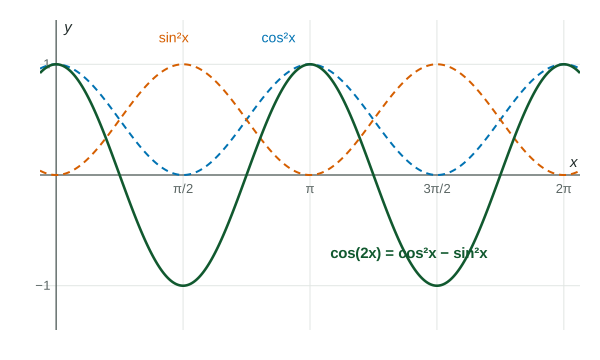
Graphs of cos squared x and sin squared x (dashed) and of cos(2x) (solid) for x from 0 to 2 pi. At every x the solid height equals the first dashed height minus the second.
At every xx, the height of cos⁡(2x)\cos(2x) equals cos2⁡x\cos^2 x minus sin2⁡x\sin^2 x: the double-angle identity as a picture. LevlPrep original diagram.

Part 5 · Step by step

How it works, step by step

  1. A point (cos⁡x,sin⁡x)(\cos x, \sin x) is on the unit circlesin2⁡x+cos2⁡x=1\sin^2 x + \cos^2 x = 1, the Pythagorean identity
  2. Divide it by cos2⁡x\cos^2 x or by sin2⁡x\sin^2 xtan2⁡x+1=sec2⁡x\tan^2 x + 1 = \sec^2 x and 1+cot2⁡x=csc2⁡x1 + \cot^2 x = \csc^2 x
  3. Add two anglessin⁡(a+b)\sin(a + b)=sin⁡acos⁡b= \sin a\cos b+cos⁡asin⁡b+ \cos a\sin b and cos⁡(a+b)\cos(a + b)=cos⁡acos⁡b−sin⁡asin⁡b= \cos a\cos b - \sin a\sin b
  4. Set b=ab = a in the sum identitiessin⁡(2a)=2sin⁡acos⁡a\sin(2a) = 2\sin a\cos a and cos⁡(2a)\cos(2a)=cos2⁡a−sin2⁡a= \cos^2 a - \sin^2 a

Part 6 · Key ideas

Key ideas

  • An identity is true for every input where both sides are defined; you use it to swap one form for another.
  • sin⁡(a+b)\sin(a + b) is not sin⁡a+sin⁡b\sin a + \sin b; use the sum identity.
  • cos⁡(2x)\cos(2x) has three forms: cos2⁡x−sin2⁡x\cos^2 x - \sin^2 x, 2cos2⁡x−12\cos^2 x - 1 and 1−2sin2⁡x1 - 2\sin^2 x. Pick the one that matches the rest of the expression.
  • To rewrite as a single trigonometric function, write everything in sines and cosines, simplify, and stop at one function.

Part 7 · Misconception

A common mistake

The wrong idea: sin⁡(2x)=2sin⁡x\sin(2x) = 2\sin x, because the 22 can come out front.

What actually happens: The 22 is part of the angle. sin⁡(2x)=2sin⁡xcos⁡x\sin(2x) = 2\sin x\cos x; for example sin⁡π=0\sin\pi = 0 while 2sin⁡π2=22\sin\frac{\pi}{2} = 2.

Part 8 · Check yourself

Check yourself

Exam-style questions. Anything you miss goes into your review queue.

Graph

The graph of f(x)=1−2sin2⁡xf(x) = 1 - 2\sin^2 x

0π/2π3π/22π−1.5−1−0.50.511.5xyf

1. The graph shows f(x)=1−2sin2⁡xf(x) = 1 - 2\sin^2 x. Which function has the same graph?

  1. y=cos⁡(2x)y = \cos(2x)
  2. y=cos2⁡xy = \cos^2 x
  3. y=sin⁡(2x)y = \sin(2x)
  4. y=2cos⁡xy = 2\cos x
Show the answer

One form of the double-angle identity is cos⁡(2x)=1−2sin2⁡x\cos(2x) = 1 - 2\sin^2 x. The graph agrees: it starts at 11, reaches −1-1 at x=π2x = \frac{\pi}{2} and repeats every π\pi.

  • Correct: y=cos⁡(2x)y = \cos(2x): Right: 1−2sin2⁡x1 - 2\sin^2 x is one of the three forms of cos⁡(2x)\cos(2x).
  • y=cos2⁡xy = \cos^2 x: cos2⁡x\cos^2 x is never negative, but the graph goes down to −1-1.
  • y=sin⁡(2x)y = \sin(2x): sin⁡(2x)\sin(2x) starts at 00; the graph starts at 11.
  • y=2cos⁡xy = 2\cos x: 2cos⁡x2\cos x reaches 22 and has period 2π2\pi; the graph stays between −1-1 and 11 and has period π\pi.

2. For the function in the graph, find the exact value of f(π6)f\left(\frac{\pi}{6}\right).

No calculator. Type the exact value (a fraction, π, e or a root is fine).

Show the answer

f(π6)f\left(\frac{\pi}{6}\right)=1−2(12)2= 1 - 2\left(\frac{1}{2}\right)^2=1−12= 1 - \frac{1}{2}=12= \frac{1}{2}. Check with the identity: cos⁡(2⋅π6)\cos\left(2\cdot\frac{\pi}{6}\right)=cos⁡π3= \cos\frac{\pi}{3}=12= \frac{1}{2}.

  • Answer: 12\frac{1}{2} ≈ 0.500

3. For the function in the graph, find every solution of f(x)=0f(x) = 0 on [0,2π)[0, 2\pi).

  1. π4\frac{\pi}{4}, 3π4\frac{3\pi}{4}, 5π4\frac{5\pi}{4} and 7π4\frac{7\pi}{4}
  2. π4\frac{\pi}{4} and 3π4\frac{3\pi}{4}
  3. π2\frac{\pi}{2} and 3π2\frac{3\pi}{2}
  4. π4\frac{\pi}{4}, 3π4\frac{3\pi}{4}, 5π4\frac{5\pi}{4}, 7π4\frac{7\pi}{4} and 9π4\frac{9\pi}{4}
Show the answer

f(x)=cos⁡(2x)=0f(x) = \cos(2x) = 0. With u=2xu = 2x in [0,4π)[0, 4\pi): uu=π2,3π2,5π2,7π2= \frac{\pi}{2}, \frac{3\pi}{2}, \frac{5\pi}{2}, \frac{7\pi}{2}, so xx=π4,3π4,5π4,7π4= \frac{\pi}{4}, \frac{3\pi}{4}, \frac{5\pi}{4}, \frac{7\pi}{4}. The graph crosses the axis four times.

  • Correct: π4\frac{\pi}{4}, 3π4\frac{3\pi}{4}, 5π4\frac{5\pi}{4} and 7π4\frac{7\pi}{4}: Right: two periods of length π\pi, two zeros each.
  • π4\frac{\pi}{4} and 3π4\frac{3\pi}{4}: That is one period; [0,2π)[0, 2\pi) holds two periods of ff.
  • π2\frac{\pi}{2} and 3π2\frac{3\pi}{2}: These are values of 2x2x; divide by 22.
  • π4\frac{\pi}{4}, 3π4\frac{3\pi}{4}, 5π4\frac{5\pi}{4}, 7π4\frac{7\pi}{4} and 9π4\frac{9\pi}{4}: 9π4\frac{9\pi}{4} is outside [0,2π)[0, 2\pi).

Table

Two angles α\alpha and β\beta in Quadrant I

Sine and cosine of two angles α and β, each between 0 and π/2
AngleSineCosine
α\alpha35\frac{3}{5}45\frac{4}{5}
β\beta1213\frac{12}{13}513\frac{5}{13}

4. Using the table, find the exact value of sin⁡(α+β)\sin(\alpha + \beta).

No calculator. Type the exact value (a fraction, π, e or a root is fine).

Show the answer

sin⁡(α+β)\sin(\alpha + \beta)=sin⁡αcos⁡β= \sin\alpha\cos\beta+cos⁡αsin⁡β+ \cos\alpha\sin\beta=35⋅513= \frac{3}{5}\cdot\frac{5}{13}+45⋅1213+ \frac{4}{5}\cdot\frac{12}{13}=1565= \frac{15}{65}+4865+ \frac{48}{65}=6365= \frac{63}{65}.

  • Answer: 6365\frac{63}{65} ≈ 0.969

5. Rewrite sin⁡(2x)2cos2⁡x\frac{\sin(2x)}{2\cos^2 x} as a single trigonometric function of xx.

Type an expression for sin⁡(2x)2cos2⁡x=\frac{\sin(2x)}{2\cos^2 x} =.

Show the answer

Use sin⁡(2x)=2sin⁡xcos⁡x\sin(2x) = 2\sin x\cos x: 2sin⁡xcos⁡x2cos2⁡x\frac{2\sin x\cos x}{2\cos^2 x}=sin⁡xcos⁡x= \frac{\sin x}{\cos x}=tan⁡x= \tan x. Stop only when one trigonometric function is left.

  • Answer: sin⁡(2x)2cos2⁡x=\frac{\sin(2x)}{2\cos^2 x} = tan⁡(x)\tan(x)

6. Find every solution of sin⁡(2x)=sin⁡x\sin(2x) = \sin x on [0,2π)[0, 2\pi).

  1. 00, π3\frac{\pi}{3}, π\pi and 5π3\frac{5\pi}{3}
  2. π3\frac{\pi}{3} and 5π3\frac{5\pi}{3}
  3. 00 and π\pi
  4. 00, π3\frac{\pi}{3}, 2π3\frac{2\pi}{3} and π\pi
Show the answer

2sin⁡xcos⁡x=sin⁡x2\sin x\cos x = \sin x, so 2sin⁡xcos⁡x−sin⁡x=02\sin x\cos x - \sin x = 0 and sin⁡x(2cos⁡x−1)=0\sin x(2\cos x - 1) = 0. Either sin⁡x=0\sin x = 0 (x=0,πx = 0, \pi) or cos⁡x=12\cos x = \frac{1}{2} (x=π3,5π3x = \frac{\pi}{3}, \frac{5\pi}{3}).

  • Correct: 00, π3\frac{\pi}{3}, π\pi and 5π3\frac{5\pi}{3}: Right: factor out sin⁡x\sin x and solve both factors.
  • π3\frac{\pi}{3} and 5π3\frac{5\pi}{3}: Dividing by sin⁡x\sin x loses x=0x = 0 and x=πx = \pi, where sin⁡x=0\sin x = 0.
  • 00 and π\pi: These come from sin⁡x=0\sin x = 0 alone; the factor 2cos⁡x−12\cos x - 1 gives two more.
  • 00, π3\frac{\pi}{3}, 2π3\frac{2\pi}{3} and π\pi: cos⁡2π3=−12\cos\frac{2\pi}{3} = -\frac{1}{2}; the second angle with cosine 12\frac{1}{2} is 5π3\frac{5\pi}{3}.

Part 9 · Summary

Summary

The Pythagorean identity sin2⁡x+cos2⁡x=1\sin^2 x + \cos^2 x = 1 and its forms with tan⁡\tan, sec⁡\sec, cot⁡\cot and csc⁡\csc; the sum and difference identities for sine and cosine; and the double-angle identities sin⁡(2x)=2sin⁡xcos⁡x\sin(2x) = 2\sin x\cos x and cos⁡(2x)\cos(2x)=cos2⁡x−sin2⁡x= \cos^2 x - \sin^2 x=2cos2⁡x−1= 2\cos^2 x - 1=1−2sin2⁡x= 1 - 2\sin^2 x. Use them to find exact values, to rewrite expressions as one function, and to solve equations.
Part 10 · Up next

What comes next

Part 11 · Connections

Connections