Sine, Cosine, and Tangent
An angle in radians is arc length over radius, so a full turn is 2π .
Part 1 · Hook
Why this matters
Part 2 · Before you start
What this builds on
Part 3 · Prerequisite check
Quick check before you start
1. A circle has radius . How long is the arc cut off by a central angle of ?
Show the answer
is a quarter turn: .
- Correct: :
- :
- :
- :
2. In a right triangle with hypotenuse , the side opposite the angle has length . What is ?
Show the answer
- Correct: :
- :
- :
- :
Part 4 · See it
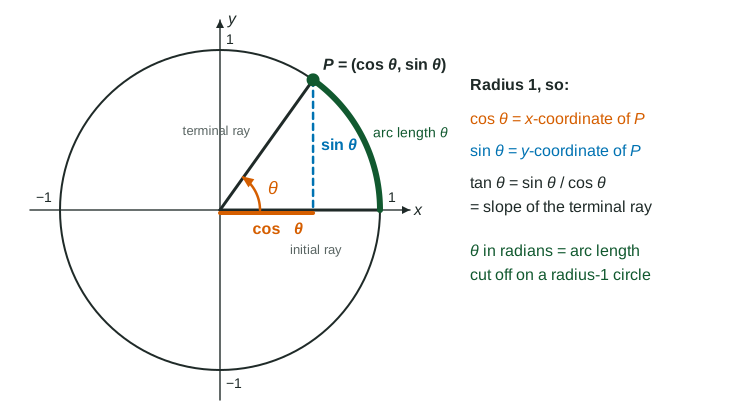
See it first
Part 5 · Step by step
How it works, step by step
- Measure an angle by the arc it cuts off, divided by the radiusthat is its radian measure: a full turn is radians, so radians
- Put the angle in standard position: vertex at the origin, initial ray on the positive -axis, turning counterclockwiseits terminal ray meets the unit circle at one point
- Read that point's coordinatesits -coordinate is and its -coordinate is , for any angle, not only acute ones
- Divide the -coordinate by the -coordinate, the slope of the terminal ray, undefined where
Part 6 · Key ideas
Key ideas
- Radians: . On the unit circle, an angle of radians cuts off an arc of length exactly .
- Convert with radians : multiply degrees by , or radians by .
- Signs follow the quadrant: in Quadrant II, and ; in Quadrant III both are negative; in Quadrant IV, and .
- Angles that differ by share a terminal ray, so they have the same sine, cosine and tangent.
Part 7 · Misconception
A common mistake
The wrong idea: is the -coordinate, because comes first.
What actually happens: Cosine comes first: the point is . Sine is the height, the -coordinate. At the point is , so and .
Part 8 · Check yourself
Check yourself
Exam-style questions. Anything you miss goes into your review queue.
Diagram
An angle on the unit circle
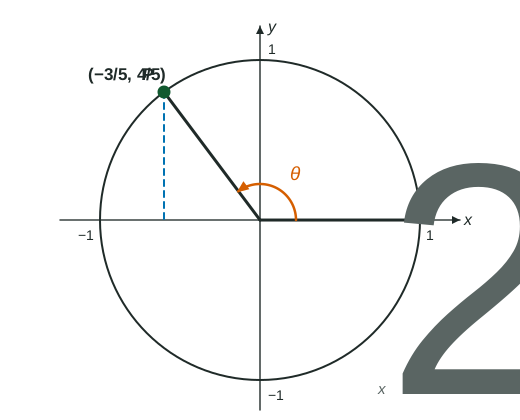
1. What is ?
Show the answer
is the -coordinate of : .
- Correct: : The height of is .
- : is the -coordinate, which is .
- : is , which is .
- : This drops the sign of the -coordinate and uses it for sine; sine is the -coordinate.
2. What is ?
No calculator. Type the exact value (a fraction, π, e or a root is fine).
Show the answer
is the -coordinate of : .
- Answer: ≈ -0.600
3. What is ?
No calculator. Type the exact value (a fraction, π, e or a root is fine).
Show the answer
- Answer: ≈ -1.333
4. Which is true about ?
Show the answer
has a negative -coordinate and a positive -coordinate, so it is in Quadrant II, between and .
- Correct: : Quadrant II runs from to .
- : In Quadrant I both coordinates are positive, but has .
- : In Quadrant III both coordinates are negative, but has .
- : In Quadrant IV, and : the opposite of 's signs.
5. What is ?
Show the answer
Turning another (half a turn) sends to the opposite point on the circle, . Its -coordinate is .
- Correct: : Half a turn flips both coordinates' signs, so the height becomes .
- : would be : a full turn, back to .
- : is the new -coordinate, .
- : This is , the -coordinate of itself.
6. What is in radians?
No calculator. Type the exact value (a fraction, π, e or a root is fine).
Show the answer
.
- Answer: ≈ 2.618
7. Which angles have the same terminal ray as ? Select all that apply.
Show the answer
Angles that differ by a multiple of share a terminal ray: and .
- Correct: : One extra full turn: .
- Correct: : One full turn clockwise: .
- : This differs by , half a turn, so its ray points the opposite way.
- : This is the mirror image across the -axis, in Quadrant II.
Part 9 · Summary
Summary
Part 10 · Up next
What comes next
Part 11 · Connections