
Exponential functions answer the question "what is ?". Often we need the reverse: " to what power is ?". The answer is a logarithm. This page defines logarithms, shows how to find exact values, introduces the common and natural logarithms, and explains logarithmic scales.
A logarithm is an exponent
For a base with and a positive number :
Read as "log base of ". It is the exponent that turns into . Because is invertible, every positive comes from exactly one exponent, so this exponent is well defined.
| Exponential form | Logarithmic form | In words |
|---|---|---|
| needs the exponent to make | ||
| a number below has a negative logarithm | ||
| every base needs the exponent to make | ||
| a base needs the exponent to make itself |
Finding exact values
Write the input as a power of the base. Then the logarithm is that power.
Worked example 1. Find and .
, so .
For , is not a whole-number power of . Write both as powers of : and . We need , that is , so and .
Worked example 2. Solve .
Rewrite in exponential form: .
Common and natural logarithms
Two bases are used so often that they have their own names and calculator keys.
- The common logarithm has base and is written , with no base shown: .
- The natural logarithm has base and is written : and .
Mixing them up is a common calculator slip: but .
Logarithms that are not whole numbers
Most logarithms are not whole numbers, but you can always say which two whole numbers they lie between.
Worked example 3. Between which consecutive integers is ?
List powers of : and . Since , the exponent is between and .
A calculator gives , which agrees.
What a logarithm can and cannot take
With a positive base, every power is positive. So exists only when : and are undefined. The value of a logarithm, though, can be any real number, including and negative numbers: .
Logarithmic scales
Some quantities span many powers of ten: sound intensity, the strength of ground shaking, the acidity of a solution, the number of users of an app. A logarithmic scale places each number at the distance given by its logarithm. Then , , and are equally spaced, and each equal step multiplies by the same factor.
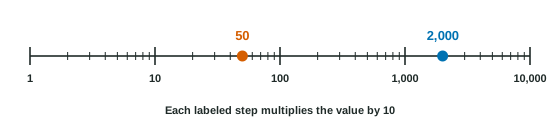
Worked example 4. On a scale with reading , one reading is and another is . Compare the amounts .
means ; means .
The ratio is . A difference of on the scale is a factor of , not of .
The rule to remember: on a logarithmic scale, differences in position stand for ratios of values.