Change in Arithmetic and Geometric Sequences
Arithmetic sequences add a common difference: a_n = a_k + d(n − k) .
Part 1 · Hook
Why this matters
Part 2 · Before you start
What this builds on
Part 3 · Prerequisite check
Quick check before you start
1. What is ?
Show the answer
Power first: , then .
- Correct: :
- :
- :
- :
2. What is the slope of the line through and ?
Show the answer
.
- Correct: :
- :
- :
- :
Part 4 · See it
See it first
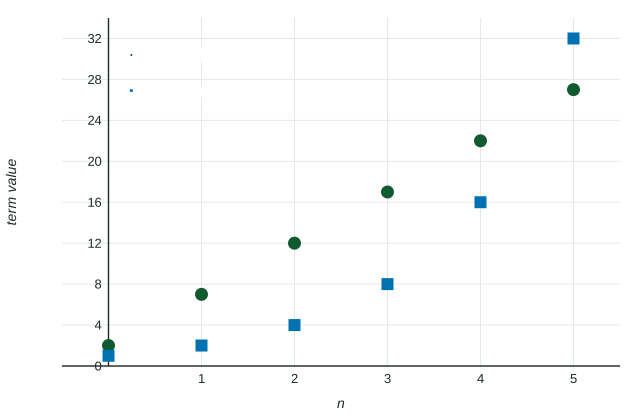
Part 5 · Step by step
How it works, step by step
- Each term is the previous term plus an arithmetic sequence, , changing by equal amounts
- Each term is the previous term times a geometric sequence, , changing by amounts that are multiplied by
- You know a term or that is not the firstuse or
Part 6 · Key ideas
Key ideas
- A sequence is a function whose inputs are whole numbers; its graph is a set of dots.
- Arithmetic: common difference , so ; like a line sampled at whole numbers.
- Geometric: common ratio , so . An increasing geometric sequence grows by increasing amounts.
Part 7 · Misconception
A common mistake
The wrong idea: If and , then .
What actually happens: The exponent counts steps from the known term: , so that .
Part 8 · Check yourself
Check yourself
Exam-style questions. Anything you miss goes into your review queue.
Table
Two sequences
| 0 | 1 | 2 | 3 | 4 | |
|---|---|---|---|---|---|
| 5 | 8 | 11 | 14 | 17 | |
| 2 | 6 | 18 | 54 | 162 |
1. Which statement describes the two sequences in the table?
- is geometric with common ratio ; is arithmetic with common difference
- is arithmetic with common difference ; is geometric with common ratio
- Both are arithmetic, with common differences and
- is arithmetic with common difference ; is geometric with common ratio
Show the answer
Each term of is more than the one before (, , ...). Each term of is times the one before (, , ...).
- is geometric with common ratio ; is arithmetic with common difference : The labels are swapped: adds , multiplies by .
- Correct: is arithmetic with common difference ; is geometric with common ratio : Equal differences for ; equal ratios for .
- Both are arithmetic, with common differences and : The differences of are , which are not equal.
- is arithmetic with common difference ; is geometric with common ratio : and are the first terms and , not the difference and ratio.
2. Using the table, find .
No calculator. Type the exact value (a fraction, π, e or a root is fine).
Show the answer
, so .
- Answer: 65
3. Using the table, find .
No calculator. Type the exact value (a fraction, π, e or a root is fine).
Show the answer
, so
- Answer: 1458
Graph
A sequence shown as points
4. The graph shows the terms to of a geometric sequence. What is its common ratio?
No calculator. Type the exact value (a fraction, π, e or a root is fine).
Show the answer
- Answer: ≈ 0.500
5. Write in terms of , using the term .
Type an expression for .
Show the answer
With a known term , . Here : . Check: .
- Answer:
6. An arithmetic sequence has and common difference . Find .
No calculator. Type the exact value (a fraction, π, e or a root is fine).
Show the answer
- Answer: -38
Part 9 · Summary
Summary
Part 10 · Up next
What comes next
Part 11 · Connections