Skills
Quadratics: Zeros and the Quadratic Formula
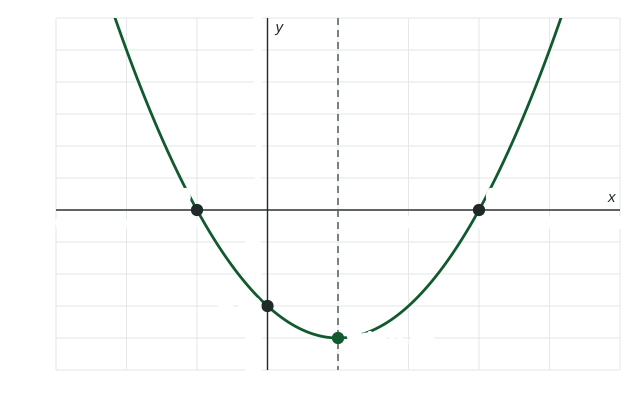
A quadratic f(x) = ax² + bx + c graphs as a parabola with its vertex at x = −b/2a .
Practice 1: Procedural and Symbolic Fluency
Part 1 · Hook
Why this matters
Throw a ball and its height traces a
parabola: up, a highest point, then down.
Quadratic functions describe that shape and many others, from the area of a garden to a company's profit. Topic 1.3 measures how their
rates of change behave, so the algebra of quadratics comes first.
Part 2 · Before you start
What this builds on
Part 3 · Prerequisite check
Quick check before you start
1. What is multiplied out?
Show the answer
.
- Correct: :
- :
- :
- :
2. The line through and has slope
- undefined
Show the answer
The outputs are equal, so the rise is .
- Correct: :
- :
- :
- undefined:
Part 5 · Step by step
How it works, step by step
- A quadratic is written as a product of two factors set to →each factor equal to gives a solution
- The quadratic does not split into easy factors→the quadratic formula gives the solutions
- The discriminant is positive, zero or negative→there are two, one or no real zeros
- The quadratic is in vertex form →the vertex is , the axis is , and opens up, opens down
Part 6 · Key ideas
Key ideas
- A quadratic function is with ; its graph is a parabola.
- Solve by factors, by square roots ( gives ) or by the quadratic formula.
- The vertex is at ; completing the square gives vertex form .
Part 7 · Misconception
A common mistake
The wrong idea: means , so .
What actually happens: Both and equal , so or : or . Taking a square root gives .
Part 8 · Check yourself
Check yourself
Exam-style questions. Anything you miss goes into your review queue.
1. Solve .
- or
- or
- or
- or
Show the answer
Find two numbers with product and sum : and . So , giving or .
- or : , which has . The signs in the factors are minus.
- or : These are the coefficients, not solutions: .
- Correct: or : Right: , and a product is when a factor is .
- or : , but , not .
2. Use the quadratic formula to find the larger solution of . Give the exact value.
No calculator. Type the exact value (a fraction, π, e or a root is fine).
Show the answer
, , . . The larger is .
- Answer: ≈ 0.851
3. What is the vertex of the parabola ?
Show the answer
The vertex is at , and .
- Correct: : Right: and .
- : The vertex is at , not .
- : This uses ; divide by .
- : is the -intercept; put into the formula.
4. How many real zeros does have?
- Two
- One
- Zero
- It depends on
Show the answer
The discriminant is negative, so the square root in the quadratic formula is not real: no real zeros. The parabola opens up and stays above the -axis.
- Two: Two real zeros need ; here it is .
- One: One real zero needs .
- Correct: Zero: Right: the discriminant is .
- It depends on : The number of zeros is a property of the whole function, found from , and .
5. A parabola has vertex and passes through . Write its equation in vertex form.
Type an expression for .
Show the answer
Vertex form with : . The point gives , so .
- Answer:
6. What are the zeros of ?
- and
- and
- and
Show the answer
Set : , or , so or .
- and : These come from the vertex , not from setting .
- Correct: and : Right: , so .
- : has two square roots, and : or .
- and : These come from , which skips the square root. Take the square root of : .
Part 9 · Summary
Summary
A quadratic
graphs as a parabola with its vertex at
. Solve
by factors, by square roots or by the quadratic formula; the discriminant
counts the real zeros. Completing the square gives vertex form
, which shows the vertex
.
Part 10 · Up next
What comes next
Part 11 · Connections
Connections