Interval Notation and Inequalities
Interval notation writes a stretch of the number line with its two ends: brackets for included ends, parentheses for excluded ends and for ±∞ , and ∪ to join pieces.
Part 1 · Hook
Why this matters
Part 2 · Before you start
What this builds on
Part 3 · Prerequisite check
Quick check before you start
1. What is the domain of ?
- Every real number except
- Every real number except
- Every real number
Show the answer
The denominator is at .
- Correct: Every real number except :
- Every real number except :
- :
- Every real number:
2. What is for ?
Show the answer
.
- Correct: :
- :
- :
- :
Part 4 · See it
See it first
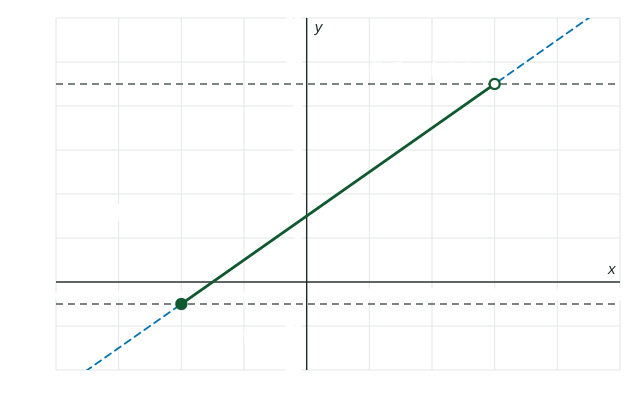
Part 5 · Step by step
How it works, step by step
- An endpoint is included ( or )it gets a bracket, or , and a closed dot on a graph
- An endpoint is not included ( or ), or the interval runs foreverit gets a parenthesis; and always take parentheses
- You multiply or divide both sides of an inequality by a negative numberthe inequality sign flips, because negation reverses order ( but )
- A domain leaves out a single number it is two intervals joined by a union:
Part 6 · Key ideas
Key ideas
- includes both ends; includes neither; includes but not .
- is not a number you reach, so it always gets a parenthesis: .
- Solve a linear inequality like an equation, but flip the sign when you multiply or divide by a negative.
- For a compound inequality , do each step to all three parts.
Part 7 · Misconception
A common mistake
The wrong idea: Dividing by gives .
What actually happens: Dividing by a negative number reverses the order, so . Check with a value: gives , true; gives , false.
Part 8 · Check yourself
Check yourself
Exam-style questions. Anything you miss goes into your review queue.
1. Which interval describes every with ?
Show the answer
A bracket means the endpoint is included ( or ); a parenthesis means it is not ( or ).
- : The brackets are swapped: is included (bracket) and is not (parenthesis).
- Correct: : Right: includes , so a bracket; leaves out , so a parenthesis.
- : This includes , but leaves out.
- : This leaves out , but includes it.
2. Solve . Write the solution in interval notation.
Show the answer
Subtract : . Divide by and flip: , which is . Check : .
- : This forgets to flip the inequality when dividing by . Check : is false.
- : gives , not : divided by is . Dividing by a negative flips the inequality, and the bound comes out negative.
- Correct: : Right: , and dividing by flips the sign: .
- : gives , and is false, so is not included.
3. For , which inputs give outputs with ?
Show the answer
Do the same step to all three parts: subtract to get , then divide by to get .
- Correct: : Right: becomes , so .
- : These are the outputs. The question asks for the inputs: solve for .
- : gives , and is false, so is left out.
- : This stops after subtracting ; divide every part by as well.
4. What is the domain of in interval notation?
Show the answer
The inside of a square root cannot be negative: , so and (flip when dividing by ).
- : Dividing by flips the sign: , not .
- : gives , a real number, so is included.
- : Solve for : the is divided by as well.
- Correct: : Right: gives .
5. What is the domain of in interval notation?
Show the answer
Only is left out. Skipping one number splits the line into two intervals, joined with the union sign .
- Correct: : Right: every real number except , written as two intervals joined by .
- : Brackets at would include it, but divides by .
- : Numbers below are fine: .
- : At the denominator is , so is not in the domain.
6. Which numbers are in the interval ? Select all that apply.
Show the answer
means : is out, is in, and so is everything between.
- : The parenthesis at leaves it out.
- Correct: : In: .
- Correct: : In: the bracket at includes it.
- : Out: is past the right end, .
Part 9 · Summary
Summary
Part 10 · Up next
What comes next
Part 11 · Connections