Lines, Slope and Linear Equations
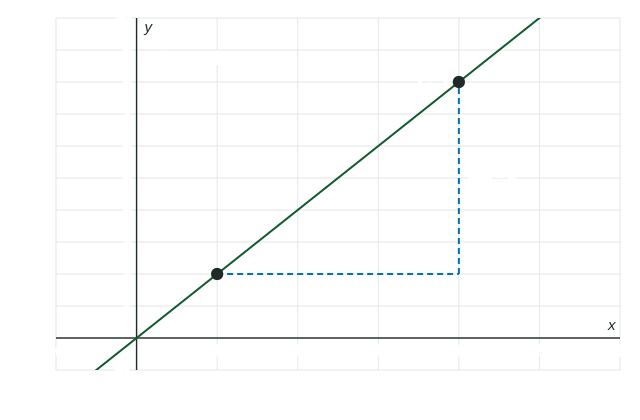
Slope is the change in y divided by the change in x , the same between any two points of a line.
Part 1 · Hook
Why this matters
Part 2 · Before you start
What this builds on
Part 3 · Prerequisite check
Quick check before you start
1. Solve .
Show the answer
, so .
- Correct: :
- :
- :
- :
2. For , what is the point ?
Show the answer
, so the point is .
- Correct: :
- :
- :
- :
Part 4 · See it
See it first
Part 5 · Step by step
How it works, step by step
- Two points and lie on a lineits slope is , rise over run, subtracted in the same order
- You know one point and the slope point-slope form gives the line, and gives any value on it
- increases by along a line of slope changes by , the same for every equal step: a line has a constant rate of change
Part 6 · Key ideas
Key ideas
- Slope
: positive rises, negative falls, is horizontal, a vertical line has none. - Point-slope form ; slope-intercept form with the -intercept.
- In context the slope has units of output per input, like dollars per minute.
Part 7 · Misconception
A common mistake
The wrong idea: In , the -intercept is .
What actually happens: is the -value at , not at . Solving gives , so the -intercept is .
Part 8 · Check yourself
Check yourself
Exam-style questions. Anything you miss goes into your review queue.
1. What is the slope of the line through and ?
Show the answer
Slope
- : The -values fall from to as rises, so the slope is negative.
- : This is run over rise. Slope is rise over run: .
- Correct: : Right:
. - : This subtracts the -values, , but adds the -values, . Subtract both in the same order: .
2. Write an equation of the line through with slope . Solve for .
Type an expression for .
Show the answer
Point-slope form: , so
- Answer:
3. A phone plan costs dollars for minutes of calls. What does the slope mean?
- Each extra minute adds $0.10 to the cost.
- The plan costs $0.10 with no calls.
- Each extra dollar buys minute.
- The cost rises $15 for each minute.
Show the answer
In , the slope is the change in per -unit change in : $0.10 per minute. The $15 is the cost at .
- Correct: Each extra minute adds $0.10 to the cost.: Right: the slope is the change in cost for each -minute increase in .
- The plan costs $0.10 with no calls.: With no calls () the cost is $15, the intercept.
- Each extra dollar buys minute.: This swaps input and output; the slope is dollars per minute.
- The cost rises $15 for each minute.: $15 is the starting cost, not the change per minute.
4. A line passes through and . What is on this line at ?
No calculator. Type the exact value (a fraction, π, e or a root is fine).
Show the answer
Slope . From : , so at , .
- Answer: 13
5. For , what is the slope of the line through and ?
No calculator. Type the exact value (a fraction, π, e or a root is fine).
Show the answer
The points are and . Slope
- Answer: 7
6. Which equation is the same line as ?
Show the answer
Distribute: . Add : . Check: at , .
- Correct: : Right:
. - : Distribute the to both terms: , not .
- : After distributing, is added to both sides: .
- : Check the point : , not .
Part 9 · Summary
Summary
Part 10 · Up next
What comes next
Part 11 · Connections