Rates of Change
The average rate of change of f on [a, b] is (f(b) − f(a))/(b − a) , the slope of the line through (a, f(a)) and (b, f(b)) , in output units per input unit.
Part 1 · Hook
Why this matters
Part 2 · Before you start
What this builds on
Part 3 · Prerequisite check
Quick check before you start
1. What is the slope of the line through and ?
Show the answer
.
- Correct: :
- :
- :
- :
2. The outputs of at are . How does the rate of change of behave?
- It is increasing
- It is decreasing
- It is constant
- It is negative
Show the answer
The changes rise.
- Correct: It is increasing:
- It is decreasing:
- It is constant:
- It is negative:
Part 4 · See it
See it first
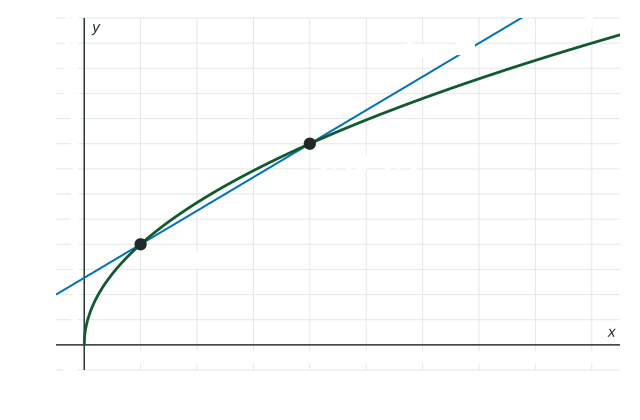
Part 5 · Step by step
How it works, step by step
- Pick an interval and find and the average rate of change is , in output units per input unit
- Draw the line through and its slope is that average rate of change
- Shrink the interval around a point the average rate of change estimates how fast changes at
- Compare such estimates at two points over equally short intervalsthe larger one tells where is changing faster
Part 6 · Key ideas
Key ideas
- The average rate of change of on is : the slope of the line through and .
- Units: output units per input unit, like miles per hour or dollars per year.
- Positive: the output ends higher. Negative: it ends lower. Zero: the outputs at the ends are equal.
- To compare rates at two points, use short intervals of the same length around each.
Part 7 · Misconception
A common mistake
The wrong idea: The interval with the biggest change in output has the biggest average rate of change.
What actually happens: Divide by the length of the interval first. The hiker gained miles on but only on , yet the rate on is higher: against miles per hour.
Part 8 · Check yourself
Check yourself
Exam-style questions. Anything you miss goes into your review queue.
Table
Distance on a hike
| (hours) | 0 | 1 | 3 | 4 | 6 |
|---|---|---|---|---|---|
| (miles) | 0 | 2.5 | 7.0 | 8.8 | 11.2 |
1. What is the average rate of change of on ?
No calculator. Type the exact value (a fraction, π, e or a root is fine), then its unit.
Show the answer
- Answer: ≈ 2.250 miles per hour
2. On which interval between consecutive table times is the average rate of change of greatest?
Show the answer
The intervals have different lengths, so compare rates, not changes: , , and miles per hour on , , and .
- : The distance grows most here ( miles), but over hours: miles per hour, less than on .
- Correct: : Right: miles in hour is miles per hour, the greatest of , , and .
- : miles per hour, the smallest.
- : miles per hour.
3. Using the table, which is the best estimate of how fast the hiker is walking at hours?
- miles per hour
- miles per hour
- miles per hour
- miles per hour
Show the answer
To estimate the rate at one time, use the average rate of change over a short interval containing it:
- Correct: miles per hour: Right: is the shortest interval in the table that contains , and its average rate is .
- miles per hour: This is , which mixes a distance at with the time ; use the average rate over .
- miles per hour: is the distance at , not a rate.
- miles per hour: That is the average over the whole hike, ; a short interval around gives a better estimate.
Graph
Concentration of a medicine
4. The concentration of a medicine in the blood is milligrams per liter, hours after a dose. Find the average rate of change of on .
Calculator allowed. Give the answer correct to three decimal places, in milligrams per liter per hour.
Show the answer
and , so
- Answer: 0.750 milligrams per liter per hour
5. The concentration of a medicine in the blood is milligrams per liter, hours after a dose. Use the average rate of change on to estimate how fast is changing at . Give your answer to three decimal places.
Calculator allowed. Give the answer correct to three decimal places, in milligrams per liter per hour.
Show the answer
and
- Answer: 2.581 milligrams per liter per hour
6. The concentration of a medicine in the blood is milligrams per liter, hours after a dose. Which interval's average rate of change gives the best estimate of how fast changes at ?
Show the answer
The shorter the interval around a point, the closer the average rate of change is to how fast the function changes at that point.
- : A long interval mixes the fast early change with the slow later change.
- : This interval is long and starts at , so it reflects mostly later, slower change.
- Correct: : Right: a short interval around uses outputs very close to the one at .
- : Better than a long interval, but is much shorter around .
Part 9 · Summary
Summary
Part 10 · Up next
What comes next
Part 11 · Connections