Unit 3 · Topic 3.8

The Tangent Function

tan θ = (sin θ)/(cos θ) , the slope of the terminal ray.

Practice 2: Multiple RepresentationsPractice 3: Communication and Reasoning

Part 1 · Hook

Why this matters

A lighthouse sweeps its beam across a straight shore. When the beam points straight at the shore, the spot of light is close. As the beam turns, the spot races away, faster and faster, until the beam runs parallel to the shore and the spot is gone. The distance along the shore is a tangent function, and its vertical asymptote is that moment.

Part 2 · Before you start

What this builds on

Part 3 · Prerequisite check

Quick check before you start

1. What is sin⁡(π/4)cos⁡(π/4)\frac{\sin(\pi/4)}{\cos(\pi/4)}?

  1. 11
  2. 22\frac{\sqrt{2}}{2}
  3. 2\sqrt{2}
  4. 00
Show the answer

sin⁡π4\sin\frac{\pi}{4}=cos⁡π4= \cos\frac{\pi}{4}=22= \frac{\sqrt{2}}{2}, so the quotient is 11.

  • Correct: 11:
  • 22\frac{\sqrt{2}}{2}:
  • 2\sqrt{2}:
  • 00:

2. What is the period of y=sin⁡(3x)y = \sin(3x)?

  1. 2π3\frac{2\pi}{3}
  2. 6π6\pi
  3. 33
  4. π3\frac{\pi}{3}
Show the answer

The period of sin⁡(bx)\sin(bx) is 2π|b|=2π3\frac{2\pi}{|b|} = \frac{2\pi}{3}.

  • Correct: 2π3\frac{2\pi}{3}:
  • 6π6\pi:
  • 33:
  • π3\frac{\pi}{3}:

3. g(x)=1x−2g(x) = \frac{1}{x - 2}. What is limx→2+g(x)\lim_{x \to 2^+} g(x)?

  1. ∞\infty
  2. −∞-\infty
  3. 00
  4. 12\frac{1}{2}
Show the answer

Just right of 22 the denominator is a small positive number, so gg grows without bound.

  • Correct: ∞\infty:
  • −∞-\infty:
  • 00:
  • 12\frac{1}{2}:

Part 4 · See it

See it first

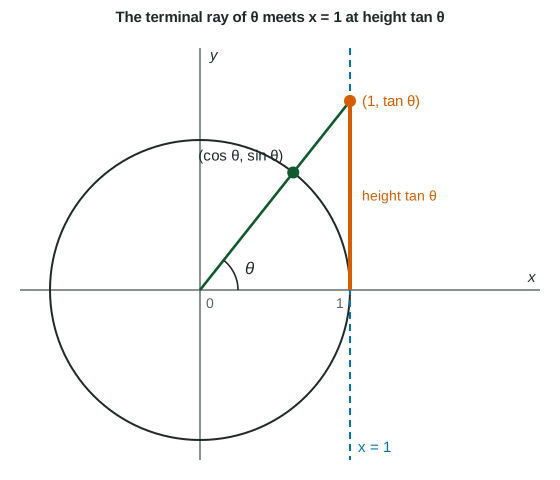
A unit circle with an angle theta in standard position. Its terminal ray passes through (cos theta, sin theta) and continues to the dashed line x = 1, which it meets at (1, tan theta). The vertical segment from the x-axis to that point has length tan theta.
The terminal ray of θ\theta meets the line x=1x = 1 at height tan⁡θ\tan\theta, which is also the slope of the ray. LevlPrep original diagram.

Part 5 · Step by step

How it works, step by step

  1. Write tan⁡θ=sin⁡θcos⁡θ\tan\theta = \frac{\sin\theta}{\cos\theta}tangent is 00 where sin⁡θ=0\sin\theta = 0, at θ=kπ\theta = k\pi
  2. cos⁡θ=0\cos\theta = 0 at θ=π2+kπ\theta = \frac{\pi}{2} + k\pithe quotient is undefined there: vertical asymptotes
  3. After a half turn, sin⁡\sin and cos⁡\cos both change signtheir quotient repeats, so the period is π\pi
  4. Use f(x)f(x)=atan⁡(b(x−c))+d= a\tan(b(x - c)) + dperiod π|b|\frac{\pi}{|b|}, shifted right cc and up dd, stretched by aa

Part 6 · Key ideas

Key ideas

  • tan⁡θ\tan\theta is the slope of the terminal ray, and the height where that ray meets the line x=1x = 1.
  • Tangent is 00 where sine is 00 and has a vertical asymptote where cosine is 00.
  • The period of atan⁡(bx)a\tan(bx) is π|b|\frac{\pi}{|b|}, half of what the sine rule would give.
  • On each branch tangent increases; it is concave down left of its zero and concave up right of it.

Part 7 · Misconception

A common mistake

The wrong idea: Tangent repeats every 2π2\pi, like sine and cosine, so the period of tan⁡(bx)\tan(bx) is 2πb\frac{2\pi}{b}.

What actually happens: After a half turn, sin⁡\sin and cos⁡\cos both change sign, so sin⁡cos⁡\frac{\sin}{\cos} is the same again. Tangent repeats every π\pi, and tan⁡(bx)\tan(bx) every π|b|\frac{\pi}{|b|}.

Part 8 · Check yourself

Check yourself

Exam-style questions. Anything you miss goes into your review queue.

Graph

The graph of f(x)=2tan⁡(x2)f(x) = 2\tan\left(\frac{x}{2}\right)

−2π−3π/2−π−π/2π/2π3π/22π−6−4−2246xyf

1. The graph shows f(x)=2tan⁡(x2)f(x) = 2\tan\left(\frac{x}{2}\right). What is the period of ff?

  1. 2π2\pi
  2. π\pi
  3. 4π4\pi
  4. π2\frac{\pi}{2}
Show the answer

For atan⁡(bx)a\tan(bx) the period is π|b|\frac{\pi}{|b|}. Here b=12b = \frac{1}{2}, so the period is π1/2=2π\frac{\pi}{1/2} = 2\pi. On the graph, the asymptotes at x=−πx = -\pi and x=πx = \pi are 2π2\pi apart.

  • Correct: 2π2\pi: Right: π1/2=2π\frac{\pi}{1/2} = 2\pi, the distance between the asymptotes at −π-\pi and π\pi.
  • π\pi: That is the period of tan⁡x\tan x; the factor 12\frac{1}{2} inside stretches the graph to period 2π2\pi.
  • 4π4\pi: That is 2πb\frac{2\pi}{b}, the sine and cosine rule; tangent repeats after πb\frac{\pi}{b}.
  • π2\frac{\pi}{2}: This multiplies π\pi by bb instead of dividing by bb.

2. For the function in the graph, which statement about ff near x=πx = \pi is true?

  1. limx→π−f(x)=∞\lim_{x \to \pi^-} f(x) = \infty
  2. limx→π−f(x)=−∞\lim_{x \to \pi^-} f(x) = -\infty
  3. limx→π−f(x)=0\lim_{x \to \pi^-} f(x) = 0
  4. limx→π−f(x)=2\lim_{x \to \pi^-} f(x) = 2
Show the answer

As xx increases toward π\pi, x2\frac{x}{2} increases toward π2\frac{\pi}{2}, where sin⁡\sin is near 11 and cos⁡\cos is a small positive number. So tan⁡x2\tan\frac{x}{2} grows without bound and limx→π−f(x)=∞\lim_{x \to \pi^-} f(x) = \infty; on the graph the branch rises along the dashed line.

  • Correct: limx→π−f(x)=∞\lim_{x \to \pi^-} f(x) = \infty: Right: from the left, the branch climbs without bound beside the asymptote.
  • limx→π−f(x)=−∞\lim_{x \to \pi^-} f(x) = -\infty: That is the behavior from the right, limx→π+f(x)=−∞\lim_{x \to \pi^+} f(x) = -\infty, where the next branch starts.
  • limx→π−f(x)=0\lim_{x \to \pi^-} f(x) = 0: ff is 00 at x=0x = 0 and x=2πx = 2\pi, not near the asymptote.
  • limx→π−f(x)=2\lim_{x \to \pi^-} f(x) = 2: f(π2)=2f(\frac{\pi}{2}) = 2 is one point on the branch; near π\pi the outputs keep growing.

3. For the function in the graph, which statement describes ff on the interval (0,π)(0, \pi)?

  1. ff is increasing, and the rate of change of ff is increasing
  2. ff is increasing, and the rate of change of ff is decreasing
  3. ff is decreasing, and the rate of change of ff is increasing
  4. ff is increasing, and the rate of change of ff is constant
Show the answer

On (0,π)(0, \pi) the outputs rise from 00 toward the asymptote, so ff is increasing. The graph bends upward (concave up): over equal steps the rises get bigger, for example ff goes up 22 on [0,π2]\left[0, \frac{\pi}{2}\right] and much more than 22 on [π2,π)\left[\frac{\pi}{2}, \pi\right). So the rate of change of ff is increasing.

  • Correct: ff is increasing, and the rate of change of ff is increasing: Right: rising outputs, and each equal step rises more than the last (concave up).
  • ff is increasing, and the rate of change of ff is decreasing: That describes a branch bending downward, like ff on (−π,0)(-\pi, 0); on (0,π)(0, \pi) the graph bends upward.
  • ff is decreasing, and the rate of change of ff is increasing: The outputs go up from 00, so ff is increasing here, not decreasing.
  • ff is increasing, and the rate of change of ff is constant: A constant rate of change means a straight line; this branch curves upward.

Table

A lighthouse beam on a straight shore

A lighthouse stands 44 kilometers from a straight shore. Its beam makes an angle θ\theta radians with the shortest path to the shore, and the spot of light is d(θ)=4tan⁡θd(\theta) = 4\tan\theta kilometers along the shore from the nearest point, for 0≤θ<π20 \le \theta < \frac{\pi}{2}.

Distance d(θ) of the spot of light along the shore, in kilometers, for selected angles θ, in radians
θ\theta (radians)00π6\frac{\pi}{6}π4\frac{\pi}{4}π3\frac{\pi}{3}
d(θ)d(\theta) (kilometers)00433\frac{4\sqrt{3}}{3}44434\sqrt{3}

4. Using the table, find the average rate of change of dd on [π6,π3]\left[\frac{\pi}{6}, \frac{\pi}{3}\right]. Give an exact value.

No calculator. Type the exact value (a fraction, π, e or a root is fine), in kilometers per radian.

Show the answer

The average rate of change of dd on [π6,π3]\left[\frac{\pi}{6}, \frac{\pi}{3}\right] is the slope of the secant line: d(π/3)−d(π/6)π/3−π/6\frac{d(\pi/3) - d(\pi/6)}{\pi/3 - \pi/6}=43−433π/6= \frac{4\sqrt{3} - \frac{4\sqrt{3}}{3}}{\pi/6}=833⋅6π= \frac{8\sqrt{3}}{3}\cdot\frac{6}{\pi}=163π= \frac{16\sqrt{3}}{\pi} kilometers per radian, about 8.828.82.

  • Answer: 163π\frac{16\,\sqrt{3}}{\pi} ≈ 8.821 kilometers per radian

5. A student says the spot is twice as far along the shore at θ=π3\theta = \frac{\pi}{3} as at θ=π6\theta = \frac{\pi}{6}, because the angle doubled. Which response is correct?

  1. No: d(π3)=43d\left(\frac{\pi}{3}\right) = 4\sqrt{3}, which is 33 times d(π6)=433d\left(\frac{\pi}{6}\right) = \frac{4\sqrt{3}}{3}
  2. Yes: dd is proportional to θ\theta, so doubling θ\theta doubles dd
  3. No: d(π3)d\left(\frac{\pi}{3}\right) is 44 times d(π6)d\left(\frac{\pi}{6}\right), because tan⁡\tan squares the angle
  4. Yes: tan⁡(2⋅π6)=2tan⁡(π6)\tan\left(2\cdot\frac{\pi}{6}\right) = 2\tan\left(\frac{\pi}{6}\right)
Show the answer

From the table, d(π3)=43d\left(\frac{\pi}{3}\right) = 4\sqrt{3} and d(π6)=433d\left(\frac{\pi}{6}\right) = \frac{4\sqrt{3}}{3}, so the ratio is 4343/3=3\frac{4\sqrt{3}}{4\sqrt{3}/3} = 3. Tangent is not linear: doubling the input does not double the output.

  • Correct: No: d(π3)=43d\left(\frac{\pi}{3}\right) = 4\sqrt{3}, which is 33 times d(π6)=433d\left(\frac{\pi}{6}\right) = \frac{4\sqrt{3}}{3}: Right: the ratio of the table values is 33, not 22.
  • Yes: dd is proportional to θ\theta, so doubling θ\theta doubles dd: dd would be proportional to θ\theta only if its graph were a line through the origin; the rates in the table are not constant.
  • No: d(π3)d\left(\frac{\pi}{3}\right) is 44 times d(π6)d\left(\frac{\pi}{6}\right), because tan⁡\tan squares the angle: The ratio from the table is 33; tangent does not square its input.
  • Yes: tan⁡(2⋅π6)=2tan⁡(π6)\tan\left(2\cdot\frac{\pi}{6}\right) = 2\tan\left(\frac{\pi}{6}\right): tan⁡π3=3\tan\frac{\pi}{3} = \sqrt{3} and 2tan⁡π6=2332\tan\frac{\pi}{6} = \frac{2\sqrt{3}}{3}, which differ.

6. The terminal ray of an angle θ\theta in standard position passes through the point (−3,4)(-3, 4). The line containing this ray meets the vertical line x=1x = 1. At what point do they meet?

  1. (1,−43)\left(1, -\frac{4}{3}\right)
  2. (1,−34)\left(1, -\frac{3}{4}\right)
  3. (1,43)\left(1, \frac{4}{3}\right)
  4. (1,45)\left(1, \frac{4}{5}\right)
Show the answer

The line through the origin and (−3,4)(-3, 4) has slope 4−3=−43\frac{4}{-3} = -\frac{4}{3}, which is tan⁡θ\tan\theta. A line through the origin with slope mm is at height mm when x=1x = 1, so it meets x=1x = 1 at (1,−43)\left(1, -\frac{4}{3}\right): the height there is tan⁡θ\tan\theta. (The ray itself points into Quadrant II; it is the line through it, extended back through the origin, that reaches x=1x = 1.)

  • Correct: (1,−43)\left(1, -\frac{4}{3}\right): Right: at x=1x = 1 the height equals the slope, tan⁡θ=4−3\tan\theta = \frac{4}{-3}.
  • (1,−34)\left(1, -\frac{3}{4}\right): This uses xy\frac{x}{y}; the slope is yx\frac{y}{x}, rise over run.
  • (1,43)\left(1, \frac{4}{3}\right): The point (−3,4)(-3, 4) has a negative xx-coordinate, so the slope, and the height at x=1x = 1, are negative.
  • (1,45)\left(1, \frac{4}{5}\right): This is sin⁡θ=yr\sin\theta = \frac{y}{r} with r=5r = 5, the height where the ray meets the unit circle, not the line x=1x = 1.

7. The graph of y=tan⁡xy = \tan x is shifted right π4\frac{\pi}{4} units and up 22 units. Write the new function gg.

Type an expression for g(x)=g(x) =.

Show the answer

A shift right by π4\frac{\pi}{4} replaces xx with x−π4x - \frac{\pi}{4}, and a shift up adds 22 outside: g(x)=tan⁡(x−π4)+2g(x) = \tan\left(x - \frac{\pi}{4}\right) + 2. Its asymptotes move to x=3π4+kπx = \frac{3\pi}{4} + k\pi.

  • Answer: g(x)=g(x) = tan⁡(x−π4)+2\tan\left(x - \frac{\pi}{4}\right) + 2

Part 9 · Summary

Summary

tan⁡θ=sin⁡θcos⁡θ\tan\theta = \frac{\sin\theta}{\cos\theta}, the slope of the terminal ray. It is 00 at θ=kπ\theta = k\pi, has vertical asymptotes at θ=π2+kπ\theta = \frac{\pi}{2} + k\pi with outputs growing without bound on each side, and has period π\pi. For atan⁡(b(x−c))+da\tan(b(x - c)) + d the period is π|b|\frac{\pi}{|b|} and the asymptotes shift with the graph.

Part 10 · Up next

What comes next

Part 11 · Connections

Connections