Restricted to [−π/2 , π/2] , [0, π] and (−π/2 , π/2) , sine, cosine and tangent are invertible.
Practice 1: Procedural and Symbolic FluencyPractice 2: Multiple Representations
Part 1 · Hook
Why this matters
A building code limits how steep a wheelchair ramp can be. The inspector measures the rise and the run, so she knows the tangent of the ramp's angle. To get the angle itself she has to run tangent backward. That backward function exists only if you agree, in advance, which angle to report.
Part 2 · Before you start
What this builds on
Part 3 · Prerequisite check
Quick check before you start
1. What is ?
Show the answer
On the unit circle the angle meets the point , so its sine is .
Correct: :
:
:
:
2. is invertible and . What is ?
Show the answer
An inverse swaps inputs and outputs: means .
Correct: :
:
:
:
Part 4 · See it
See it first
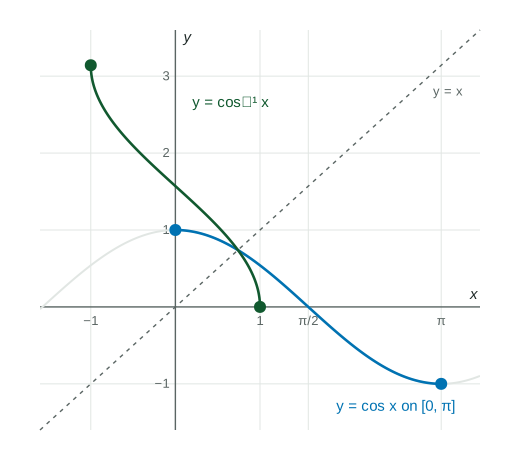
Cosine kept only on (blue) takes each value from to once. Reflecting it across gives (green). LevlPrep original diagram.
Part 5 · Step by step
How it works, step by step
Sine, cosine and tangent repeat outputs→they have no inverse on their whole domains
Restrict each to one interval where it is one-to-one→ on , on , on
Swap inputs and outputs of the restricted function→, and , whose outputs are angles in those intervals
Evaluate →you get back only when is already in
Part 6 · Key ideas
Key ideas
An inverse trigonometric function takes a ratio and returns an angle.
and return angles between and ; returns angles between and .
is the inverse function, not the reciprocal .
For a composite like , find the inner value first, then the angle in the right range.
Part 7 · Misconception
A common mistake
The wrong idea: , because .
What actually happens: Many angles have tangent , but returns the one in : .
Part 8 · Check yourself
Check yourself
Exam-style questions. Anything you miss goes into your review queue.
Graph
The graph of
1. The graph shows . What is the range of ?
Show the answer
undoes cosine restricted to , so its outputs are the angles in . The graph runs from height at down to at .
Correct: : Right: the outputs are angles from to .
: That is the range of and (open) of , not of .
: That is the domain of : the inputs are cosine values.
: Cosine is not one-to-one on (), so that interval cannot be the range.
2. Using the graph or the unit circle, find the exact value of .
No calculator. Type the exact value (a fraction, π, e or a root is fine).
Show the answer
is the angle in whose cosine is . That angle is in Quadrant II with reference angle : .
Answer: ≈ 2.094
3. The graph of is symmetric about the point . If , which expression equals ?
Show the answer
Symmetry about means the heights at and average to : . On the unit circle, the angle with cosine is the reflection of angle across the -axis, which is .
Correct: : Right: the two outputs add to .
: is negative, outside the range .
: , not ; the inputs differ in sign, so the angles differ.
: is greater than , outside the range.
Table
Four wheelchair ramp designs
Each ramp rises a vertical distance over a horizontal run. The angle between a ramp and the ground satisfies , with . Use a calculator in radian mode.
Rise and horizontal run of four ramp designs, in meters
Ramp
Rise (meters)
Run (meters)
K
L
M
N
4. Use a calculator to find the angle, in radians, between ramp L and the ground. Give your answer correct to three decimal places.
Calculator allowed. Give the answer correct to three decimal places, in radians.
Show the answer
Set up , so radians (calculator in radian mode), which is to three decimal places.
Answer: 0.080 radians
5. with domain is invertible. Find for .
Type an expression for .
Show the answer
Write , swap: . Undo in reverse order: subtract , divide by , then apply : . The restricted domain is the range of , so this is the inverse.
Answer:
6. Find the exact value of .
No calculator. Type the exact value (a fraction, π, e or a root is fine).
Show the answer
gives the angle in with the given tangent. and tangent is odd, so .
Answer: ≈ -0.785
7. What is the exact value of ?
Show the answer
Let , so with in ; here is in Quadrant I. Draw a right triangle with opposite side and hypotenuse : the adjacent side is . So , positive because is in Quadrant I.
Correct: : Right: adjacent over hypotenuse in the -- triangle.
: That is , opposite over adjacent.
: of a positive number is an angle in Quadrant I, where cosine is positive.
: That is hypotenuse over adjacent, the reciprocal of the cosine.
Part 9 · Summary
Summary
Restricted to , and , sine, cosine and tangent are invertible. , and take a ratio and return the one angle in that interval. Inverse is not reciprocal, and only for in the restricted interval.