An arterial blood gas tells you, in three numbers, whether a patient's acid–base balance has failed, which end of the system failed, and how far the other end has responded. This page teaches ABG interpretation step by step. It starts with what the three numbers mean, then covers the four primary acid–base disorders and their causes, how the lungs and kidneys compensate, and how to read a blood gas in five steps, with worked examples you can check yourself against.
The arterial blood gas
A paramedic brings in a man found unresponsive with slow, shallow breathing. A nurse draws blood from his radial artery into a heparinized syringe, and within two minutes the analyzer prints his arterial blood gas (ABG): the pH, carbon dioxide, oxygen and bicarbonate of his arterial blood. Arterial blood is used because it has just left the lungs, so it shows how well the lungs are working, and it is the same everywhere in the arterial tree.
Three of the numbers carry the acid–base story:
- pH. Normal 7.35 to 7.45. Below 7.35 is acidemia; above 7.45 is alkalemia.
- PaCO2, the partial pressure of carbon dioxide in arterial blood (P = partial pressure, a = arterial). Normal 35 to 45 mm Hg. It is set by ventilation, so it is the respiratory number.
- HCO3−, bicarbonate. Normal 22 to 26 mmol/L. The analyzer calculates it from the pH and PaCO2 with the Henderson–Hasselbalch equation. It is set mainly by the kidneys and by fixed acids, so it is the metabolic number.
The fourth number, PaO2 (normal about 80 to 100 mm Hg), tells you about oxygenation, not acid–base balance. You read it separately.
From the last topic, pH follows the ratio of bicarbonate to dissolved carbon dioxide:
pH = 6.1 + log ( HCO3− ÷ (0.03 × PaCO2) )
So pH can fall for only two reasons: PaCO2 goes up, or bicarbonate goes down. And it can rise for only two reasons: PaCO2 goes down, or bicarbonate goes up. Those four possibilities are the four primary disorders.
The four primary disorders
An acid–base disorder is named for two things: which way it pushes pH, and which number changed first.
- Respiratory disorders start with a change in PaCO2, caused by a change in breathing.
- Metabolic disorders start with a change in bicarbonate, caused by a gain or loss of fixed acid or of bicarbonate.
One pattern makes them easy to tell apart. In a respiratory disorder, pH and PaCO2 move in opposite directions: PaCO2 up, pH down. In a metabolic disorder, pH and bicarbonate move in the same direction: bicarbonate down, pH down. (Students remember this as "ROME": respiratory opposite, metabolic equal.)
| Respiratory acidosis | Respiratory alkalosis | Metabolic acidosis | Metabolic alkalosis | |
|---|---|---|---|---|
| Primary change | PaCO2 up (above 45) | PaCO2 down (below 35) | HCO3− down (below 22) | HCO3− up (above 26) |
| pH | Down | Up | Down | Up |
| Underlying cause | Hypoventilation | Hyperventilation | Fixed acid gained, or bicarbonate lost | Acid lost, or bicarbonate gained |
| Compensating change | HCO3− up | HCO3− down | PaCO2 down | PaCO2 up |
| Who compensates | Kidneys, over 3 to 5 days | Kidneys, over 3 to 5 days | Lungs, within minutes to hours | Lungs, within minutes to hours |
| Common causes | Opioid or sedative overdose, COPD, weak breathing muscles, airway obstruction | Anxiety, pain, fever, high altitude, early pneumonia or asthma | Diabetic ketoacidosis, lactic acid in shock, kidney failure, severe diarrhea | Vomiting, stomach suction, diuretics, excess aldosterone |
| Typical signs | Drowsiness, headache, confusion | Lightheadedness, tingling, hand spasms | Deep, fast breathing; confusion | Slow, shallow breathing; tingling, cramps |
Respiratory acidosis
The man with slow, shallow breathing took too much of an opioid painkiller. Opioids depress the respiratory centers, so his alveolar ventilation fell far below his carbon dioxide production. Carbon dioxide built up, and his blood grew acidic.
Respiratory acidosis is a fall in pH caused by a rise in PaCO2 above 45 mm Hg, from hypoventilation. Anything that reduces alveolar ventilation can cause it:
- Depressed respiratory centers: opioid or sedative overdose, brainstem injury.
- Weak or injured breathing muscles or chest wall: spinal cord injury above the phrenic nerve roots, nerve and muscle diseases, broken ribs.
- Blocked airways: choking, a severe asthma attack that is tiring the patient.
- Lung disease, above all COPD, where damaged lungs cannot move enough air through the alveoli.
High carbon dioxide dilates the brain's arterioles and depresses the nervous system: headache, drowsiness, confusion and, if PaCO2 keeps climbing, coma.
The kidneys respond, slowly
The lungs cannot fix a problem that the lungs are causing, so the correction falls to the kidneys. The high PaCO2 reaches tubule cells, which make more H+, secrete more of it and make more ammonium. Each H+ excreted adds a new bicarbonate to the blood. Bicarbonate rises, the ratio moves back toward 20, and pH rises toward normal. This takes 3 to 5 days to reach full effect.
That is why doctors distinguish two forms:
- Acute respiratory acidosis, in the first hours: PaCO2 high, bicarbonate barely changed, pH low. The opioid overdose is an example.
- Chronic respiratory acidosis, after days: PaCO2 high, bicarbonate high, pH low-normal or only a little low. Many people with severe COPD live this way for years.
Oxygen and carbon dioxide retention in COPD
In the control of breathing you met people with severe COPD whose PaCO2 rises further when they are given a lot of oxygen. The better-supported explanation is that oxygen worsens ventilation–perfusion mismatch, by reversing hypoxic pulmonary vasoconstriction, and that the Haldane effect lets the blood hold less carbon dioxide at the same PaCO2. A lost "hypoxic drive" plays at most a small part. The result is a worse respiratory acidosis, so oxygen is given to a target saturation, often 88 to 92%, while breathing is watched. It is never withheld from a person who is hypoxic.
Respiratory alkalosis
A 22-year-old sits in the emergency department after a panic attack, breathing fast and deep. Her lips and fingers tingle and her hands have cramped into claws.
Respiratory alkalosis is a rise in pH caused by a fall in PaCO2 below 35 mm Hg, from hyperventilation. Causes include:
- Anxiety, panic, pain and fever, which drive the respiratory centers from above.
- Low oxygen: high altitude, early pneumonia or asthma, a clot in the lungs. Low PaO2 stimulates the carotid bodies, and PaCO2 falls as a side effect.
- Some drugs and illnesses: early aspirin poisoning, sepsis and liver failure stimulate the respiratory centers directly.
- A ventilator set to breathe too much for the patient.
Her symptoms follow from the chain you met in the control of breathing. Low carbon dioxide constricts the brain's arterioles, so she feels lightheaded. In alkalemia, more calcium binds to albumin, free calcium falls, and nerves and muscles fire too easily: tingling and the cramping spasms of the hands and feet.
The kidneys respond by secreting less H+, reclaiming less bicarbonate and letting type B intercalated cells excrete it. Over several days, bicarbonate falls to match the lower PaCO2. You met this as acclimatization at high altitude. A panic attack, over in minutes, is too short for the kidneys to act.
Metabolic acidosis
Metabolic acidosis is a fall in pH caused by a fall in bicarbonate below 22 mmol/L. Bicarbonate can fall in two ways:
- Acid is gained. A fixed acid adds hydrogen ions, and bicarbonate is used up buffering them. Ketone bodies, lactic acid and the sulfuric and phosphoric acids that failed kidneys cannot excrete all work this way. So do poisons such as methanol, antifreeze and large doses of aspirin.
- Bicarbonate is lost. Severe diarrhea carries away intestinal fluid rich in bicarbonate. In cholera, stool losses of over 10 L a day take bicarbonate and potassium with them. Drugs such as acetazolamide, and some diseases of the proximal tubule, let filtered bicarbonate escape in the urine.
The anion gap
A blood test can tell these two apart. Plasma must carry as much negative charge as positive, but a routine test measures only the main ions. The anion gap is the difference between the main measured cation and the main measured anions:
anion gap = Na+ − (Cl− + HCO3−)
It is not a real gap in charge. It stands for the anions the test does not measure, mostly albumin, plus phosphate, sulfate and organic anions. With most modern analyzers it is normally about 8 to 12 mmol/L.
Worked example 1: a normal anion gap
Problem. Plasma Na+ is 140, Cl− 104 and HCO3− 24 mmol/L. What is the anion gap?
- Add the measured anions. 104 + 24 = 128 mmol/L.
- Subtract from sodium. 140 − 128 = 12 mmol/L.
Answer. 12 mmol/L: normal. The unmeasured anions make up the difference.
Now think about what happens to the gap in each kind of metabolic acidosis:
- High anion gap: acid gained. A ketone body acid releases H+ and leaves its anion behind. The H+ uses up bicarbonate, and the anion, which the test does not measure, takes bicarbonate's place. Bicarbonate falls, chloride stays the same, and the gap rises. Ketoacidosis, lactic acidosis, advanced kidney failure and the poisons above all do this.
- Normal anion gap: bicarbonate lost. When bicarbonate is lost in stool or urine, the kidneys and gut keep chloride in its place. Bicarbonate falls, chloride rises (hyperchloremia) and the gap stays normal. Diarrhea is the classic cause. In cholera severe enough to cause shock, the gap can rise as well, from concentrated plasma proteins and lactic acid.
Worked example 2: two patients with low bicarbonate
Problem. Patient 1: Na+ 134, Cl− 98, HCO3− 5. Patient 2: Na+ 137, Cl− 112, HCO3− 15. Which one has gained acid, and which has lost bicarbonate?
- Patient 1. 134 − (98 + 5) = 134 − 103 = 31 mmol/L. High.
- Patient 2. 137 − (112 + 15) = 137 − 127 = 10 mmol/L. Normal, with a high chloride.
- Interpret. In Patient 1, an unmeasured anion has replaced bicarbonate: an acid has been added. In Patient 2, chloride has replaced bicarbonate: bicarbonate has been lost.
Answer. Patient 1 has gained acid (a high anion gap metabolic acidosis; he turns out to have diabetic ketoacidosis). Patient 2 has lost bicarbonate (a normal anion gap metabolic acidosis; she has had three days of severe diarrhea).
Diabetic ketoacidosis
Diabetic ketoacidosis (DKA) is a common and dangerous metabolic acidosis, and the leading cause of death in children and young adults with type 1 diabetes. It happens when insulin is nearly absent, as in untreated or undertreated type 1 diabetes, often set off by an infection or missed insulin doses. You met its pieces in the metabolism and endocrine chapters. Here they come together:
- With almost no insulin, lipolysis runs unchecked, and glucagon stays high.
- The liver turns the flood of fatty acids into ketone bodies, far faster than other tissues can burn them.
- Acetoacetate and beta-hydroxybutyrate release hydrogen ions. Bicarbonate is used up buffering them, and the ketone body anions raise the anion gap.
- Glucose is also very high. The glucose spilling into the urine holds water with it, so the patient passes large volumes of urine, loses water, sodium and potassium, and becomes badly dehydrated.
- The fall in pH drives deep, fast breathing, and acetone, a ketone body that is breathed out, gives the breath a fruity smell.
DKA is diagnosed from three findings: a blood glucose of 200 mg/dL (11.1 mmol/L) or more, or known diabetes, because DKA can occur at near-normal glucose; beta-hydroxybutyrate of 3.0 mmol/L or more; and a metabolic acidosis, with pH below 7.30 or bicarbonate below 18 mmol/L. Potassium needs care. Lack of insulin, and the high glucose that draws water, and potassium with it, out of cells, let potassium move into the plasma. So plasma potassium is often normal or high at first, even though the body has lost a lot of it in the urine. When insulin treatment starts, potassium moves back into cells, and plasma potassium can fall dangerously. That is why fluids, insulin and potassium are given together.
Lactic acidosis
In shock or severe sepsis, tissues get too little oxygen and turn to anaerobic metabolism. They release hydrogen ions and lactate faster than the liver and other tissues can clear them. As you met in Foundations, the H+ comes from splitting glucose and spending the ATP it yields; lactate is the anion that raises the gap, and it is also a fuel the body normally burns. A high blood lactate is a sign of poor tissue perfusion.
How the lungs compensate
Metabolic acidosis lowers arterial pH, and the carotid bodies respond within minutes. Breathing becomes deeper and faster, PaCO2 falls, and the ratio moves back toward 20. In severe acidosis this deep, sighing breathing is called Kussmaul breathing, after Adolf Kussmaul, the German physician who described it in people dying of diabetes in 1874. It reaches full effect in 12 to 24 hours.
Effects of acidemia
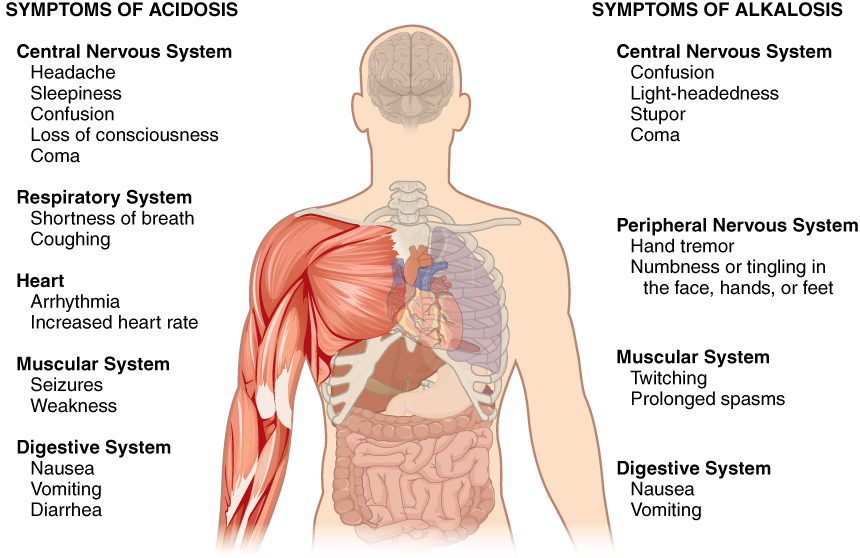
Severe acidemia depresses the nervous system (confusion, drowsiness, coma), weakens the heart's contractions, dilates arterioles and makes the heart prone to abnormal rhythms. It can also shift potassium out of cells, especially when the acid is a mineral acid rather than a ketone body or lactic acid, so plasma potassium rises. Figure 1 sets out the symptoms of acidosis beside those of alkalosis.
Metabolic alkalosis
Metabolic alkalosis is a rise in pH caused by a rise in bicarbonate above 26 mmol/L. Bicarbonate can rise because acid is lost or because base is added:
- Vomiting and stomach suction. You met the alkaline tide: for every H+ a parietal cell secretes into the stomach, one bicarbonate enters the blood. Normally that is balanced when the acid reaches the small intestine and bicarbonate is secreted to neutralize it. When the acid is vomited or suctioned out, the bicarbonate stays in the blood.
- Diuretics. Loop and thiazide diuretics make the kidneys lose sodium, chloride, water and potassium, and more sodium reaches the collecting duct, where H+ and K+ are secreted in its place.
- Too much aldosterone, as from an aldosterone-secreting adrenal tumor, which speeds H+ and K+ secretion. The very high cortisol of some cases of Cushing syndrome has the same effect, because cortisol at high levels acts like aldosterone on the kidney.
- Too much base: large amounts of antacids or baking soda.
Why the kidneys do not simply excrete the extra bicarbonate
Healthy kidneys can excrete bicarbonate fast. So a metabolic alkalosis that lasts means something is stopping them. Vomiting shows three such things at once:
- Volume loss. The fluid lost lowers blood volume. Angiotensin II speeds the sodium–hydrogen exchanger in the proximal tubule, so more bicarbonate is reclaimed, and aldosterone speeds H+ secretion in the collecting duct.
- Chloride loss. Vomit is rich in hydrochloric acid, so plasma chloride falls (hypochloremia). Type B intercalated cells secrete bicarbonate in exchange for chloride, and with little chloride in the tubular fluid they cannot excrete much.
- Potassium loss. Potassium is lost in vomit and, under aldosterone, in urine. Low potassium itself speeds H+ secretion and ammonium production.
This is why these patients are treated with salt water (normal saline) and potassium chloride. Once volume, chloride and potassium are replaced, the kidneys excrete the extra bicarbonate within a day or two.
How the lungs compensate
A higher pH slows breathing, and PaCO2 rises to match the higher bicarbonate. This compensation is limited: breathing less also lowers PaO2, and once it falls far enough the carotid bodies drive breathing back up. PaCO2 rarely climbs above about 55 mm Hg.
Alkalemia makes nerves and muscles excitable, through the fall in free calcium: tingling, cramps, twitching and, if severe, abnormal heart rhythms, made worse by the low potassium that so often comes with it.
Compensation
Compensation is the response of the system that did not cause the disorder: it changes its own number in the direction that moves the ratio back toward 20. The rule is simple. The compensating number moves in the same direction as the primary number.
- Bicarbonate falls in metabolic acidosis, so the lungs lower PaCO2 too.
- PaCO2 rises in respiratory acidosis, so the kidneys raise bicarbonate too.
If both went down, or both went up, the ratio can return toward 20 even though neither number is normal.
| Respiratory compensation | Renal compensation | |
|---|---|---|
| Compensates for | Metabolic acidosis and metabolic alkalosis | Respiratory acidosis and respiratory alkalosis |
| Number it changes | PaCO2 | HCO3− |
| Mechanism | Chemoreceptors change ventilation | Tubule cells change H+ secretion, ammonium production and bicarbonate reclaim |
| Starts | Within minutes | Within hours |
| Full effect | 12 to 24 hours | 3 to 5 days |
| Main limit | Slowing breathing lowers PaO2; faster breathing tires | Needs working kidneys and time |
Clinicians grade how far compensation has gone:
- Uncompensated: the primary number is abnormal and the other number is still normal. The pH is abnormal. This is typical of the first hours of a respiratory disorder, before the kidneys have acted.
- Partially compensated: both numbers are abnormal, moving in the same direction, and the pH is still outside 7.35 to 7.45.
- Fully compensated: both numbers are abnormal and the pH is back within 7.35 to 7.45. To find which disorder came first, look at which side of 7.40 the pH sits. Compensation seldom overshoots, so a pH of 7.36 points to an acidosis, and 7.44 to an alkalosis.
Compensation is not a cure. The primary number stays abnormal until the cause is treated: the opioid reversed, the insulin given, the vomiting stopped.
ABG interpretation step by step
Every blood gas can be read with the same five steps. Work through them in order, every time.
- pH. Below 7.35 is acidemia; above 7.45 is alkalemia. If it is within range, note which side of 7.40 it sits.
- PaCO2. Above 45 pushes toward acid; below 35 pushes toward alkaline.
- HCO3−. Below 22 pushes toward acid; above 26 pushes toward alkaline.
- Primary disorder. Whichever number pushes the same way as the pH caused the disorder. PaCO2 means respiratory; HCO3− means metabolic.
- Compensation. If the other number is normal, the disorder is uncompensated. If it has moved in the same direction as the primary number, compensation is under way: partial if the pH is still abnormal, full if it is back in range.
For a metabolic acidosis, add one more step: calculate the anion gap to tell acid gain from bicarbonate loss.
Each worked example below uses real-looking values. You can check any of them with the Henderson–Hasselbalch equation: the pH printed always matches the other two numbers.
Worked example 3: the opioid overdose
ABG. pH 7.26, PaCO2 60 mm Hg, HCO3− 26 mmol/L.
- pH 7.26: below 7.35, acidemia.
- PaCO2 60: above 45, pushing toward acid.
- HCO3− 26: within 22 to 26, normal.
- Primary. PaCO2 matches the acidemia: respiratory acidosis.
- Compensation. Bicarbonate is normal, so the kidneys have not responded yet: uncompensated.
- Check. 26 ÷ (0.03 × 60) = 26 ÷ 1.8 = 14.4; log 14.4 = 1.16; 6.1 + 1.16 = 7.26.
Answer. Uncompensated (acute) respiratory acidosis, from hypoventilation.
Worked example 4: severe COPD
ABG. pH 7.34, PaCO2 60 mm Hg, HCO3− 31 mmol/L.
- pH 7.34: just below 7.35, acidemia.
- PaCO2 60: high, pushing toward acid.
- HCO3− 31: high, pushing toward alkaline.
- Primary. Only PaCO2 matches the acidemia: respiratory acidosis.
- Compensation. Bicarbonate has risen in the same direction as PaCO2, and pH is still just outside the range: partially compensated.
- Check. 31 ÷ 1.8 = 17.2; log 17.2 = 1.24; pH = 7.34.
Answer. Partially compensated (chronic) respiratory acidosis. Compare it with Worked example 3: the same PaCO2, but days of kidney work have raised bicarbonate by 5 mmol/L and pH from 7.26 to 7.34.
Worked example 5: diabetic ketoacidosis
ABG. pH 7.12, PaCO2 16 mm Hg, HCO3− 5 mmol/L. Na+ 134, Cl− 98 mmol/L.
- pH 7.12: severe acidemia.
- PaCO2 16: very low, pushing toward alkaline.
- HCO3− 5: very low, pushing toward acid.
- Primary. Bicarbonate matches the acidemia: metabolic acidosis.
- Compensation. PaCO2 has fallen in the same direction as bicarbonate, but pH is still low: partially compensated. This is her Kussmaul breathing.
- Anion gap. 134 − (98 + 5) = 31: high. An acid has been added.
- Check. 5 ÷ (0.03 × 16) = 5 ÷ 0.48 = 10.4; log 10.4 = 1.02; pH = 7.12.
Answer. Partially compensated high anion gap metabolic acidosis: with high glucose and ketone bodies, diabetic ketoacidosis.
Worked example 6: three days of vomiting
ABG. pH 7.50, PaCO2 48 mm Hg, HCO3− 36 mmol/L.
- pH 7.50: alkalemia.
- PaCO2 48: high, pushing toward acid.
- HCO3− 36: high, pushing toward alkaline.
- Primary. Bicarbonate matches the alkalemia: metabolic alkalosis.
- Compensation. PaCO2 has risen with bicarbonate, and pH is still high: partially compensated.
- Check. 36 ÷ (0.03 × 48) = 36 ÷ 1.44 = 25; log 25 = 1.4; pH = 7.50.
Answer. Partially compensated metabolic alkalosis, from loss of stomach acid.
Worked example 7: a panic attack
ABG. pH 7.52, PaCO2 28 mm Hg, HCO3− 22 mmol/L.
- pH 7.52: alkalemia.
- PaCO2 28: low, pushing toward alkaline.
- HCO3− 22: at the bottom of normal.
- Primary. PaCO2 matches the alkalemia: respiratory alkalosis.
- Compensation. Bicarbonate is still within the normal range: uncompensated. (Buffers release a little H+ within minutes, which is why it has dipped from 24 to 22, but the kidneys have not yet acted.)
- Check. 22 ÷ (0.03 × 28) = 22 ÷ 0.84 = 26.2; log 26.2 = 1.42; pH = 7.52.
Answer. Uncompensated (acute) respiratory alkalosis.
Worked example 8: three weeks at altitude
ABG. pH 7.44, PaCO2 32 mm Hg, HCO3− 21 mmol/L.
- pH 7.44: within range, on the alkaline side of 7.40.
- PaCO2 32: low, pushing toward alkaline.
- HCO3− 21: low, pushing toward acid.
- Primary. PaCO2 matches the alkaline side: respiratory alkalosis.
- Compensation. Bicarbonate has fallen with PaCO2, and the pH is back in range: fully compensated.
- Check. 21 ÷ 0.96 = 21.9; log 21.9 = 1.34; pH = 7.44.
Answer. Fully compensated respiratory alkalosis: the kidneys' bicarbonate loss during acclimatization.
Worked example 9: severe diarrhea
ABG. pH 7.31, PaCO2 31 mm Hg, HCO3− 15 mmol/L. Na+ 137, Cl− 112 mmol/L.
- pH 7.31: acidemia.
- PaCO2 31: low, pushing toward alkaline.
- HCO3− 15: low, pushing toward acid.
- Primary. Bicarbonate matches the acidemia: metabolic acidosis.
- Compensation. PaCO2 has fallen with bicarbonate, pH still low: partially compensated.
- Anion gap. 137 − (112 + 15) = 10: normal, with a high chloride. Bicarbonate has been lost.
Answer. Partially compensated normal anion gap metabolic acidosis, from bicarbonate lost in stool.
When two disorders happen at once
A man collapses in cardiac arrest. During the resuscitation, his ABG reads pH 7.11, PaCO2 55 mm Hg, HCO3− 17 mmol/L. Step 2 says PaCO2 pushes toward acid; step 3 says bicarbonate pushes toward acid too. The numbers themselves have moved in opposite directions, PaCO2 up and bicarbonate down, which compensation never does. He has two primary disorders: a respiratory acidosis, because he is not breathing well, and a metabolic acidosis, from lactic acid made by tissues without enough blood flow. Together they drive the pH far lower than either would alone.
That gives you a quick check on every gas: if PaCO2 and bicarbonate have moved in opposite directions, or if one has moved far more or less than compensation would explain, look for a second disorder. Aspirin poisoning is another classic: it stimulates the respiratory centers (a respiratory alkalosis) while its acid adds a high anion gap metabolic acidosis.
Putting it together
Read the pH first, then ask which number explains it. A high PaCO2 from hypoventilation causes respiratory acidosis; a low PaCO2 from hyperventilation causes respiratory alkalosis. A low bicarbonate, from acid gained or bicarbonate lost, causes metabolic acidosis, and the anion gap tells you which. A high bicarbonate, most often from vomiting or diuretics and kept up by volume, chloride and potassium loss, causes metabolic alkalosis. The other system compensates by moving its own number in the same direction as the primary one: the lungs within hours, the kidneys over days. Compensation narrows the gap but does not remove the cause.