Biomass is the oldest fuel people use and is still one of the most common. This page covers what counts as biomass, how biofuels are made, and when biomass is really renewable.
What biomass is
For energy, biomass means organic matter from recently living things: wood and charcoal, crop waste such as corn stalks and rice husks, dried animal dung, and plants grown as fuel. Its energy is sunlight captured by photosynthesis, stored in the chemical bonds of the plant. Burning releases that energy as heat.
Most biomass is burned directly. About 2.1 billion people lack clean cooking fuels and rely mostly on wood, charcoal, dung or crop waste, often in open fires or simple stoves. In wealthier countries, wood chips and pellets are burned in some power plants and home stoves.
Biofuels
Biofuels are liquid or gas fuels made from biomass:
- Ethanol is made by fermenting the sugars in corn, sugarcane or other crops with yeast, then distilling it. Most gasoline sold in the United States contains about 10 percent ethanol, and many cars in Brazil run on sugarcane ethanol.
- Biodiesel is made from vegetable oils (soybean, canola, palm) or animal fats and can run diesel engines.
- Biogas is mostly methane, made when bacteria break down manure, food waste or sewage without oxygen.
Is biomass carbon neutral?
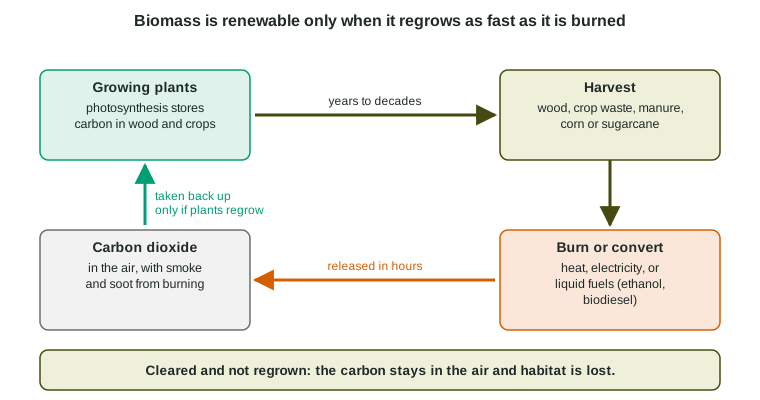
The carbon in a tree came from the air. When the tree is burned, the carbon returns to the air. If a new tree grows and takes the same carbon back, the cycle is close to carbon neutral. Three things break that balance:
- Timing. Burning releases the carbon in hours; regrowth takes years to decades.
- Overharvesting. If forest is cut faster than it regrows, the carbon stays in the air.
- Land clearing. Clearing forest to plant fuel crops releases the forest's stored carbon, far more than the fuel saves for many years.
Net energy
Growing, harvesting and processing fuel crops takes energy, mostly from fossil fuels: tractors, fertilizer, transport and distilling. Net energy is the energy in the fuel minus the energy used to make it.
Net energy of corn ethanol. A hectare of corn yields ethanol holding 75 GJ, and growing and processing it uses 55 GJ of fossil energy.
Setup:
Answer: per hectare. Sugarcane, which needs less fertilizer and uses its own waste as fuel at the mill, returns far more.
Burning biomass and health
Burning wood, dung or crop waste in an open fire or a simple stove is incomplete, so it releases soot, fine particles and poisonous gases along with carbon dioxide. Cooking indoors over these fires fills homes with smoke. Breathing it day after day damages the lungs and is one of the largest health risks in poorer countries, falling hardest on women and children who spend the most time near the fire. Cleaner stoves, chimneys and switching to gas or electricity cut this exposure.
Weighing biomass
| Advantages | Disadvantages |
|---|---|
| renewable when harvest matches regrowth | releases carbon dioxide, soot and particles; indoor smoke harms health |
| widely available; can use waste | overharvesting causes deforestation, destroys habitat and speeds erosion |
| liquid biofuels fit existing engines | fuel crops compete with food for land and water and need fertilizer |
| near carbon neutral when regrown | low energy per kilogram compared with fossil fuels |
"Renewable" and "clean" are different claims. Biomass is renewable when managed, but burning it still pollutes the air.