Energy from Biomass
Biomass energy releases the sunlight stored in wood, crops and waste, either by burning or by making biofuels such as ethanol and biodiesel.
Part 1 · Hook
Why this matters
Part 2 · Before you start
What this builds on
Part 3 · Prerequisite check
Quick check before you start
1. What is biomass in an ecosystem?
- The total mass of living or recently living organisms
- The mass of rock in the soil
- The energy in sunlight
- The water in a lake
Show the answer
Biomass is organic matter from living things, and it stores energy captured by producers.
- Correct: The total mass of living or recently living organisms:
- The mass of rock in the soil:
- The energy in sunlight:
- The water in a lake:
2. When is a renewable resource depleted?
- When it is used faster than it is replaced
- When it releases carbon dioxide
- When it is burned
- Never
Show the answer
Depletable renewables, like forests, shrink if harvest outpaces regrowth.
- Correct: When it is used faster than it is replaced:
- When it releases carbon dioxide:
- When it is burned:
- Never:
Part 4 · See it
See it first
Part 5 · Step by step
How it works, step by step
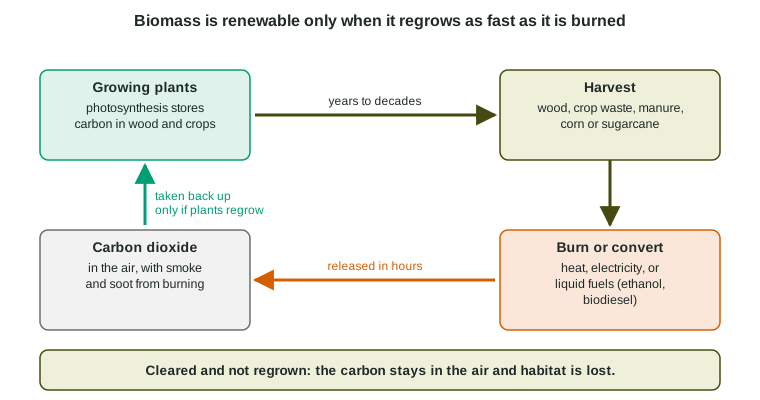
- Plants capture carbon dioxide and sunlight by photosynthesisenergy and carbon are stored in wood, crops and waste
- The biomass is burned, or turned into biofuels such as ethanol and biodieselits energy is released, along with carbon dioxide, soot and other pollutants
- New plants grow on the same land at the same ratethey take the carbon back up, so the cycle is close to carbon neutral
- Forest is cut faster than it regrows, or cleared for fuel cropscarbon dioxide rises, habitat is destroyed and soil erodes
Part 6 · Key ideas
Key ideas
- Biomass energy comes from wood, charcoal, crop waste, dung and plants grown for fuel. It is renewable but depletable.
- Biofuels: ethanol is fermented from crop sugars (corn, sugarcane) and blended into gasoline; biodiesel is made from plant oils or animal fats.
- Burning biomass releases carbon dioxide, soot and particles. Indoor smoke from cooking fires harms the lungs, a major cause of illness in poorer countries.
- Biomass is near carbon neutral only if regrowth keeps pace. Corn ethanol takes much fossil energy to make; clearing forest for fuel crops releases more carbon than the fuel saves.
Part 7 · Misconception
A common mistake
The wrong idea: Biomass is a clean fuel, because it is renewable and carbon neutral.
What actually happens: Burning biomass releases carbon dioxide, soot and other pollutants. It is close to carbon neutral only when new growth takes the carbon back at the same rate, and it still pollutes the air.
Part 8 · Check yourself
Check yourself
Exam-style questions. Anything you miss goes into your review queue.
1. How is ethanol for vehicle fuel usually made?
- By pressing vegetable oil and mixing it with methanol
- By splitting water into its parts with electricity
- By fermenting the sugars in crops such as corn
- By refining crude oil at a very high temperature
Show the answer
Yeast ferments the sugars in corn, sugarcane or other crops into ethanol, which is distilled and blended into gasoline.
- By pressing vegetable oil and mixing it with methanol: That process makes biodiesel.
- By splitting water into its parts with electricity: Splitting water makes hydrogen.
- Correct: By fermenting the sugars in crops such as corn: Right: fermentation of crop sugars.
- By refining crude oil at a very high temperature: Refining crude oil makes gasoline, not ethanol.
2. A family cooks every day over an open wood fire inside a small house with poor ventilation. What is the most serious health effect?
- Lung damage from breathing smoke
- Radiation given off by the burning wood
- Warmer water in the streams near the house
- Loss of hearing from the noise of the fire
Show the answer
Indoor smoke from wood, charcoal, crop waste or dung harms the lungs and is a major cause of illness and early death in poorer countries, especially for women and children.
- Correct: Lung damage from breathing smoke: Right: indoor smoke is a leading health risk.
- Radiation given off by the burning wood: Wood is not a meaningful radiation source.
- Warmer water in the streams near the house: A home cooking fire does not heat streams.
- Loss of hearing from the noise of the fire: A cooking fire is not loud enough to damage hearing.
3. Why can burning wood be called close to carbon neutral, and when does that stop being true?
- Wood contains no carbon, unless it is burned along with some coal
- Burning wood removes carbon dioxide from the air, unless the fire is too hot
- Wood smoke does not trap any heat in the atmosphere, unless the wood is wet
- Regrowth reabsorbs the carbon, unless cutting outpaces it
Show the answer
The carbon in wood came from the air a few decades ago. If new trees grow at the same rate, they take it back up. If forest is cleared and not regrown, the carbon stays in the air.
- Wood contains no carbon, unless it is burned along with some coal: Wood is about half carbon by dry mass.
- Burning wood removes carbon dioxide from the air, unless the fire is too hot: Burning releases carbon dioxide; it does not remove it.
- Wood smoke does not trap any heat in the atmosphere, unless the wood is wet: Burning wood releases carbon dioxide, which traps heat.
- Correct: Regrowth reabsorbs the carbon, unless cutting outpaces it: Right: neutrality depends on regrowth keeping pace.
Model or diagram
Biomass energy and carbon
4. According to the diagram, how does carbon get into biomass?
- Plants take in carbon dioxide by photosynthesis
- Burning releases carbon into the plants
- Plants absorb carbon from fossil fuels in the soil
- Harvesting adds carbon to the wood
Show the answer
The diagram shows growing plants storing carbon from the air through photosynthesis.
- Correct: Plants take in carbon dioxide by photosynthesis: Right: photosynthesis takes carbon dioxide from the air.
- Burning releases carbon into the plants: Burning releases carbon to the air.
- Plants absorb carbon from fossil fuels in the soil: Plants do not take carbon from buried fossil fuels.
- Harvesting adds carbon to the wood: Harvesting moves carbon; it does not add it.
5. The diagram labels the arrows "released in hours" and "years to decades." What does this difference mean?
- Regrowth removes the carbon faster than burning releases it
- Carbon released from biomass stays in the air permanently
- Both steps take the same time, so the cycle stays balanced
- Carbon is released far faster than regrowth takes it up
Show the answer
A tree's carbon returns to the air in hours when it burns but takes years to decades to be taken up again, so heavy use raises carbon dioxide for a long time.
- Regrowth removes the carbon faster than burning releases it: The labels show the opposite.
- Carbon released from biomass stays in the air permanently: Regrowth takes the carbon back over time.
- Both steps take the same time, so the cycle stays balanced: The labels show very different times.
- Correct: Carbon is released far faster than regrowth takes it up: Right: release is fast, uptake is slow.
6. A country clears tropical forest to plant oil palms for biodiesel. Using the diagram, what is the most likely result?
- No change, as biomass of any kind is carbon neutral when it burns
- Carbon dioxide falls, as burning the cleared forest removes carbon
- Carbon dioxide rises, as the forest's stored carbon is released
- Carbon dioxide falls, as palm biodiesel replaces diesel made from oil
Show the answer
The diagram's banner warns that cleared, unregrown land keeps its carbon in the air. Clearing forest releases its stored carbon, far more than the biodiesel saves for many years, and destroys habitat.
- No change, as biomass of any kind is carbon neutral when it burns: Biomass is near neutral only when regrowth keeps pace.
- Carbon dioxide falls, as burning the cleared forest removes carbon: Burning releases carbon; it does not remove it.
- Correct: Carbon dioxide rises, as the forest's stored carbon is released: Right: the carbon lost from the forest outweighs the fuel savings.
- Carbon dioxide falls, as palm biodiesel replaces diesel made from oil: Any savings from biodiesel are swamped by the carbon released by clearing.
Part 9 · Summary
Summary
Part 10 · Up next
What comes next
Part 11 · Connections