Solar Energy
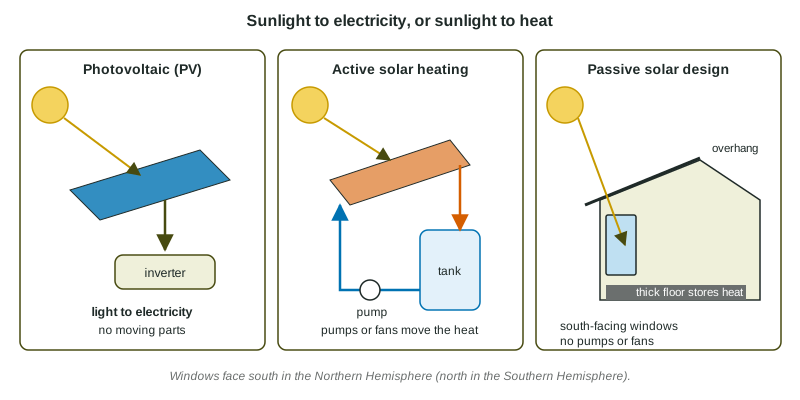
Solar energy can be turned into electricity by photovoltaic cells or by mirrors that make steam, or used as heat through active collectors or passive building design.
Part 1 · Hook
Why this matters
Part 2 · Before you start
What this builds on
Part 3 · Prerequisite check
Quick check before you start
1. Why does a place get more solar energy in summer?
- The sun is higher and days are longer, because of Earth's tilt
- Earth is closer to the sun in summer
- There are fewer clouds everywhere in summer
- The sun gives off more energy in summer
Show the answer
Axial tilt makes the sun higher and days longer in summer.
- Correct: The sun is higher and days are longer, because of Earth's tilt:
- Earth is closer to the sun in summer:
- There are fewer clouds everywhere in summer:
- The sun gives off more energy in summer:
2. Which renewable source is nondepletable?
- Sunlight
- Firewood
- Corn grown for fuel
- Groundwater
Show the answer
Using sunlight today does not reduce tomorrow's.
- Correct: Sunlight:
- Firewood:
- Corn grown for fuel:
- Groundwater:
Part 4 · See it
See it first
Part 5 · Step by step
How it works, step by step
- Sunlight strikes a photovoltaic cellit knocks electrons loose and makes an electric current, with no fuel and no emissions
- Sunlight heats a fluid in a roof collector, or mirrors focus it to make steamthe heat warms water or buildings, or drives a turbine
- Windows face the sun and a thick floor absorbs heata building warms itself in winter with no pumps or fans
- The sun sets or clouds passoutput falls, so solar needs storage, a grid or backup
Part 6 · Key ideas
Key ideas
- Photovoltaic cells turn sunlight directly into electricity. Active solar systems use collectors with pumps or fans to move heat, and concentrated solar plants use mirrors to make steam. Passive solar design uses windows, overhangs and thermal mass.
- In the Northern Hemisphere, sun-facing windows and panels face south; in the Southern Hemisphere, north.
- Solar releases no air pollution or carbon dioxide while running, but its intermittency (night, clouds, winter) means it needs storage or backup.
- Drawbacks: large land area for big farms, habitat disturbance in deserts, and mining and manufacturing for panels. Savings = kWh × price per kWh.
Part 7 · Misconception
A common mistake
The wrong idea: Solar panels heat up in the sun, and that heat is what makes the electricity.
What actually happens: A photovoltaic cell turns light directly into electricity. Heat actually lowers a PV panel's efficiency a little; it is solar thermal systems that use heat.
Part 8 · Check yourself
Check yourself
Exam-style questions. Anything you miss goes into your review queue.
1. What does a photovoltaic cell do?
- Heats water in roof pipes with sunlight and a pump
- Stores the sun's heat in a thick stone floor for the night
- Burns fuel to make steam whenever the sun goes down
- Turns sunlight directly into an electric current
Show the answer
A photovoltaic (PV) cell is a semiconductor that turns light directly into an electric current, with no moving parts.
- Heats water in roof pipes with sunlight and a pump: Heating water with collectors and pumps is active solar heating.
- Stores the sun's heat in a thick stone floor for the night: Storing heat in a thick floor is passive solar design.
- Burns fuel to make steam whenever the sun goes down: Burning fuel is not solar energy.
- Correct: Turns sunlight directly into an electric current: Right: light directly to electricity.
2. Which home feature is an example of passive solar heating?
- Photovoltaic panels on the roof wired to an inverter in the garage
- An electric heater powered by a nearby solar farm
- Large south-facing windows and a thick stone floor
- Roof panels that pump hot fluid to a storage tank in the basement
Show the answer
Passive solar design uses the building itself: windows facing the sun (south, in the Northern Hemisphere), thermal mass such as stone or concrete floors, and overhangs that shade summer sun. No pumps or fans.
- Photovoltaic panels on the roof wired to an inverter in the garage: PV panels make electricity; that is not passive heating.
- An electric heater powered by a nearby solar farm: An electric heater uses electricity made elsewhere, not the building's design.
- Correct: Large south-facing windows and a thick stone floor: Right: windows and thermal mass, no moving parts.
- Roof panels that pump hot fluid to a storage tank in the basement: Pumps and a tank make this an active solar system.
3. What is intermittency, and why is it a problem for solar power?
- Output varies with clouds, seasons and night, so storage or backup is needed
- Panels wear out after a few weeks, so they are replaced often
- Sunlight releases carbon dioxide when it strikes the panels
- Solar panels use up the sunlight, so less reaches the next panel
Show the answer
Intermittency means the source is not available all the time. Solar output drops to zero at night and falls on cloudy days and in winter.
- Correct: Output varies with clouds, seasons and night, so storage or backup is needed: Right: variable output needs storage or backup.
- Panels wear out after a few weeks, so they are replaced often: Panels usually last about 25 to 30 years.
- Sunlight releases carbon dioxide when it strikes the panels: Sunlight striking a panel releases nothing.
- Solar panels use up the sunlight, so less reaches the next panel: Each panel collects the light that falls on it; it does not use up sunlight elsewhere.
Model or diagram
Three ways to use solar energy
4. A family in Australia (Southern Hemisphere) builds the passive solar house in the diagram. Which change should they make?
- Remove the thick floor so the house heats faster
- Remove the overhang so summer sun can enter
- Face the large windows north instead of south
- Face the large windows west to catch the evening sun
Show the answer
In the Southern Hemisphere the sun is in the northern sky, so sun-facing windows face north. The diagram's note says this.
- Remove the thick floor so the house heats faster: The thick floor stores heat for the night.
- Remove the overhang so summer sun can enter: Summer sun would overheat the house.
- Correct: Face the large windows north instead of south: Right: the sun is to the north south of the equator.
- Face the large windows west to catch the evening sun: West windows overheat the house on summer evenings.
5. Which are drawbacks of photovoltaic solar power? Select all that apply.
- No output at night
- Noise from spinning parts inside each panel
- Carbon dioxide released while running
- Warm cooling water returned to rivers
- Radioactive waste from used panels
- Fuel that has to be bought each month
Show the answer
Of these, only intermittency is a drawback of PV: no sunlight, no output. Panels have no moving parts, burn nothing, need no cooling water and make no radioactive waste. (Their real drawbacks also include land use and the mining and manufacturing behind them.)
- Correct: No output at night: Right: intermittency.
- Noise from spinning parts inside each panel: A PV cell has no moving parts; light frees electrons in the silicon.
- Carbon dioxide released while running: Panels release nothing while making electricity.
- Warm cooling water returned to rivers: PV makes no steam, so it needs no cooling water; that is a drawback of steam power plants.
- Radioactive waste from used panels: Old panels are discarded electronics, not radioactive waste.
- Fuel that has to be bought each month: Sunlight is free; there is no fuel to buy.
6. A school installs PV panels and wants to use solar electricity after sunset. What should it add?
- Batteries that store electricity made during the day
- More panels facing away from the sun
- A passive solar overhang above the panels
- A thicker concrete floor in the classrooms
Show the answer
Batteries store daytime output for evening use; a grid connection can also supply power at night.
- Correct: Batteries that store electricity made during the day: Right: storage covers the hours without sun.
- More panels facing away from the sun: Panels facing away from the sun make less electricity.
- A passive solar overhang above the panels: An overhang would shade the panels.
- A thicker concrete floor in the classrooms: A thick floor stores heat, not electricity.
Part 9 · Summary
Summary
Part 10 · Up next
What comes next
Part 11 · Connections