Almost all the energy that drives Earth's weather, winds, moving seawater and ecosystems comes from the Sun. But the Sun does not heat Earth evenly. Some places get far more energy than others, and the amount changes through the year. This page explains why the tropics are warm and the poles cold, what really causes the seasons, and why bright and dark surfaces heat differently.
Insolation: how much sunlight a place gets
Insolation (incoming solar radiation) is the amount of the Sun's energy reaching an area, measured in watts per square meter (W/m²). It depends mostly on the angle at which sunlight strikes the surface.
Shine a flashlight straight down at a table and you get a small, bright circle. Tilt the flashlight and the same light spreads into a larger, dimmer oval. Earth is a sphere, so the same thing happens: near the equator sunlight strikes almost head-on, and near the poles it strikes at a low slant and spreads out. A low-angle beam also passes through more atmosphere, which absorbs and scatters some of it.
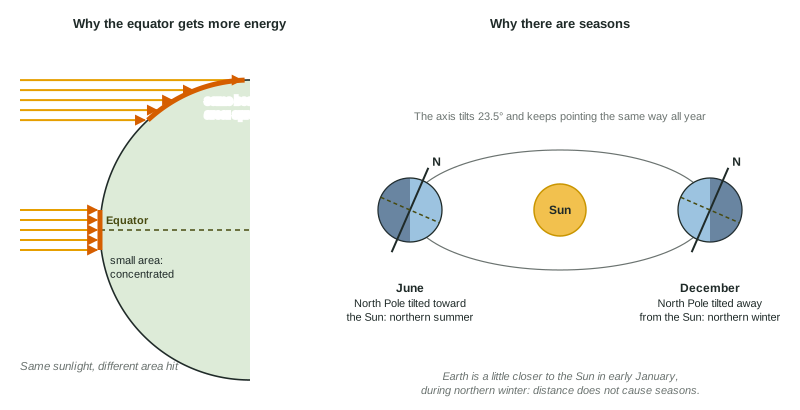
So, averaged over a year, insolation is highest near the equator and lowest near the poles. That difference in heating drives the global winds you studied in the previous topic, and it is the first reason biomes change from rainforest to tundra as you move toward the poles.
Worked example. Averaged over a year, sunlight at the top of the atmosphere is about 415 W/m² at the equator and about 235 W/m² at 60° N. What is the percent change from the equator to 60° N?
Setup: .
Answer: . A place at 60° N gets about 43% less solar energy than the equator.
The seasons come from the tilt
Earth's axis is tilted about 23.5° from straight up and down, and it keeps pointing the same way in space, toward the North Star, all year. As Earth travels around the Sun:
- Around June 21, the North Pole leans toward the Sun. The Northern Hemisphere gets the most direct sunlight and the longest days: northern summer. The Southern Hemisphere has winter.
- Around December 21, the North Pole leans away. The Southern Hemisphere has summer; the Northern Hemisphere has winter.
- Around March 20 and September 22 (the equinoxes), neither pole leans toward the Sun, and day and night are about 12 hours each everywhere.
The hemisphere tilted toward the Sun is warmer for two reasons: the Sun climbs higher in the sky, so its light is more direct, and the days are longer, so there are more hours of heating.
Distance is not the cause. Earth's orbit is nearly a circle; Earth is closest to the Sun in early January, during northern winter. If distance caused seasons, both hemispheres would have summer at the same time, but they have opposite seasons.
| Place | What the seasons are like | Why |
|---|---|---|
| Near the equator | warm all year; seasons are wet and dry | the Sun is high in the sky all year |
| Middle latitudes (30° to 60°) | clear summers and winters | the sun angle and day length change a lot |
| Near the poles | months of daylight in summer, months of darkness in winter | the tilt points the whole region toward or away from the Sun |
Albedo: reflect or absorb
Not all sunlight that reaches the ground warms it. Some is reflected. Albedo is the share of sunlight a surface reflects, as a fraction or a percent.
- High albedo: fresh snow (about 80% to 90%), sea ice, clouds, light-colored sand.
- Low albedo: open ocean (under 10%), forests, dark soil and asphalt.
A surface absorbs what it does not reflect, so low-albedo surfaces warm more. That is why a black parking lot is hotter than a light sidewalk on a sunny day.
Worked example. Sea ice has an albedo of 60%. If 250 W/m² of sunlight reaches it, how much does it absorb?
It absorbs the part it does not reflect: .
absorbed.
Albedo can set off a chain. When bright sea ice melts, it exposes dark ocean water, which absorbs much more sunlight. The water warms and melts more ice, which exposes more water. A chain that feeds itself like this speeds up warming in the Arctic; Unit 9 returns to it.
Check yourself
- Why is it hotter at the equator? (Sunlight strikes it more directly, so insolation is higher.)
- What causes the seasons? (The tilt of Earth's axis, not distance from the Sun.)
- Which absorbs more sunlight, snow or ocean? (Ocean: its albedo is lower.)