Solar Radiation and Earth's Seasons
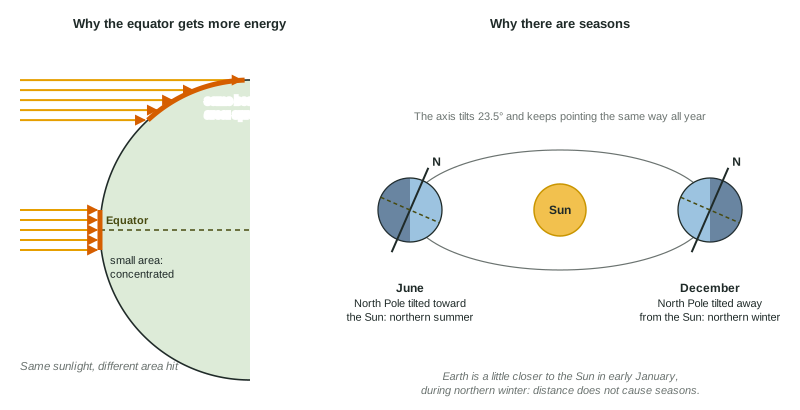
Insolation, the solar energy per square meter, is highest near the equator because sunlight strikes it most directly.
Part 1 · Hook
Why this matters
Part 2 · Prerequisite check
Quick check before you start
1. Where does warm air rise in the global wind pattern?
- Near the equator
- Near 30° N and 30° S
- At the poles
- Nowhere: air only sinks
Show the answer
The equator is heated most, so air rises there.
- Correct: Near the equator:
- Near 30° N and 30° S:
- At the poles:
- Nowhere: air only sinks:
2. Which biome is cold, treeless and found at high latitudes?
- Tundra
- Savanna
- Tropical rainforest
- Chaparral
Show the answer
Tundra lies at high latitudes, where it is too cold for trees.
- Correct: Tundra:
- Savanna:
- Tropical rainforest:
- Chaparral:
Part 3 · See it
See it first
Part 4 · Step by step
How it works, step by step
- Earth is a sphere, so sunlight strikes the equator head-on and high latitudes at a slantinsolation, the solar energy per square meter, is highest near the equator
- Earth's axis is tilted about 23.5° and keeps pointing the same way as Earth orbitseach hemisphere leans toward the Sun for half the year and away for the other half
- The hemisphere tilted toward the Sun gets more direct sunlight and longer daysit has summer, while the other hemisphere has winter
- Dark surfaces absorb more sunlight than bright ones (lower albedo)dark ocean and forest warm more than snow and ice under the same sun
Part 5 · Key ideas
Key ideas
- Insolation is the solar radiation reaching an area, in watts per square meter (W/m²). It is greatest near the equator, where sunlight is most direct.
- Seasons come from axial tilt (about 23.5°): the hemisphere tilted toward the Sun has higher sun angles and longer days. Distance from the Sun is not the cause; Earth is closest in early January.
- Northern summer is southern winter, and the reverse. Near the equator, insolation stays high all year, so seasons are mostly wet and dry, not warm and cold.
- Albedo is the share of sunlight a surface reflects: high for snow and ice, low for ocean and forest. Low-albedo surfaces absorb more energy and warm more.
- Insolation sets temperature by latitude, which helps place the biomes and drives the global winds.
Part 6 · Misconception
A common mistake
The wrong idea: It is summer when Earth is closest to the Sun.
What actually happens: Earth is closest to the Sun in early January, during northern winter. The seasons come from the tilt of Earth's axis, which is also why the two hemispheres have opposite seasons at the same time.
Part 7 · Check yourself
Check yourself
Exam-style questions. Anything you miss goes into your review queue.
1. What causes Earth's seasons?
- The tilt of Earth's axis
- Earth's changing distance from the Sun
- The Sun giving off more energy in summer
- Changes in how fast Earth spins
Show the answer
Earth's axis is tilted about 23.5°. As Earth orbits, each hemisphere takes turns leaning toward the Sun, getting more direct sunlight and longer days.
- Correct: The tilt of Earth's axis: Right: the tilt makes each hemisphere lean toward or away from the Sun.
- Earth's changing distance from the Sun: Earth is closest to the Sun in early January, during northern winter, so distance is not the cause.
- The Sun giving off more energy in summer: The Sun's output barely changes over a year.
- Changes in how fast Earth spins: Earth spins at a steady rate; that makes day and night, not seasons.
2. Why does the equator receive more solar energy per square meter than the poles over a year?
- Sunlight strikes it more directly, so it is more concentrated
- The equator is much closer to the Sun than the poles are
- The poles have more clouds, which block most of the sunlight
- The equator has more hours of daylight on each day of the year
Show the answer
A beam of light that hits the surface head-on lights a small area; the same beam at a low angle spreads over a larger area, so each square meter gets less.
- Correct: Sunlight strikes it more directly, so it is more concentrated: Right: the angle of the sunlight decides how concentrated it is.
- The equator is much closer to the Sun than the poles are: The difference in distance is tiny compared with 150 million km.
- The poles have more clouds, which block most of the sunlight: Clouds matter locally, but the main cause is the angle of sunlight.
- The equator has more hours of daylight on each day of the year: The equator has about 12 hours of daylight all year; the poles have long summer days, so day length is not the main cause.
3. What is albedo?
- The share of incoming sunlight a surface reflects
- The amount of heat a surface gives off at night
- The angle at which sunlight strikes the ground
- The amount of sunlight a plant uses for photosynthesis
Show the answer
Albedo is reflectivity: fresh snow reflects most sunlight (high albedo); dark ocean water absorbs most of it (low albedo).
- Correct: The share of incoming sunlight a surface reflects: Right: albedo is the fraction or percent of sunlight reflected.
- The amount of heat a surface gives off at night: Heat given off is a separate process from reflecting sunlight.
- The angle at which sunlight strikes the ground: The angle of sunlight is a different idea; it sets insolation.
- The amount of sunlight a plant uses for photosynthesis: Photosynthesis uses a small share of light; albedo is about reflection.
Data
Average sunlight reaching the top of the atmosphere by latitude
4. What trend does the graph show?
- Incoming sunlight decreases from the equator toward the pole
- Incoming sunlight increases from the equator toward the pole
- Incoming sunlight is about the same at each latitude
- Incoming sunlight is lowest at 45° and highest at the pole
Show the answer
Sunlight falls from 415 W/m² at the equator to 170 W/m² at the pole.
- Correct: Incoming sunlight decreases from the equator toward the pole: Right: the line falls with latitude.
- Incoming sunlight increases from the equator toward the pole: The line slopes down, not up.
- Incoming sunlight is about the same at each latitude: The values range from 415 to 170 W/m².
- Incoming sunlight is lowest at 45° and highest at the pole: The pole has the lowest value, 170 W/m².
5. Use the graph. Write the setup for the percent change in incoming sunlight from the equator (415 W/m²) to 60° N (235 W/m²), then the answer.
Type the setup as on the exam, with brackets and units, then the answer.
Show the answer
- Setup: ; answer -43.37 %
6. Which explanation best accounts for the trend in the graph?
- Sunlight strikes high latitudes at a low angle and spreads out
- Higher latitudes are a great deal farther from the Sun
- The atmosphere is thinner at the poles, so it blocks more light
- Higher latitudes have shorter days in each of the seasons
Show the answer
The curve of Earth means sunlight hits high latitudes at a slant, spreading the same energy over a larger area.
- Correct: Sunlight strikes high latitudes at a low angle and spreads out: Right: the angle of the sunlight explains the decrease.
- Higher latitudes are a great deal farther from the Sun: All latitudes are essentially the same distance from the Sun.
- The atmosphere is thinner at the poles, so it blocks more light: A thinner atmosphere would block less light, not more.
- Higher latitudes have shorter days in each of the seasons: High latitudes have very long days in summer.
Part 8 · Summary
Summary
Part 9 · Up next
What comes next
Part 10 · Connections