Put a desert plant in the Arctic and it dies; put a spruce tree in the Sahara and it dies too. Each kind of plant can live only within certain conditions, so the same climate produces the same kind of landscape wherever it occurs. A biome is a large region with a typical climate and the typical plants and animals that come with it. The same biome shows up on several continents: grasslands in North America, Asia and South America look alike even though the species differ.
Two numbers decide the biome
The main abiotic factors that set a biome are temperature (how warm, and how much it swings between seasons) and precipitation (rain and snow: how much, and when it falls). Temperature controls how long plants can grow each year. Precipitation controls how much water they have. Together they decide whether a place supports trees, shrubs, grasses or almost nothing.
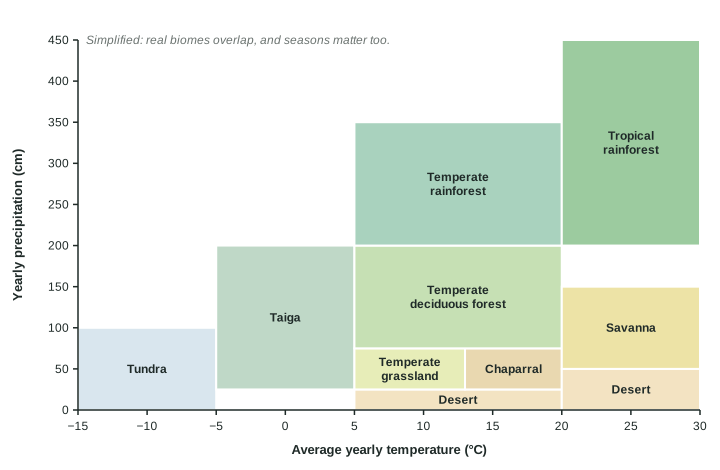
Read the chart like a map. Moving right means warmer; moving up means wetter. Cold and dry gives tundra. Warm and dry gives desert. Warm and very wet gives tropical rainforest. Soil, fire and grazing also matter at the edges, which is why real biomes blend into each other.
The biomes at a glance
| Biome | Temperature | Precipitation | Plants and notes |
|---|---|---|---|
| Tundra | very cold, short summer | low | mosses, lichens, low shrubs; no trees; permafrost (soil frozen all year) |
| Taiga (boreal forest) | cold, long winters | moderate, much as snow | cone-bearing evergreens; acidic, thin soil |
| Temperate deciduous forest | warm summers, cold winters | moderate, all year | broadleaf trees that drop leaves in fall; fairly rich soil |
| Temperate rainforest | mild | very high, from ocean air | giant conifers, mosses, ferns |
| Temperate grassland | hot summers, cold winters | low to moderate | grasses, few trees; deep, very fertile soil |
| Chaparral | hot dry summers, mild wet winters | moderate, in winter | shrubs with small waxy leaves; frequent fire |
| Desert biome | hot or cold | very low (under about 25 cm) | plants that store water, such as cacti |
| Savanna | warm all year | moderate, in a wet season | grasses with scattered trees; long dry season; fire and grazing |
| Tropical rainforest | warm all year | very high, all year | dense layered forest; huge number of species; soil poor in nutrients |
Why some soils are rich and others poor
Warmth and water speed up the breakdown of dead leaves. In a tropical rainforest dead matter breaks down within weeks, heavy rain washes many nutrients out of the soil, and the dense plants take up the rest almost at once. So the soil itself stays poor, which is why cleared rainforest land often fails as farmland after a few years. In a temperate grassland, cold winters slow breakdown and grass roots add organic matter year after year, building deep, dark, fertile soil.
Reading a climatograph
A climatograph shows a place's average temperature (usually a line) and precipitation (usually bars or a second line) for each month. To name the biome, ask three questions: Is it cold, temperate or warm? How wet is the year in total? Does the rain come all year or in one season?
Worked example. A site averages 24 to 27 °C every month. It gets about 200 mm in each of the wettest months and almost nothing for five months. Total precipitation is about 1,100 mm (110 cm). Step 1: warm all year, so a warm biome. Step 2: 110 cm is far too wet for a desert. Step 3: the rain comes in one season, with a long dry season, so it is not a tropical rainforest. The answer: savanna.
Mountains and latitude
Air gets colder as you climb. So going up a tall mountain changes the biomes in roughly the same order as traveling from the equator toward the poles: forest at the base, then conifers, then low tundra-like plants and finally bare rock and ice near the top.
Climate also decides where useful resources are. Water, and trees for lumber, are spread unevenly over the land because of climate, geography, latitude and elevation, nutrients and soil: a temperate rainforest grows timber fast, a desert grows almost none.
Biomes on the move
Biomes follow climate, so when climate shifts, biomes shift too. As the climate warms, the edge of the taiga moves north into the tundra and plants on mountains move uphill. Species that cannot move fast enough, or that are already at a mountaintop, have nowhere to go.