Trophic levels sort organisms into rungs, but real feeding is messier. A fox eats mice, rabbits, berries and insects; a mouse is eaten by snakes, owls, hawks and foxes. Drawing every link turns a neat ladder into a web. Reading that web, and predicting what happens when one strand is cut, is a skill the exam tests in almost every unit.
Chains and webs
A food chain is one path that energy and matter take through an ecosystem: grass → grasshopper → frog → snake → hawk. A food web combines all the chains in an ecosystem, showing that most organisms have several foods and several predators.
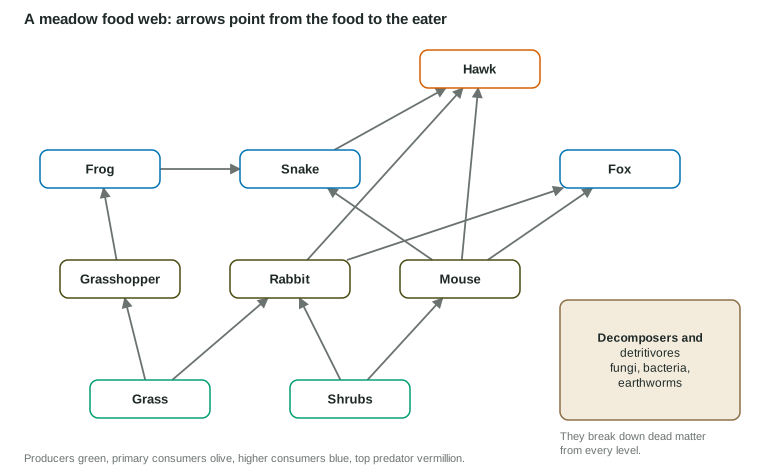
Arrows always point from the food to the eater, because that is the way energy and nutrients move. An organism with many arrows coming in has many foods; one with many arrows going out is eaten by many species.
Decomposers and detritivores
Every level produces dead bodies, shed leaves and wastes. Two groups recycle them.
- Detritivores (earthworms, millipedes, some crabs) eat detritus, dead organic matter, and break it into smaller pieces.
- Decomposers (bacteria and fungi) break the material down chemically, releasing nutrients such as nitrogen and phosphorus back to the soil and water, and carbon dioxide to the air.
Without them, nutrients would stay locked in dead matter and producers would run short. Energy is not recycled, though: the energy in dead matter ends up as heat released by the decomposers' respiration.
Predicting changes
When one population changes, follow each arrow in and out of it.
Worked example. In the meadow web, a disease kills most of the frogs. What happens?
Step 1, what the frogs eat: grasshoppers. Fewer frogs means fewer grasshoppers are eaten, so grasshoppers increase.
Step 2, what eats the frogs: snakes. Snakes lose one food source, but they also eat mice, so they decline only a little and may eat more mice.
Step 3, farther away: more grasshoppers eat more grass, so grass may decrease.
The written answer names each link and its direction: "Grasshoppers increase because fewer are eaten by frogs."
A predator that holds down a plant-eater can protect the plants two links below it. Along the North Pacific coast, where sea otters were hunted out, sea urchins multiplied and grazed many kelp forests down to bare rock; where otters returned, urchins declined and kelp recovered. Ecologists caution that storms, water temperature and urchin disease matter too, so one species is rarely the whole explanation.
Feedback in a food web
Predators and prey can hold each other in check. When hares become common, lynx have plenty to eat and their numbers rise; more lynx eat more hares, so hares fall; then lynx run short of food and fall too, and the hares recover. A change that sets off effects that push the system back toward where it started is called a negative feedback loop. It is one reason populations in a food web often rise and fall in cycles instead of growing without limit.
Why complex webs are more stable
In a simple web, a predator with one prey species is in trouble when that prey declines. In a web with many links, consumers can switch to other foods, so the loss of one species is buffered. That is one reason ecosystems with many species tend to recover from fires, storms and droughts better than ecosystems with few.
Reading a food web on the exam
| Question | How to read it |
|---|---|
| What does X eat? | arrows pointing into X |
| What eats X? | arrows leaving X |
| What trophic level is X? | count steps from a producer; an organism can be at more than one level |
| What happens if X is removed? | its prey increase, its predators lose food, then follow the next links |