Every cell needs phosphorus. It is part of DNA, of ATP (the molecule that carries energy in cells), of the membranes around cells, and of bones and teeth. Yet phosphorus is often in short supply, and the reason is in how it moves. Carbon and nitrogen ride through the air and reach any place on Earth within years. Phosphorus has no significant gas form, so it has to creep out of rock and travel in water and soil.
The reservoirs
Most of Earth's phosphorus is locked in rock (phosphate minerals) and in ocean sediments. Much smaller, faster-moving amounts are in soil, in living things and dissolved in water. Because there is no atmospheric reservoir, the phosphorus cycle is the slowest of the major nutrient cycles.
How phosphorus moves
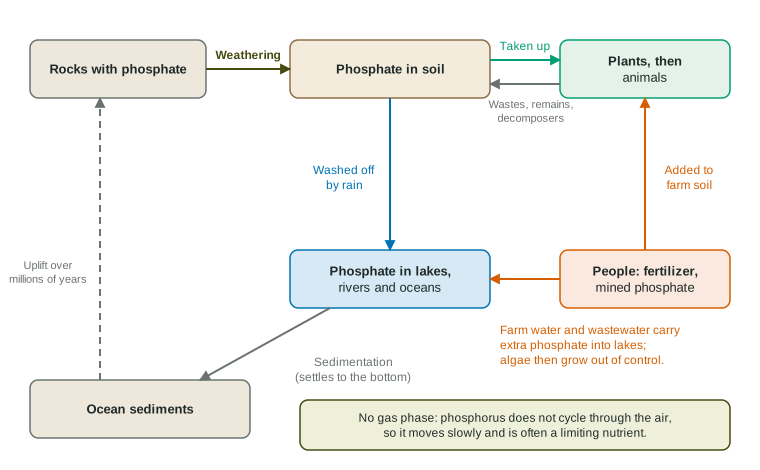
- Weathering. Rain, freezing and thawing, chemical reactions and plant roots break rock down, slowly releasing phosphate into the soil.
- Uptake. Plants take up dissolved phosphate through their roots. Animals get phosphorus by eating plants or other animals.
- Return. Wastes and dead organisms are broken down by decomposers, which release phosphate back into the soil.
- Transport. Phosphate clings tightly to soil particles. It moves mostly when soil itself is washed or blown away, into streams, lakes and eventually the ocean.
- Sedimentation. In water, phosphate settles to the bottom with particles and dead matter and builds up in sediments.
- Uplift. Over millions of years, sediments harden into rock and geological forces lift it above sea level, where weathering begins again.
Seabird and bat droppings (guano), rich in phosphate, are one of the few quick shortcuts: birds eat fish at sea and deposit the phosphorus on land.
Comparing the three nutrient cycles
| Carbon | Nitrogen | Phosphorus | |
|---|---|---|---|
| Largest reservoir | sedimentary rock | atmosphere (N2) | rock and ocean sediments |
| Gas phase? | yes (CO2, methane) | yes (N2) | no significant gas |
| Speed | fast and slow parts | fairly fast | slow |
| Key processes | photosynthesis, respiration, decomposition, combustion | fixation, nitrification, assimilation, ammonification, denitrification | weathering, uptake, decomposition, sedimentation, uplift |
| Human change | burning fossil fuels, clearing forests | fertilizer made from N2 | mined phosphate fertilizer, detergents, wastewater |
Phosphorus as a limiting nutrient
Because it cycles so slowly, phosphorus is often the limiting nutrient in lakes and streams: algae have enough of everything else and are held back by a lack of phosphate. Add phosphate and they grow fast.
Worked example: reading a nutrient trial. Test ponds with nothing added grew 4 µg/L of algae; with nitrate, 5; with phosphate, 28; with both, 31. How many times more algae grew with phosphate than with nothing?
Setup:
Answer: 7 times as much. Nitrate alone barely changed growth (4 to 5), so phosphate was the limiting nutrient. The ponds with nothing added are the control: a baseline for comparison.
How people change the cycle
People mine phosphate rock to make fertilizer and, in the past, laundry detergents. That moves phosphorus out of long-term storage much faster than weathering would. Extra phosphate reaches water in three main ways: soil washed off fields, animal manure, and wastewater from homes and towns. In a lake the result is algae growing out of control, which clouds the water and, when the algae die and decompose, uses up oxygen.
Because phosphate moves on soil, the best fixes keep soil on the land: cover crops in winter, strips of plants along streams, and not spreading fertilizer before heavy rain. Many places now limit phosphate in detergents and remove it from wastewater. And because phosphate rock is mined far faster than it forms, the supply will not be replaced on any human time scale.