The Phosphorus Cycle
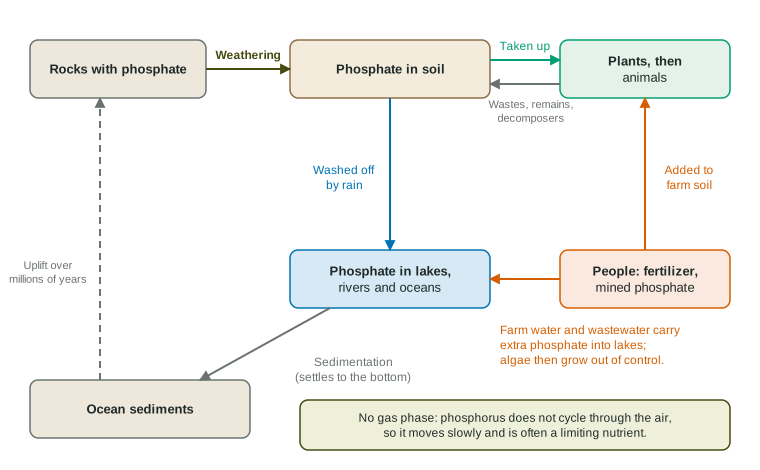
Phosphorus is stored mostly in rock and ocean sediments and has no significant gas phase, so it cycles slowly.
Part 1 · Hook
Why this matters
Part 2 · Before you start
What this builds on
Part 3 · Prerequisite check
Quick check before you start
1. What is a limiting nutrient?
- The nutrient in shortest supply compared with need
- The nutrient plants use the most
- A nutrient that poisons plants
- A gas in the air
Show the answer
Adding the limiting nutrient raises growth.
- Correct: The nutrient in shortest supply compared with need:
- The nutrient plants use the most:
- A nutrient that poisons plants:
- A gas in the air:
2. Which process returns nutrients from dead matter to the soil?
- Decomposition
- Photosynthesis
- Combustion
- Sedimentation
Show the answer
Decomposers break down dead matter and release its nutrients.
- Correct: Decomposition:
- Photosynthesis:
- Combustion:
- Sedimentation:
Part 4 · See it
See it first
Part 5 · Step by step
How it works, step by step
- Weathering breaks down rockphosphate enters the soil
- Plants take up phosphate and animals eat plantsdecomposers return phosphate to the soil when they die
- Rain washes phosphate-carrying soil into waterit settles as sediment and returns to land only when rock is uplifted, over millions of years
Part 6 · Key ideas
Key ideas
- The main reservoirs are rock and ocean sediments; the phosphorus cycle has no significant gas phase, so it is slow.
- Weathering releases phosphate; plants take it up; decomposers return it; sedimentation stores it.
- Phosphorus builds DNA, ATP, cell membranes, bones and teeth.
- Phosphate is often the limiting nutrient in fresh water, so extra phosphate (fertilizer, detergents, wastewater) makes algae grow fast.
Part 7 · Misconception
A common mistake
The wrong idea: Phosphorus cycles through the air like carbon and nitrogen.
What actually happens: Phosphorus has no significant gas form. It moves in rock, soil, water and living things, which is why it cycles slowly and is so often in short supply.
Part 8 · Check yourself
Check yourself
Exam-style questions. Anything you miss goes into your review queue.
1. Why does phosphorus usually move through ecosystems more slowly than carbon or nitrogen?
- It has no significant gas phase.
- Plants do not need phosphorus to grow and reproduce.
- It is released mainly by volcanoes, which erupt rarely.
- Decomposers do not release it from dead plants and animals.
Show the answer
Carbon and nitrogen move quickly through the atmosphere. Phosphorus must be weathered from rock and moved by water, which is slow.
- Correct: It has no significant gas phase.: Right: no trip through the air makes it slow.
- Plants do not need phosphorus to grow and reproduce.: Plants need phosphorus for DNA, ATP and cell membranes.
- It is released mainly by volcanoes, which erupt rarely.: Weathering of rock, not volcanoes, is the main source.
- Decomposers do not release it from dead plants and animals.: Decomposers do return phosphate to the soil.
Data
Adding nutrients to small test ponds
| Ponds | Nutrient added each week | Algae (µg chlorophyll/L) |
|---|---|---|
| A | none | 4 |
| B | nitrate | 5 |
| C | phosphate | 28 |
| D | nitrate and phosphate | 31 |
2. Which ponds grew the most algae?
- Ponds D, with both added
- Ponds A, with no nutrient added
- Ponds B, with nitrate added each week
- Ponds C, with phosphate added each week
Show the answer
Ponds D reached 31 µg/L, the highest value.
- Correct: Ponds D, with both added: Right: 31 µg/L.
- Ponds A, with no nutrient added: Ponds A had the least (4 µg/L).
- Ponds B, with nitrate added each week: Ponds B had 5 µg/L, barely more than A.
- Ponds C, with phosphate added each week: Ponds C had 28 µg/L, close to D but lower.
3. Which nutrient was limiting algae growth in these ponds?
- Phosphate: it raised algae 4 to 28
- Nitrate, since adding it raised algae from 4 to 5
- Neither one, since algae need just light and water
- Both equally, since ponds D have the most algae
Show the answer
Phosphate alone gave a large rise; nitrate alone gave almost none. So phosphate was in shortest supply.
- Correct: Phosphate: it raised algae 4 to 28: Right: adding phosphate made the big difference.
- Nitrate, since adding it raised algae from 4 to 5: A rise of 1 µg/L is tiny compared with phosphate’s 24.
- Neither one, since algae need just light and water: Nutrients clearly changed growth.
- Both equally, since ponds D have the most algae: D is only a little above C, so phosphate did most of the work.
4. How many times more algae grew in ponds C than in ponds A?
Type a number, then its unit (times). Scale words (2.5 million) and powers of ten (2.5 × 10^6) are read.
Show the answer
times as much.
- Answer: 7 times
5. What is the purpose of ponds A in this study?
- A baseline for comparison
- They test the effect of adding both nutrients at once.
- They show how fast phosphate is weathered from rock.
- They are spare ponds in case another pond fails.
Show the answer
Ponds A had nothing added, so they show how much algae grows without the treatment: the control.
- Correct: A baseline for comparison: Right: the control is a baseline for comparison.
- They test the effect of adding both nutrients at once.: Ponds D test both nutrients.
- They show how fast phosphate is weathered from rock.: Weathering is not measured.
- They are spare ponds in case another pond fails.: A control is part of the design, not a spare.
Model or diagram
Phosphate in three streams
6. How much more phosphate does the farmland stream carry than the forest stream, in mg/L?
Type a number, then its unit (mg/L). Scale words (2.5 million) and powers of ten (2.5 × 10^6) are read.
Show the answer
mg/L more.
- Answer: 0.16 mg/L
7. Which action would most directly lower phosphate in the farmland stream?
- Winter cover crops on the fields
- Adding more phosphate fertilizer just before heavy rain
- Removing the trees that grow along the stream banks
- Plowing the fields right before the winter storms
Show the answer
Plant cover holds soil, and phosphate moves on soil. Less soil lost means less phosphate in the stream.
- Correct: Winter cover crops on the fields: Right: keeping soil in place keeps phosphate out of the water.
- Adding more phosphate fertilizer just before heavy rain: More fertilizer before rain adds phosphate.
- Removing the trees that grow along the stream banks: Trees along the bank catch soil; removing them adds phosphate.
- Plowing the fields right before the winter storms: Bare plowed soil washes away in storms.
Part 9 · Summary
Summary
Part 10 · Up next
What comes next
Part 11 · Connections