The Hydrologic (Water) Cycle
The water cycle moves water among the ocean, air, land, ice and groundwater.
Part 1 · Hook
Why this matters
Part 2 · Before you start
What this builds on
Part 3 · Prerequisite check
Quick check before you start
1. What is a reservoir in a cycle?
- A place where something is stored for a time
- A movement between two stores
- A living thing
- A kind of rock
Show the answer
A reservoir stores; a flux moves.
- Correct: A place where something is stored for a time:
- A movement between two stores:
- A living thing:
- A kind of rock:
2. What does leaching do to nitrate?
- Washes it down through the soil with water
- Turns it into N2 gas
- Fixes it from the air
- Locks it in rock
Show the answer
Leaching carries dissolved substances down through soil.
- Correct: Washes it down through the soil with water:
- Turns it into N2 gas:
- Fixes it from the air:
- Locks it in rock:
Part 4 · See it
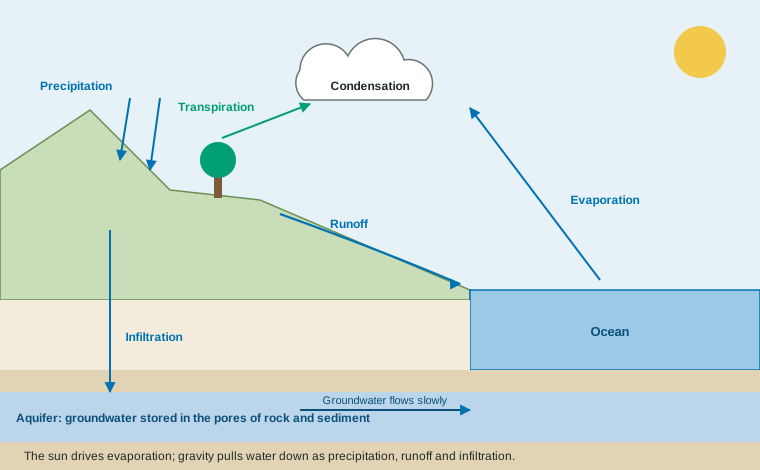
See it first
Part 5 · Step by step
How it works, step by step
- The sun heats water and plants transpirewater vapor rises into the air
- Rising vapor cools and condensesclouds form and precipitation falls
- On land, water either flows over the surface or soaks inrunoff feeds rivers; infiltration refills groundwater in aquifers
Part 6 · Key ideas
Key ideas
- The hydrologic cycle is driven by the sun (evaporation, transpiration) and gravity (precipitation, runoff, infiltration).
- About 96.5% of Earth’s water is in the ocean; most freshwater is ice or groundwater, and lakes and rivers hold a tiny share.
- An aquifer is porous rock or sediment that holds groundwater; deep aquifers refill very slowly.
- Pavement and cleared land mean less infiltration and more runoff: more floods and less groundwater recharge.
Part 7 · Misconception
A common mistake
The wrong idea: Groundwater is an underground lake or river.
What actually happens: Most groundwater fills the tiny spaces between grains of sand, gravel and rock in an aquifer, like water in a sponge. It moves slowly, often centimeters to meters a day.
Part 8 · Check yourself
Check yourself
Exam-style questions. Anything you miss goes into your review queue.
1. What is an aquifer?
- Porous rock that holds groundwater
- The area of land that drains into one river
- A large lake formed behind a dam on a river
- A low cloud that is full of water droplets
Show the answer
An aquifer is porous rock or sediment that stores and transmits groundwater, which can be pumped from wells.
- Correct: Porous rock that holds groundwater: Right: an underground layer that holds and moves groundwater.
- The area of land that drains into one river: That describes the land that drains to one river, which is a different idea from an aquifer.
- A large lake formed behind a dam on a river: A lake behind a dam is a surface reservoir.
- A low cloud that is full of water droplets: Clouds are in the air, not underground.
Model or diagram
Where Earth’s water is stored
2. About what share of Earth’s water is in the oceans?
- About 96.5%
- About 50.0%
- About 3.5%
- About 1.7%
Show the answer
The ocean bar is at about 96.5%.
- Correct: About 96.5%: Right: almost all water is salty ocean water.
- About 50.0%: The ocean bar is far above half.
- About 3.5%: 3.5% is roughly everything that is not ocean.
- About 1.7%: 1.7% is the groundwater (or ice) bar.
3. Earth has about cubic kilometers of water. Using the chart, about how many cubic kilometers are groundwater? Use 1.7%.
Type a number, then its unit (km^3). Scale words (2.5 million) and powers of ten (2.5 × 10^6) are read.
Show the answer
- Answer: 23,630,000 km^3
4. Which conclusion about freshwater does the chart support?
- Most freshwater is ice or groundwater.
- Lakes and rivers hold most of the freshwater on Earth.
- Freshwater makes up about half of the water on Earth.
- Groundwater is the largest of the water reservoirs.
Show the answer
Ice and groundwater are about 1.7% each, while lakes, rivers, soil and air together are well under 0.1%.
- Correct: Most freshwater is ice or groundwater.: Right: ice and groundwater dwarf surface freshwater.
- Lakes and rivers hold most of the freshwater on Earth.: Lakes and rivers are in the smallest bar.
- Freshwater makes up about half of the water on Earth.: Freshwater is only a few percent of all water.
- Groundwater is the largest of the water reservoirs.: The oceans hold far more water than groundwater.
Data
Where rain goes on two kinds of land
| Path | Forest (cm) | Parking lot (cm) |
|---|---|---|
| Evaporation and transpiration | 50 | 25 |
| Runoff over the surface | 10 | 70 |
| Infiltration into the ground | 40 | 5 |
5. How does paving change where rain goes, according to the table?
- Runoff rises and infiltration falls.
- Infiltration rises from 40 to 70 cm, and runoff falls.
- Evaporation and transpiration double, from 25 to 50 cm.
- Evaporation changes, but runoff and infiltration stay put.
Show the answer
On the parking lot, runoff is 70 cm instead of 10, and infiltration is 5 instead of 40.
- Correct: Runoff rises and infiltration falls.: Right: much more runoff, much less infiltration.
- Infiltration rises from 40 to 70 cm, and runoff falls.: The table shows the opposite.
- Evaporation and transpiration double, from 25 to 50 cm.: They fall from 50 to 25 cm.
- Evaporation changes, but runoff and infiltration stay put.: Runoff and infiltration change the most of the three paths.
6. What percent of the forest’s yearly rain infiltrates the ground?
Type a number, then its unit (%). Scale words (2.5 million) and powers of ten (2.5 × 10^6) are read.
Show the answer
.
- Answer: 40 %
7. Based on the table, what happens to the groundwater below a town as more land is paved?
- It refills more slowly.
- It is refilled faster, because the runoff soaks in.
- It does not change, because the rain is the same.
- It turns salty from chemicals on the pavement.
Show the answer
Infiltration falls from 40 to 5 cm a year, so far less water reaches the groundwater.
- Correct: It refills more slowly.: Right: less infiltration means less recharge.
- It is refilled faster, because the runoff soaks in.: Runoff flows away over the surface rather than soaking in.
- It does not change, because the rain is the same.: The same rain is split differently, so recharge changes.
- It turns salty from chemicals on the pavement.: Paving does not make groundwater salty by itself.
Part 9 · Summary
Summary
Part 10 · Up next
What comes next
Part 11 · Connections