Atoms are not used up; they move. The carbon in a maple leaf this summer was carbon dioxide in the air last spring, and by next year it may be in the soil, in a beetle or back in the air. The carbon cycle is the path carbon takes among the places it is stored. It matters because the amount of carbon dioxide in the air helps control Earth's temperature, and people are changing that amount quickly.
Reservoirs and fluxes
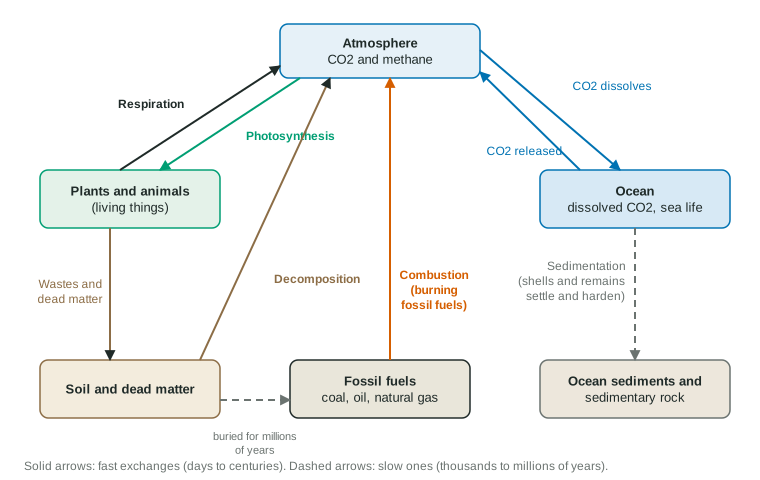
A reservoir is a place where carbon is stored for a while. A flux is a movement of carbon from one reservoir to another, usually given as an amount per year. Think of reservoirs as bank accounts and fluxes as deposits and withdrawals.
| Reservoir | Form of carbon | How long carbon stays |
|---|---|---|
| Atmosphere | CO2 and a little methane (CH4) | years |
| Living things | sugars, wood, tissues | days to centuries |
| Soil and dead matter | dead leaves, roots, organic matter | years to centuries |
| Ocean | dissolved CO2, sea life | years (surface) to centuries (deep water) |
| Fossil fuels | coal, oil, natural gas | millions of years, unless burned |
| Sediments and sedimentary rock | limestone, shells, buried remains | millions of years; the largest reservoir |
The processes that move carbon
- Photosynthesis: plants, algae and some bacteria use light to turn CO2 and water into sugar, releasing oxygen. Carbon moves from the air into living things.
- Cellular respiration: living things, including plants, break sugar down with oxygen to get energy, releasing CO2. Carbon moves back to the air.
- Decomposition: decomposers (mostly bacteria and fungi) break down dead matter and wastes and respire, releasing CO2. Where oxygen is scarce, as in swamps and landfills, some release methane instead, and decomposition is slower.
- Combustion: burning wood or fossil fuels joins their carbon with oxygen, releasing CO2 quickly.
- Ocean exchange: CO2 dissolves into the sea surface and is also released from it; ocean algae use dissolved CO2 for photosynthesis.
- Sedimentation: shells and remains settle on the sea floor and, over long times, harden into sedimentary rock such as limestone. Buried plant and animal remains, under heat and pressure, slowly become fossil fuels.
Fast and slow carbon
The fast part of the cycle, among air, living things, soil and the ocean surface, turns carbon over in days to centuries. Photosynthesis and respiration roughly balance each other there. The slow part, sedimentation and the formation of rock and fossil fuels, takes millions of years. Burning fossil fuels short-circuits the slow cycle: it moves carbon that took millions of years to bury into the air within decades.
Sinks and sources
A carbon sink takes in more carbon than it releases, so carbon builds up in it. A growing forest and the ocean are sinks today. A carbon source releases more than it takes in: a burning forest, a drained swamp whose buried dead plants are decomposing, a factory burning coal.
Worked example: a carbon budget. In one year people add 9.7 billion metric tons of carbon by burning fossil fuels and 1.1 billion by clearing forests. The ocean takes up 2.9 billion and land plants and soils 3.2 billion (invented, rounded numbers of a realistic size). How much stays in the air?
Added: billion metric tons. Removed: billion metric tons.
Left in the atmosphere: billion metric tons of carbon. The sinks take up a bit more than half; the rest is why atmospheric CO2 keeps rising.
The yearly up and down
Measured month by month, CO2 in the air rises from year to year but also swings within each year. In the Northern Hemisphere, which has most of the land and plants, CO2 falls from late spring to early fall as plants photosynthesize, then rises through fall and winter as leaves drop and decomposition and respiration continue. The yearly swing is the planet breathing; the rising trend underneath it is mostly from combustion.
Say it precisely
Trees take in CO2 but store carbon in their wood, leaves and roots; the oxygen is released. Write "the forest stores carbon", not "the forest stores CO2". And name the process for each arrow: photosynthesis in, respiration, decomposition and combustion out.