The Carbon Cycle
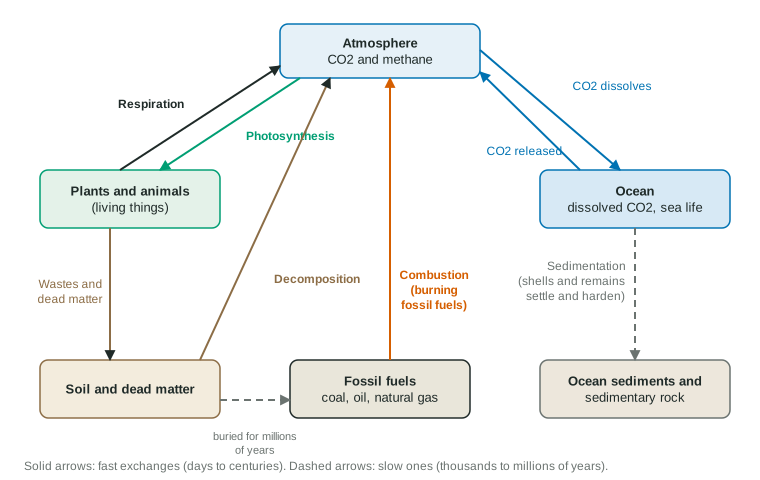
Carbon cycles among the atmosphere, living things, soil, the ocean, sediments and rock, and fossil fuels.
Part 1 · Hook
Why this matters
Part 2 · Before you start
What this builds on
Part 3 · Prerequisite check
Quick check before you start
1. Which is a biotic part of an ecosystem?
- Bacteria in the soil
- Sunlight
- Rain
- Minerals
Show the answer
Bacteria are living.
- Correct: Bacteria in the soil:
- Sunlight:
- Rain:
- Minerals:
2. What is ?
Show the answer
Multiply the fronts (6.0) and add the exponents (4 + 3 = 7).
- Correct: :
- :
- :
- :
Part 4 · See it
See it first
Part 5 · Step by step
How it works, step by step
- Photosynthesis takes CO2 from the aircarbon is stored in plants and the animals that eat them
- Respiration and decomposition break those sugars downCO2 returns to the air
- Combustion of fossil fuels releases carbon buried for millions of yearsCO2 builds up in the atmosphere faster than sinks can take it back
Part 6 · Key ideas
Key ideas
- Carbon moves between reservoirs (air, living things, soil, ocean, rock, fossil fuels); each movement is a flux.
- Photosynthesis removes CO2; cellular respiration, decomposition and combustion release it.
- A carbon sink takes in more carbon than it releases (forests, the ocean); a carbon source releases more than it takes in.
- The fast cycle (air, life, ocean surface) turns over in days to centuries; the slow cycle (sedimentation, rock, fossil fuels) takes millions of years.
Part 7 · Misconception
A common mistake
The wrong idea: Trees store CO2.
What actually happens: Trees take in CO2 but store the carbon, built into sugars, wood and leaves; the oxygen is released. Say "trees store carbon".
Part 8 · Check yourself
Check yourself
Exam-style questions. Anything you miss goes into your review queue.
1. A forest takes in more carbon by photosynthesis each year than it releases. What is the forest?
- A carbon sink
- A carbon source
- A fossil fuel reservoir
- A flux of zero
Show the answer
A sink takes in more carbon than it releases, so carbon builds up in it.
- Correct: A carbon sink: Right: net uptake makes it a sink.
- A carbon source: A source releases more than it takes in.
- A fossil fuel reservoir: Living forests are not fossil fuel reservoirs.
- A flux of zero: The flux into the forest is larger than the flux out, so the net flux is not zero.
Data
A simplified yearly carbon budget
| Flux | Billions of metric tons of carbon per year |
|---|---|
| Added: combustion of fossil fuels and cement making | 9.7 |
| Added: clearing and burning forests | 1.1 |
| Removed: taken up by the ocean | 2.9 |
| Removed: taken up by plants and soils on land | 3.2 |
2. How much carbon do human activities add to the atmosphere in the year shown? Give the total with its scale word and unit, such as 2.5 billion metric tons.
Type a number, then its unit (metric tons). Scale words (2.5 million) and powers of ten (2.5 × 10^6) are read.
Show the answer
billion metric tons of carbon ( metric tons).
- Answer: 10,800,000,000 metric tons
3. How much of the added carbon stays in the atmosphere that year? Subtract both removals from the total added, and give the answer with its scale word and unit.
Type a number, then its unit (metric tons). Scale words (2.5 million) and powers of ten (2.5 × 10^6) are read.
Show the answer
Added: . Removed: . Left in the air: billion metric tons ( metric tons).
- Answer: 4,700,000,000 metric tons
4. Which conclusion do the data support?
- Sinks remove a bit over half of the added carbon.
- The ocean removes more carbon than plants and soils on land do.
- Natural sinks remove the whole amount of carbon people add.
- Clearing forests adds more carbon than burning fossil fuels does.
Show the answer
Removed of added, a bit more than half (about 56%). The rest stays in the air.
- Correct: Sinks remove a bit over half of the added carbon.: Right: 6.1 of 10.8 is a little over half.
- The ocean removes more carbon than plants and soils on land do.: Land (3.2) removes more than the ocean (2.9).
- Natural sinks remove the whole amount of carbon people add.: 6.1 is less than 10.8, so some carbon stays in the air.
- Clearing forests adds more carbon than burning fossil fuels does.: Forest clearing (1.1) adds far less than fossil fuels (9.7).
Model or diagram
Carbon dioxide over two years at one station
5. Which two patterns does the graph show?
- A yearly rise, with a peak in spring and a dip in late summer
- A steady fall from one year to the next, with no seasonal cycle
- A rise each summer and a fall each winter, with no yearly trend
- No change over the two years shown on the graph
Show the answer
Each year ends higher (about 419 to 421.5 ppm in December), and within each year CO2 is highest around May and lowest around September.
- Correct: A yearly rise, with a peak in spring and a dip in late summer: Right: an upward trend plus a yearly cycle.
- A steady fall from one year to the next, with no seasonal cycle: The values rise from year 1 to year 2.
- A rise each summer and a fall each winter, with no yearly trend: The dips come in late summer, not the peaks.
- No change over the two years shown on the graph: Year 2 is about 2 to 3 ppm higher than year 1.
6. Why does CO2 fall from about May to September at a northern station?
- Northern plants photosynthesize more in summer.
- People burn more fossil fuels in the summer months.
- Decomposition of dead leaves speeds up in summer.
- The ocean releases more CO2 during the summer.
Show the answer
Most land is in the Northern Hemisphere. In its growing season, photosynthesis takes in more CO2 than respiration and decomposition release, so CO2 falls.
- Correct: Northern plants photosynthesize more in summer.: Right: summer photosynthesis draws CO2 down.
- People burn more fossil fuels in the summer months.: More burning would raise CO2, not lower it.
- Decomposition of dead leaves speeds up in summer.: More decomposition would raise CO2.
- The ocean releases more CO2 during the summer.: Releasing CO2 would raise it.
7. By how much did CO2 change from month 1 (418 ppm) to month 13 (420.5 ppm)?
Type a number, then its unit (ppm). Scale words (2.5 million) and powers of ten (2.5 × 10^6) are read.
Show the answer
ppm higher after one year.
- Answer: 2.5 ppm
Part 9 · Summary
Summary
Part 10 · Up next
What comes next
Part 11 · Connections