The Nitrogen Cycle
Nitrogen’s largest reservoir is N2 gas in the air, which most organisms cannot use.
Part 1 · Hook
Why this matters
Part 2 · Before you start
What this builds on
Part 3 · Prerequisite check
Quick check before you start
1. What do decomposers do?
- Break down dead matter and wastes
- Make food from sunlight
- Eat only living plants
- Store carbon in rock
Show the answer
Decomposers break down dead matter and return nutrients to the soil.
- Correct: Break down dead matter and wastes:
- Make food from sunlight:
- Eat only living plants:
- Store carbon in rock:
2. What is a reservoir in a nutrient cycle?
- A place where an element is stored for a time
- A movement between two places
- A kind of decomposer
- A gas in the air
Show the answer
A reservoir stores; a flux moves.
- Correct: A place where an element is stored for a time:
- A movement between two places:
- A kind of decomposer:
- A gas in the air:
Part 4 · See it
See it first
Part 5 · Step by step
How it works, step by step
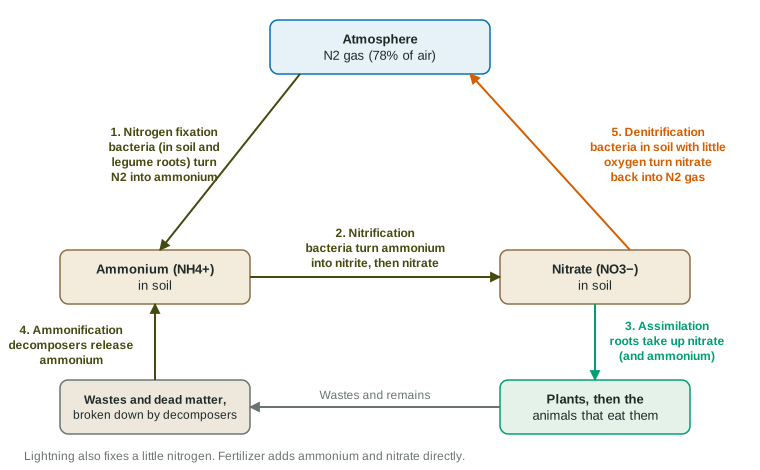
- Bacteria fix N2 from the air (nitrogen fixation)ammonium enters the soil
- Other bacteria turn ammonium into nitrate (nitrification)plants take up nitrate and build proteins (assimilation)
- Decomposers break down wastes and remains (ammonification)ammonium returns to the soil, and denitrifying bacteria send some nitrate back to the air as N2
Part 6 · Key ideas
Key ideas
- The atmosphere (78% N2) is the main reservoir, but most living things cannot use N2.
- Nitrogen fixation (bacteria, lightning, industry) makes ammonium; nitrification makes nitrate; assimilation brings it into living things; ammonification returns ammonium; denitrification returns N2 to the air.
- Nitrogen is often the limiting nutrient on land, which is why fertilizer raises crop yields.
- Nitrate dissolves and is not held by soil, so extra nitrate is lost by leaching into streams and wells.
Part 7 · Misconception
A common mistake
The wrong idea: Plants take nitrogen straight from the air, since the air is mostly nitrogen.
What actually happens: Most plants cannot break N2 apart. They take up nitrate and ammonium from the soil, made by nitrogen-fixing and nitrifying bacteria (or added as fertilizer). Legumes get help from bacteria in their root nodules.
Part 8 · Check yourself
Check yourself
Exam-style questions. Anything you miss goes into your review queue.
1. A soil stays soaked with water for weeks, so it has very little oxygen. Which process speeds up there?
- Denitrification
- Nitrification
- Nitrogen fixation by lightning
- Assimilation by animals
Show the answer
Denitrifying bacteria work where oxygen is scarce and turn nitrate into N2 gas, which escapes to the air.
- Correct: Denitrification: Right: low oxygen favors denitrification.
- Nitrification: Nitrification needs oxygen, so it slows in soaked soil.
- Nitrogen fixation by lightning: Lightning is not affected by soil oxygen.
- Assimilation by animals: Animals assimilate nitrogen by eating; soil oxygen does not drive it.
2. Nitrogen is often the limiting nutrient for plant growth on land. What does that mean?
- Adding nitrogen raises growth more than adding other nutrients.
- Nitrogen in the soil stops plants from growing taller.
- Plants contain more nitrogen than any other element.
- Too much nitrogen in the soil poisons the roots of plants.
Show the answer
A limiting nutrient is the one in shortest supply compared with need; adding it raises growth until something else becomes limiting.
- Correct: Adding nitrogen raises growth more than adding other nutrients.: Right: the scarcest needed nutrient limits growth.
- Nitrogen in the soil stops plants from growing taller.: Nitrogen is needed for growth; it does not stop it.
- Plants contain more nitrogen than any other element.: Plants contain far more carbon, oxygen and hydrogen than nitrogen.
- Too much nitrogen in the soil poisons the roots of plants.: Excess nitrogen causes other problems, but that is not what limiting means.
Data
Nitrate in a stream below farm fields
| Month | Above the farm fields (mg/L) | Below the farm fields (mg/L) |
|---|---|---|
| March | 0.8 | 2.1 |
| April (fertilizer spread) | 0.9 | 6.4 |
| May | 0.8 | 4.0 |
| August | 0.6 | 1.2 |
3. Which statement describes the data?
- Higher below the fields each month, peaking in April
- Higher above the fields than below them in each month
- The same above the fields and below them in each month
- Rising steadily below the fields from March to August
Show the answer
Below the fields: 2.1, 6.4, 4.0, 1.2 mg/L, each higher than above (0.6 to 0.9), peaking in April.
- Correct: Higher below the fields each month, peaking in April: Right: higher below each month, highest in April.
- Higher above the fields than below them in each month: Above the fields is the lower site each month.
- The same above the fields and below them in each month: Below the fields is 1.2 to 6.4, above is 0.6 to 0.9.
- Rising steadily below the fields from March to August: It rises to April, then falls to 1.2 in August.
4. In April, how many times higher was nitrate below the fields than above them?
Type a number, then its unit (times). Scale words (2.5 million) and powers of ten (2.5 × 10^6) are read.
Show the answer
, so about 7 times higher below the fields.
- Answer: 7.111 times
5. What best explains the April peak below the fields?
- April fertilizer was leached into the stream.
- Denitrification added nitrate to the stream in April.
- Fish in the stream released extra nitrate in April.
- Nitrate fell from the air in the April rain.
Show the answer
The peak matches the month fertilizer was spread, and it appears below the fields but not above them.
- Correct: April fertilizer was leached into the stream.: Right: timing and location both point to fertilizer washing off the fields.
- Denitrification added nitrate to the stream in April.: Denitrification removes nitrate; it does not add it.
- Fish in the stream released extra nitrate in April.: Fish would raise nitrate at both sites, and not mostly in April.
- Nitrate fell from the air in the April rain.: Rain falls on both sites, but only the lower one peaks.
Passage
Beans in the rotation
A farmer who grows corn year after year adds nitrogen fertilizer every spring. A neighbor plants soybeans every other year instead of corn. The neighbor says the soybeans "put nitrogen back in the ground for free," so the corn that follows needs less fertilizer. Soybeans are legumes; their roots carry swellings, called nodules, that house bacteria. The neighbor adds that less fertilizer also means less nitrate washing into the creek.
Invented passage for practice.
6. What is the neighbor’s main claim?
- Soybeans add nitrogen, so the next corn needs less.
- Corn grows better than soybeans in most kinds of soil.
- Fertilizer is the main source of nitrogen for soybeans.
- Bacteria in the creek remove nitrate from farm water.
Show the answer
The neighbor says soybeans put nitrogen back in the ground, so the following corn needs less fertilizer.
- Correct: Soybeans add nitrogen, so the next corn needs less.: Right: that is the claim.
- Corn grows better than soybeans in most kinds of soil.: The passage does not compare corn and soybean growth.
- Fertilizer is the main source of nitrogen for soybeans.: The claim is that soybeans add nitrogen, not that they need fertilizer.
- Bacteria in the creek remove nitrate from farm water.: The creek is mentioned, but not bacteria in it.
7. Which process explains how the soybeans "put nitrogen back in the ground"?
- Bacteria in the nodules fix nitrogen.
- Soybean leaves absorb nitrate from the air.
- Soybean roots carry out denitrification.
- The nodules turn other minerals into nitrogen.
Show the answer
Nitrogen-fixing bacteria living in legume root nodules turn N2 into ammonium, which the plant uses; leftover roots and stems release it to the soil.
- Correct: Bacteria in the nodules fix nitrogen.: Right: nitrogen fixation by bacteria in the nodules.
- Soybean leaves absorb nitrate from the air.: Leaves do not take nitrate from air.
- Soybean roots carry out denitrification.: Denitrification removes nitrogen from soil.
- The nodules turn other minerals into nitrogen.: One element cannot become another.
Part 9 · Summary
Summary
Part 10 · Up next
What comes next
Part 11 · Connections