Nitrogen is in every protein and every strand of DNA, so every living thing needs it. The puzzle of the nitrogen cycle is that the biggest supply, the air, is useless to almost everyone. About 78% of the atmosphere is nitrogen gas, N2, but its two atoms are held together by a triple bond so strong that plants and animals cannot break it. Life depends on a few kinds of bacteria to turn N2 into forms plants can use.
The reservoirs
The atmosphere is by far the largest nitrogen reservoir. Smaller amounts sit in soil (as ammonium, NH4+, and nitrate, NO3−), in living things (as proteins and DNA), in dead matter, in water and in ocean sediments. Unlike carbon, very little nitrogen is stored in rock.
The five steps
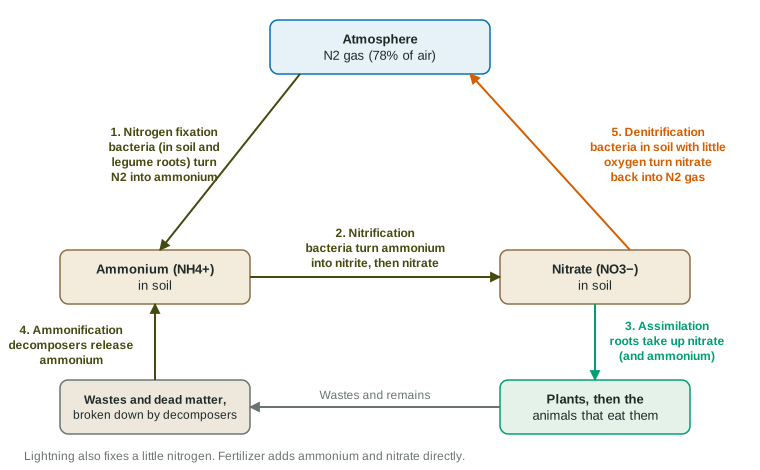
| Step | From | To | Done by |
|---|---|---|---|
| 1. Nitrogen fixation | N2 gas | ammonia / ammonium | nitrogen-fixing bacteria in soil and in legume root nodules; lightning; industry (fertilizer) |
| 2. Nitrification | ammonium | nitrite, then nitrate | nitrifying bacteria in soil with oxygen |
| 3. Assimilation | nitrate (and ammonium) | proteins and DNA | plant roots; animals get it by eating |
| 4. Ammonification | wastes and dead matter | ammonium | decomposers |
| 5. Denitrification | nitrate | N2 gas | bacteria in soil or water with little oxygen |
A memory aid: Fix, Nitrify, Assimilate, Ammonify, Denitrify. Fixation brings nitrogen in from the air; denitrification sends it back.
Legumes (beans, peas, clover, alfalfa) have swellings on their roots called nodules, where nitrogen-fixing bacteria live. The plant feeds the bacteria sugar; the bacteria give the plant ammonium. That mutualism is why farmers rotate corn with soybeans: when the soybean roots and stems decompose, they leave nitrogen in the soil for the next crop.
Why nitrogen limits growth
A limiting nutrient is the one in shortest supply compared with what organisms need. On land, nitrogen is often limiting: plants have plenty of carbon from the air and water from the soil, but too little usable nitrogen. Add nitrogen and they grow more, until something else (phosphorus, water, light) runs short. That is the reason for fertilizer. Since the early 1900s, factories have fixed N2 from the air to make ammonia fertilizer. Together with planting crops such as soybeans, this has about doubled (or more) the nitrogen fixed on land each year, compared with nature alone.
Where extra nitrogen goes
Ammonium has a positive charge, so it sticks to soil particles, which are mostly negative. Nitrate is negative, so soil does not hold it. When more nitrate is added than plants can take up, rain carries it down through the soil, a process called leaching, toward underground water, wells and streams.
Worked example: a stream below farm fields. In April, just after fertilizer was spread, nitrate was 6.4 mg/L below the fields and 0.9 mg/L above them. How many times higher was it below?
Setup:
Answer: about 7.1 times higher. The chain: fertilizer spread → more nitrate than the crop can use → rain leaches nitrate → nitrate in the stream rises. Above the fields nitrate stayed below 1 mg/L all year, which points to the fields as the source.
Ways to lose less nitrogen: apply fertilizer in smaller doses when the crop is growing, not before heavy rain; plant legumes in the rotation; keep strips of grass and trees between fields and streams so their roots take up nitrate; and protect wetlands, where denitrifying bacteria turn nitrate back into N2.
Read the arrows
On any cycle diagram, name the process by its starting and ending forms. N2 to ammonium is fixation. Ammonium to nitrate is nitrification. Soil to plant is assimilation. Dead matter to ammonium is ammonification. Nitrate to N2 is denitrification, and it happens where oxygen is low, such as soil soaked with water.