Every organism needs energy, and in an ecosystem there are only two ways to get it: make your own food from sunlight, or eat something else. Sorting organisms by where they get their energy gives the trophic levels ("trophic" comes from a Greek word for food). It is the scaffolding for the next topics, which follow the energy as it moves up the levels and how feeding links tie a whole ecosystem together.
The levels
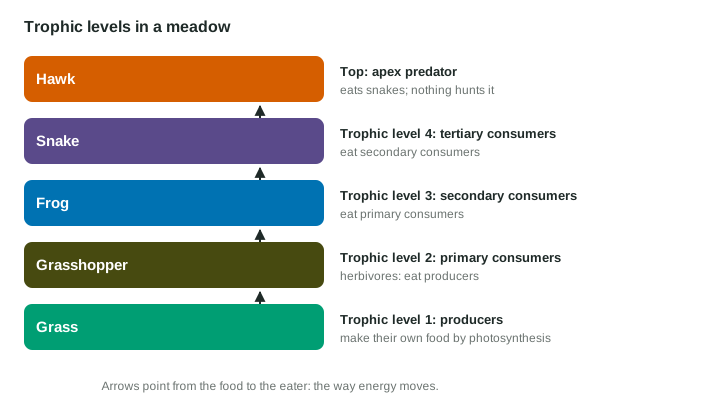
| Trophic level | Who | Gets energy from | Meadow example |
|---|---|---|---|
| 1 | producers (autotrophs) | sunlight, by photosynthesis | grass |
| 2 | primary consumers (herbivores) | producers | grasshopper |
| 3 | secondary consumers | primary consumers | frog |
| 4 | tertiary consumers | secondary consumers | snake |
| top | apex predator | the levels below; no natural predators as an adult | hawk |
Consumers (heterotrophs) are everything that cannot make its own food. A carnivore eats animals; a herbivore eats plants or algae; an omnivore eats both, so it feeds at more than one level. A bear eating berries is a primary consumer; the same bear eating a salmon that ate smaller fish is a tertiary consumer or higher.
Decomposers, which feed on dead matter from every level, are not a separate rung but the cleanup crew for all of them.
Reading the arrows
In trophic diagrams, an arrow points from the food to the eater: grass → grasshopper. The arrow shows the direction energy moves. Students often draw it the other way ("the grasshopper eats the grass, so the arrow points at the grass"); that is the most common mistake on these diagrams.
Worked example: assign the levels. In a pond, tadpoles and water fleas eat algae; dragonfly larvae eat water fleas and tadpoles; sunfish eat dragonfly larvae and water fleas; herons eat sunfish.
Step 1: algae make their own food, so they are producers (level 1). Step 2: tadpoles and water fleas eat algae, so they are primary consumers (level 2). Step 3: dragonfly larvae eat level 2, so they are level 3. Step 4: sunfish eat water fleas (making them level 3) and dragonfly larvae (making them level 4), so they feed at two levels. Step 5: herons, with no predators in this pond, are the apex predator.
Effects travel up and down
Because each level depends on the one below, a change at one level spreads.
- From the bottom up: if a spill poisons the algae, primary consumers lose food first, then the animals that eat them.
- From the top down: remove snakes from a meadow and frogs increase (fewer are eaten), so frogs eat more grasshoppers, and grasshoppers decrease. Removing a predator can help the level two steps below it.
When wolves returned to parts of western North America, elk became fewer and avoided open riverbanks, and in some places streamside willows grew back. Scientists still debate how much of that change was due to wolves and how much to other factors, such as weather, elk hunting outside the park, other predators and the loss of beavers, which is a good reminder to look for more than one cause.
Writing about trophic levels
When an exam question removes or adds a species, name each level the effect passes through, say which way each population goes, and say why: "With fewer snakes, the frog population increases because fewer frogs are eaten, so more grasshoppers are eaten and the grasshopper population decreases."