A fuel is anything burned to release stored energy. This page compares the fuels people use most: what each is, where it comes from, what it is used for, and how much energy and carbon dioxide it gives.
Wood, charcoal and peat
For most of history people burned wood, and about 2.1 billion people still lack clean cooking fuels and rely mostly on wood, charcoal, crop waste or dung. Charcoal is made by heating wood with little air, which drives off water and leaves mostly carbon that burns hotter and with less smoke than wood. Making it uses a lot of wood, so heavy charcoal demand can strip forests.
Peat is partly decayed plant matter from waterlogged bogs. It is the first step toward coal and is burned for heat in a few countries. It holds a lot of water and gives little energy per kilogram.
Coal
When plants are buried in swamps without oxygen, they do not fully decay. Over millions of years, heat and pressure turn the buried peat into coal, and the coal's rank rises the longer and deeper it is cooked:
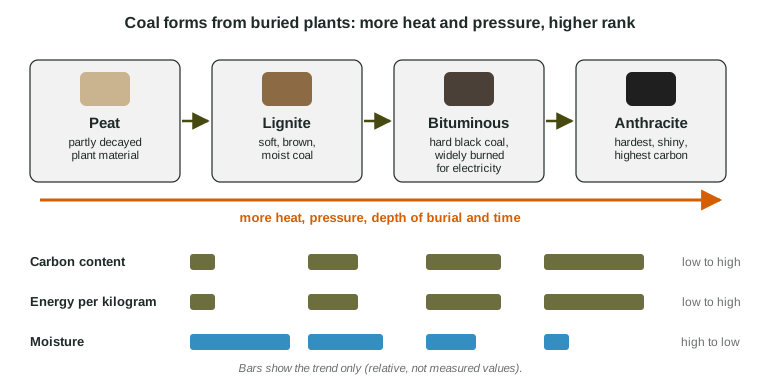
| Rank | Carbon and energy per kg | Notes |
|---|---|---|
| Lignite | lowest of the coals | soft, brown, moist; burned near the mine |
| Bituminous | high | hard and black; widely burned for electricity and used for steel making |
| Anthracite | highest | hardest, shiny; burns hot and clean for coal, but is rare |
Coal is cheap and plentiful in many countries and is the largest single source of electricity in the world. Of the fossil fuels it releases the most carbon dioxide per unit of energy.
Petroleum
Petroleum, or crude oil, formed from tiny sea organisms buried in sediment. At a refinery it is heated, and its parts separate by boiling point (fractional distillation) into gasoline, diesel, jet fuel, heating oil, asphalt and the raw materials for plastics. Most oil is burned for transportation because liquid fuels pack a lot of energy into a small, easy-to-carry volume.
Tar sands (oil sands) are a mix of sand, clay, water and bitumen, a thick, heavy oil. The bitumen is strip-mined or melted underground with steam, then upgraded into crude oil. This takes much more energy and water than drilling ordinary oil, so the fuel has larger emissions per barrel.
Natural gas
Natural gas is mostly methane. It heats homes, fuels stoves, runs factories and generates electricity. Methane has four hydrogen atoms for each carbon atom, and burning the hydrogen gives energy while making water, not carbon dioxide. So natural gas releases about half as much carbon dioxide as coal for the same energy. It is the cleanest-burning fossil fuel, but it is not zero emissions, and methane that leaks before it is burned traps far more heat than carbon dioxide does.
Carbon dioxide saved by switching fuels. A factory uses 2,000 GJ a year. Bituminous coal releases 90 kg of carbon dioxide per GJ; natural gas releases 50 kg per GJ.
Setup: . GJ cancels and kg is left.
Answer: of carbon dioxide avoided each year.
Cogeneration
A typical generating station turns only about a third of its fuel's energy into electricity; the rest leaves as heat. Cogeneration, also called combined heat and power, captures that heat and uses it to warm buildings, make hot water or run industrial processes. The same fuel then does two jobs, so less fuel is burned for the same useful energy.
"Natural gas is zero emissions" is a classic wrong answer. Say "natural gas releases less carbon dioxide per unit of energy than coal."