Wind is solar energy in motion: the sun heats Earth unevenly, warm air rises, cooler air rushes in, and moving air carries energy that turbines can catch.
How a wind turbine works
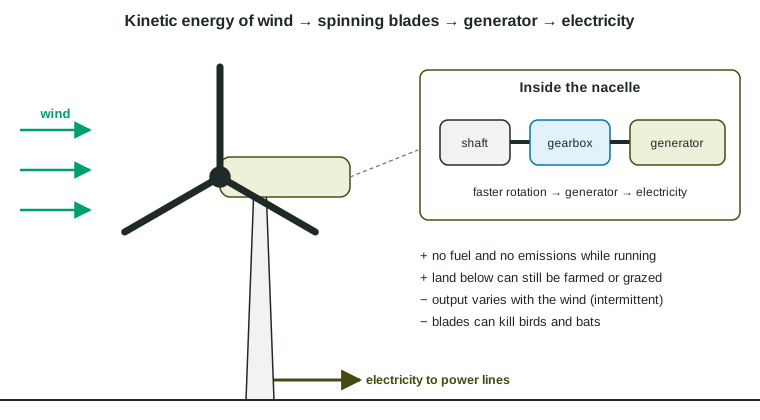
Wind pushes on the long blades and spins the rotor. The rotor turns a shaft inside the nacelle, the housing at the top of the tower. A gearbox speeds up the slow rotation, and a generator turns it into electricity, which runs down the tower to the grid. Sensors turn the nacelle to face the wind, and the blades are feathered to stop the turbine in storms.
Wind speed matters enormously: a turbine's power rises with the cube of wind speed, so doubling the speed gives about eight times the power. That is why towers are tall (wind is faster and steadier above trees and buildings) and why many turbines are built on open plains, ridges, coasts and offshore.
Calculating output
A turbine's capacity is its maximum power. Because the wind varies, it averages only part of that, its capacity factor, about 35 percent for a good onshore site.
Yearly output. A 3 MW turbine with a capacity factor of 35% runs for a year (8,760 hours).
Setup:
Answer: , enough for roughly 875 homes using 10.5 MWh a year each.
Comparing sources
Every source releases some carbon dioxide over its life: building it, mining materials, fuel and running. Wind's life-cycle emissions are among the lowest of all.
| Source | Carbon dioxide while running | Land | Intermittent? |
|---|---|---|---|
| Coal | highest | mines and plants | no |
| Natural gas | about half of coal | wells, pipelines, plants | no |
| Nuclear | none | small | no |
| Hydroelectric | none (some methane from reservoirs) | large flooded areas | depends on rain and snow |
| Solar | none | large for big farms | yes: night, clouds, winter |
| Wind | none | spread out, but shared with farming | yes: calm periods |
Keeping the lights on when the wind drops
Because wind is intermittent, a grid that gets much of its power from wind plans ahead. Weather forecasts predict wind output a day or more in advance. Long transmission lines link wind farms spread over a large area, since the wind is rarely calm everywhere at once. Batteries and pumped storage hold extra electricity from windy hours, and hydroelectric dams or natural gas plants can be turned up quickly when the wind falls. Wind and solar also help each other: in many places winds are stronger at night and in winter, when sunlight is weakest.
Weighing wind energy
Advantages: no fuel to buy; no air pollution or carbon dioxide while running; quick to build; land between turbines stays in farming or grazing; lease payments add income for rural landowners.
Disadvantages: output varies with the wind, so grids need storage, wide connections or backup; spinning blades kill birds and bats, which careful siting and pausing turbines at low wind speeds can reduce; turbines make noise and change the view; the windiest places are often far from cities and need new transmission lines; offshore turbines cost more to build and maintain.
Name the specific drawback and how to address it: "turbines can kill migrating bats; pausing them on low-wind nights reduces deaths."