Wind Energy
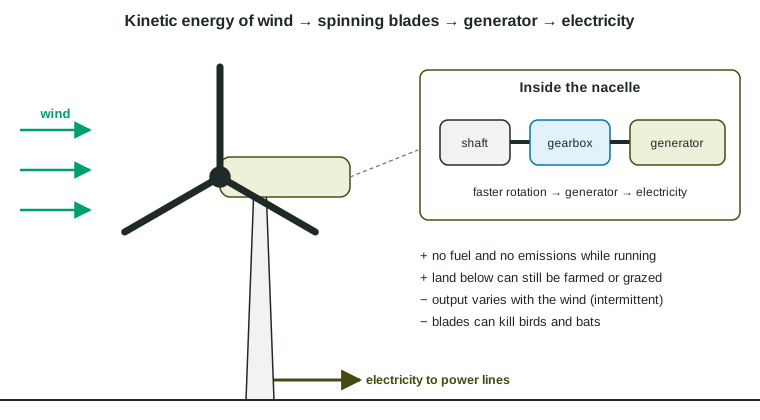
Wind turbines turn the kinetic energy of moving air into electricity with blades, a gearbox and a generator.
Part 1 · Hook
Why this matters
Part 2 · Before you start
What this builds on
Part 3 · Prerequisite check
Quick check before you start
1. What drives the wind?
- Uneven heating of Earth's surface by the sun
- The moon's gravity
- Heat from Earth's core
- Ocean tides
Show the answer
Unequal heating makes air pressure differences, and air moves from high to low pressure.
- Correct: Uneven heating of Earth's surface by the sun:
- The moon's gravity:
- Heat from Earth's core:
- Ocean tides:
2. What does intermittency mean for an energy source?
- It is not available all the time
- It runs out
- It pollutes
- It needs fuel
Show the answer
An intermittent source, like solar at night, needs storage or backup.
- Correct: It is not available all the time:
- It runs out:
- It pollutes:
- It needs fuel:
Part 4 · See it
See it first
Part 5 · Step by step
How it works, step by step
- The sun heats Earth unevenly, so air moves from high to low pressurewind carries kinetic energy across plains, coasts and seas
- Wind pushes on the turbine bladesthe rotor turns a shaft, a gearbox speeds it up and a generator makes electricity
- No fuel is burnedthere is no air pollution or carbon dioxide while running, and land below can still be farmed
- The wind slows or stopsoutput falls, so a grid with much wind needs storage, a wide network or backup
Part 6 · Key ideas
Key ideas
- A wind turbine turns the kinetic energy of moving air into electricity. A wind farm is a group of turbines, on land or offshore.
- Taller towers and offshore sites reach faster, steadier wind; output rises steeply with wind speed (about eight times for double the speed).
- Advantages: no fuel, no emissions while running, very low life-cycle carbon dioxide, land shared with farming, income for landowners.
- Drawbacks: intermittency, bird and bat deaths, noise and changed views, and new transmission lines from remote windy areas.
Part 7 · Misconception
A common mistake
The wrong idea: A wind farm takes a whole field out of use, the way a coal mine does.
What actually happens: The tower bases and access roads cover only a small share of a wind farm. Crops and cattle use most of the land between turbines, and the farmer earns lease payments too.
Part 8 · Check yourself
Check yourself
Exam-style questions. Anything you miss goes into your review queue.
1. How does a wind turbine make electricity?
- Wind cools a steam boiler, which then spins a turbine
- Sunlight on the blades makes an electric current flow
- Air pressure squeezes a battery inside the tall tower
- Wind spins the blades, which turn a generator
Show the answer
The kinetic energy of moving air pushes on the blades; the rotor turns a shaft (often through a gearbox) that spins a generator in the nacelle.
- Wind cools a steam boiler, which then spins a turbine: There is no boiler or steam in a wind turbine.
- Sunlight on the blades makes an electric current flow: Blades are not solar cells.
- Air pressure squeezes a battery inside the tall tower: Turbines do not squeeze batteries.
- Correct: Wind spins the blades, which turn a generator: Right: moving air, spinning blades, generator.
2. Which is an environmental drawback of wind farms?
- They produce radioactive waste each year
- Spinning blades can kill birds and bats
- They release carbon dioxide while turning
- They flood large areas of nearby farmland
Show the answer
Collisions kill birds and bats; careful siting and pausing turbines at low wind speeds reduce deaths. Turbines also make noise and change views.
- They produce radioactive waste each year: Wind turbines make no radioactive waste.
- Correct: Spinning blades can kill birds and bats: Right: bird and bat deaths.
- They release carbon dioxide while turning: Turbines release nothing while running.
- They flood large areas of nearby farmland: Wind farms do not flood land; that is a dam's impact.
3. A region gets a large share of its electricity from wind. What does it need to keep power steady on calm days?
- More turbines built in the same calm valley
- Taller blades that keep spinning without wind
- Turbines that run on sunlight stored in the tower
- Storage, a wide grid or backup power sources
Show the answer
Wind is intermittent. Batteries and pumped storage, grids that link windy and calm areas, and flexible backup plants keep supply steady.
- More turbines built in the same calm valley: More turbines in a calm place still make nothing when there is no wind.
- Taller blades that keep spinning without wind: Blades need wind to spin.
- Turbines that run on sunlight stored in the tower: Turbines do not run on sunlight.
- Correct: Storage, a wide grid or backup power sources: Right: storage, a wider grid or flexible backup.
Data
Electricity sources compared
| Source | Life-cycle carbon dioxide (g per kWh) | Capacity factor (%) |
|---|---|---|
| Coal | 820 | 50 |
| Natural gas | 490 | 55 |
| Nuclear | 12 | 90 |
| Solar (photovoltaic) | 45 | 25 |
| Wind (onshore) | 11 | 35 |
4. Which two sources in the table release the least carbon dioxide over their full life cycle?
- Coal and solar
- Wind and nuclear
- Coal and natural gas
- Solar and natural gas
Show the answer
Wind (11) and nuclear (12) grams per kWh are the lowest. Solar is low too (45), and coal (820) is highest.
- Coal and solar: Coal is the highest.
- Correct: Wind and nuclear: Right: 11 and 12 g per kWh.
- Coal and natural gas: These are the two highest.
- Solar and natural gas: Natural gas is about 490 g per kWh.
5. A town replaces 50,000 MWh a year of coal electricity with wind. Using the life-cycle values, how many metric tons of carbon dioxide does it avoid each year? (1 MWh = 1,000 kWh; 1 metric ton = 1,000,000 g.)
Type a number, then its unit (metric tons). Scale words (2.5 million) and powers of ten (2.5 × 10^6) are read.
Show the answer
Saved per kWh: g. Total:
- Answer: 40,450 metric tons
6. Wind's capacity factor (35%) is lower than nuclear's (90%). What does this mean?
- A wind farm releases more carbon dioxide than a nuclear plant
- Wind turbines are broken down 65 percent of the time
- A wind farm costs more to build than a nuclear plant
- A wind farm averages a smaller share of its maximum
Show the answer
Capacity factor is average output divided by maximum. Wind varies, so it averages about a third of its maximum; this is not breakdown time.
- A wind farm releases more carbon dioxide than a nuclear plant: The table shows wind's life-cycle emissions slightly below nuclear's.
- Wind turbines are broken down 65 percent of the time: Low output is mostly from light winds, not breakdowns.
- A wind farm costs more to build than a nuclear plant: Capacity factor says nothing about building cost.
- Correct: A wind farm averages a smaller share of its maximum: Right: lower average output relative to maximum.
Part 9 · Summary
Summary
Part 10 · Up next
What comes next
Part 11 · Connections