Every energy source answers one question: when we use some, does nature put it back, and how fast? That single idea, the rate of replacement compared with the rate of use, sorts every source you will meet in this unit.
Nonrenewable resources
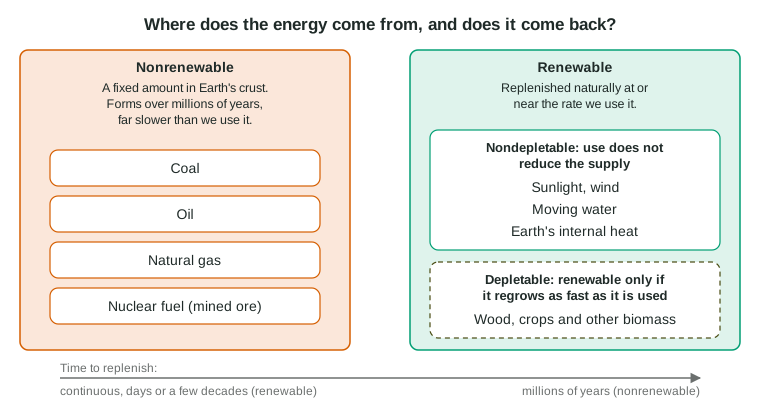
A nonrenewable resource exists in a fixed amount and forms far more slowly than people use it. Coal, oil and natural gas are the remains of plants and tiny sea organisms buried hundreds of millions of years ago. Heat and pressure turned them into fuels over millions of years. New fossil fuels are forming today in swamps and on the sea floor, but so slowly that, for people, the supply is fixed: every ton burned is gone.
Nuclear fuel is also nonrenewable. It is made from ore mined from rock, and there is only so much of that ore in Earth's crust.
Renewable resources
A renewable resource is replenished naturally at or near the rate people use it. Sunlight arrives every day. Wind blows because the sun heats Earth unevenly. Rivers keep flowing because the water cycle lifts water back into the sky. Earth's internal heat keeps rising from deep inside. Plants (biomass) regrow each season or over a few decades.
Depletable and nondepletable
Renewable does not always mean unlimited. Split renewables into two groups:
- Nondepletable: using the source does not lower the amount available later. Collecting today's sunlight or wind does not reduce tomorrow's.
- Depletable: the source can run down if it is used faster than it is replaced. A forest is the classic case. Cut 90 metric tons of wood a year from a woodlot that regrows 50, and the stock shrinks by 40 metric tons every year. The wood is renewable, but this woodlot is being depleted.
Is the woodlot being depleted? A woodlot holds 2,000 metric tons of wood. People harvest 90 metric tons a year and 50 metric tons regrow.
Change per year: metric tons lost each year.
After 10 years:
The stock falls, so the woodlot is being depleted. Cutting the harvest to 50 metric tons a year or less would keep it steady.
Groundwater works the same way. An aquifer that recharges 1 cm a year but is pumped down 1 m a year is being used about 100 times faster than it refills. In practice it is being mined like a fossil fuel.
Renewable is not the same as clean
Two ideas are easy to mix up. Renewable is about how fast a resource is replaced. Low carbon or clean is about what it releases. They do not always go together:
| Source | Renewable? | Releases carbon dioxide while making energy? |
|---|---|---|
| Coal, oil, natural gas | No: fixed supply | Yes, when burned |
| Nuclear fuel | No: mined ore | No, while the plant runs |
| Wood and other biomass | Yes, if regrown as fast as used (depletable) | Yes, when burned, along with smoke and soot |
| Sunlight, wind | Yes (nondepletable) | No |
| Moving water, Earth's internal heat | Yes | No, or very little |
So "nuclear power is renewable because it is clean" is wrong twice over: nuclear is low carbon while running, but its fuel is a fixed, mined supply.
Why the classification matters
Most of the world's energy today comes from nonrenewable fossil fuels. A society that runs on a fixed supply faces rising costs as the easiest deposits are used up, and burning these fuels adds carbon dioxide that drives climate change. Renewable sources avoid running out, but they bring their own trade-offs: sunlight and wind vary with weather and time of day, so they need storage or backup, and collecting them takes land and equipment. You will weigh these trade-offs source by source in the rest of this unit.
When a question asks you to classify a source, say why: "nonrenewable, because it forms over millions of years, far slower than we use it." Do not justify with pollution.